



OPINION:
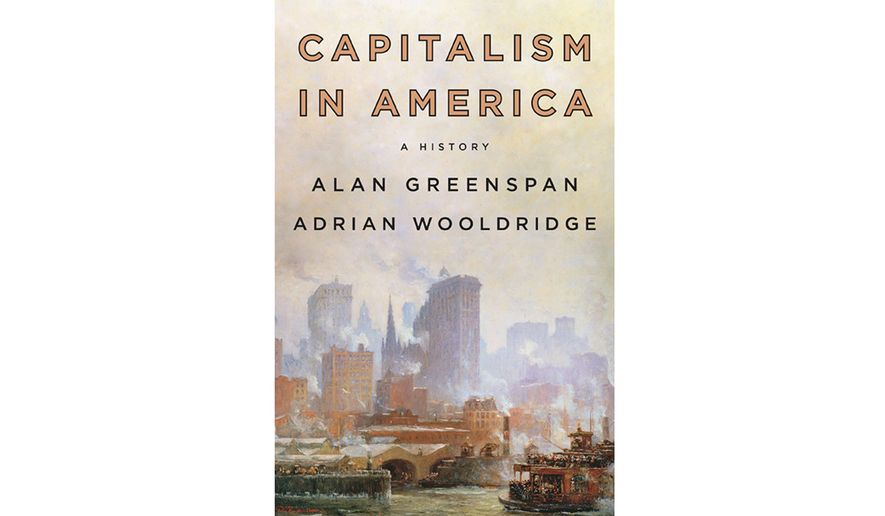
CAPITALISM IN AMERICA: A HISTORY
By Alan Greenspan and Adrian Wooldridge
Penguin Press, $35, 496 pages
Long ago, but not very far away, I was a young presidential speechwriter in the Nixon and Ford White Houses. In 1974 a man named Alan Greenspan succeeded my dear friend Herbert Stein as head of the presidential Council of Economic Advisors. I remember the 1974 model Alan Greenspan as friendly, down-to-earth, extremely articulate and, above all, a clear, sharp thinker. Because of an 18-year gap in our ages, I also remember thinking of him as old at the time. He would eventually go on to distinguish himself as the second longest-serving chairman of the Federal Reserve Board from 1987 to 2006.
Fast forward to autumn 2018, and I still think of Alan Greenspan as old, this time on considerably sounder grounds: He is now 92. Having read his new book, “Capitalism in America,” it gives me pleasure to report that, besides still being old, Alan also remains down-to-earth, extremely articulate and a clear, sharp thinker.
You don’t have to be an economics wonk to enjoy and learn from “Capitalism in America.” As long as you engage your brain and pay attention, you will find plenty of food for thought in this lucid, accessible potted history of what one might call Capitalism American Style. It probably helps that Mr. Greenspan’s co-author, Adrian Wooldridge, is a skilled journalist and editor at The Economist, the London-based weekly that provides generally informed, well written political, economic and cultural coverage of a quality unequalled by any competing American periodical.
If Mr. Wooldridge brings a sophisticated outsider’s eye to his subject, Alan Greenspan’s heritage as the son of Romanian and Hungarian Jewish immigrant parents also gives him a still fresh perspective on what makes American capitalism exceptional — not magically superior, but more resilient, adaptable and optimistic — than most other sophisticated, advanced Western economies. In this sense, “Capitalism in America” is a 21st century economic equivalent to Alexis de Tocqueville’s 19th century masterpiece, “Democracy in America,” a penetrating, objective analysis of a complex subject dissected by objective “outside” eyes.
The structure of “Capitalism in America” is straightforwardly chronological, preceded by an introductory overview and followed by a powerful, forward-looking section on “Conclusions.” In between are 12 well-executed chapters beginning with “A Commercial Republic: 1776-1860,” then taking us through the slave/non-slave, North/South economic divide that was only resolved by a bloody civil war. “The Triumph of Capitalism: 1865-1914” covers the urbanization and industrialization of America and the emergence of a massive corporate complex, followed by the turn of the century populist revolt against the robber barons of the gilded age and the “Business of America is Business” era that ended only with the trauma of the Great Depression.
From there we go to the post-war “Golden Age” from 1945-1975 when a dynamic, undamaged America led the way to post-WWII Western prosperity, followed by the sagging economy (and morale) of the stagflation of the ’70s which yielded to “The Age of Optimism” launched, and personified, by Ronald Reagan. Nothing, alas, lasts forever, and we are still in recovery today from the subsequent “Great Recession” and facing tell-tale signs of “America’s Fading Dynamism”.
Longevity — the result of prosperity, scientific progress and incredible but costly medical breakthroughs — has led to a situation in which Americans 65 and older will soon increase by 30 million while working age Americans will increase by only 14 million. The expansionary Ponzi scheme that has propped up social entitlements as many more young Americans were joining the workforce than older Americans were retiring from it (and dying sooner) is on the verge of collapse.
But if the chronological core of their book ends on that relatively down note, the authors themselves do not, reminding us in their concluding essay that:
“America’s are problems of poor policy rather than senescent technology. This does not mean that they are insignificant: unless we fix them, the U.S. growth rate will remain permanently reduced Some suggest that America is mired in a swamp of slow growth. We prefer to think that it is trapped in an iron cage of its own making: out-of-control entitlements and ill-considered regulations “
But, they go on to point out, cages can be opened if you use the right keys, and “America has all the keys that it needs to open the cage. The great question is whether it has the political will to turn them.”
Readers — and leaders — seeking a reliable road map to solutions will find many of them in “Capitalism in America.”
• Aram Bakshian Jr., a former aide to Presidents Nixon, Ford and Reagan, has written widely on politics, history, gastronomy and the arts.

Please read our comment policy before commenting.