



OPINION:
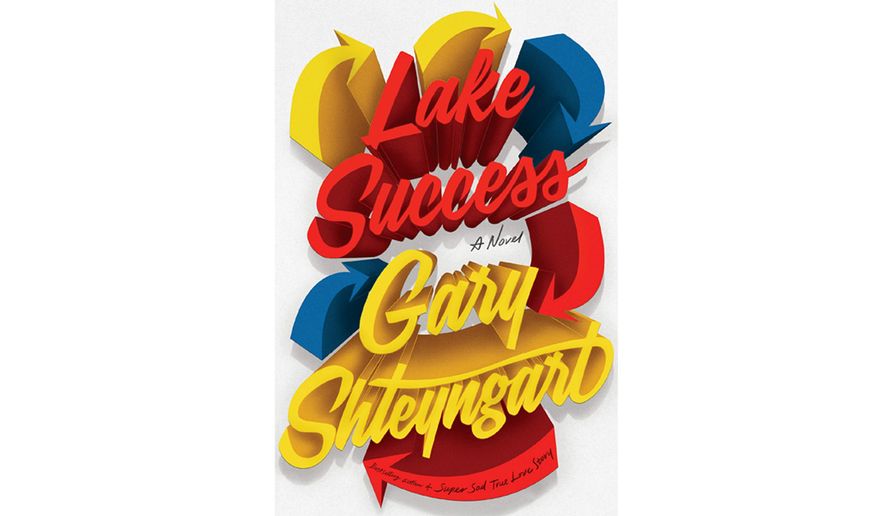
LAKE SUCCESS
By Gary Shteyngart
Random House, $28, 338 pages
Barry Cohen is living the dream. The youngish Princeton graduate from the wrong side of the tracks has made it big time. His hedge fund is worth $2.4 billion “AUM” (assets under management); he has a gorgeous Yale law graduate wife who was born and raised in India; and an apartment to die for — the top three floors of the 17-story building belongs to Rupert Murdoch.
But all is not right in Barry’s world. His wife no longer loves or respects him; his infant’s nanny attacked him and as the book opens he has long red scratches on his face; and the SEC may be after him for fraud. Not to mention that there’s something wrong with his 4-month-old son.
Barry knows that this is not the correct scenario for someone like him, a master of the universe as the late Tom Wolfe called such men in “Bonfire of the Vanities.” Barry and his wife, Shiva, are not ready to accept the fact that their son is autistic; in fact, they rarely use the word, substituting either “on the spectrum” or “the diagnosis.”
So what does Barry do to face these sudden hard facts of life? He runs. For months, he’s been Googling the whereabouts of Layla, his college girlfriend, and in a weirdly romantic and decidedly quixotic gesture he boards a Greyhound bus, and charges off across America heading for El Paso, Texas, where the divorced Layla now lives.
He takes a small amount of cash, his black Amex card (which, along with his phone he soon throws away), and no luggage except for a rollerboard (a carry-on suitcase with wheels) filled with the cream of his hugely-expensive wrist watch collection.
Apparently, Barry Cohen, author Gary Shteyngart’s anti-hero, rates people, meaning males, based on two criteria, their net worth and what they wear on their wrists. But he worries about his treasures:
“The automatic ones were safe within their Swiss Kubik watch winders, but the manually wound ones should not be exposed to such shocks, especially the Universal Genve Tri-Compax, which was from the 1940s and in frail health. Barry normally couldn’t go on a trip without at least three watches to keep him company, each was an old and rare friend, but he would need no fewer than half a dozen timepieces to complete this journey.”
(If the description of this one-percenter obsessed with shamefully expensive wristwatches rings a bell, it may be because you read “The Luck of the Kokura,” an excerpt from this novel that ran in The New Yorker last June.)
Asked why he put his protagonist on a bus, the author told an interviewer, “Much like Barry, I went across the country by Greyhound, a melancholy but very instructive experience. I travelled roughly from June through September of 2016, the election year that changed America. After the Greyhound left the Northeast, many people I met seemed to be telling me that Hillary was going down in flames, which, back then, I thought was preposterous.”
“The Luck of Kokura” captures one such scene when Barry is instructed on the new American reality by the locals in an Atlanta bar. If you want to try to figure out America, get on the Hound.”
(That’s probably sage advice, as is what any experienced bus rider will tell you: On a long trip you do not want to sit in the back near the toilet.)
As the bus rolls on, the author pushes Barry through a series of hoops that reveal his essential cluelessness, and you see why Barry is in the wind: One of the most important reasons is that he and his trophy-wife-with-a-law-degree can’t accept the fact that their parental life is not as perfect as their so-called real life.
Barry stops in Richmond, where Layla is from, and surprises her parents, who still live there. When they treat him with warmth and kindness, typically, Barry doesn’t recognize their essential goodness and humanity. Throughout “Lake Success,” those who represent the 99 percent come off far better than the super-rich hedge funders.
The author has spent a great deal of time with (and written non-fiction about) hedge funders. He told the same interviewer that some of his subjects ” would often say funny things like, ’You know, I actually pay my taxes,’implying that they could find ways not to do so and it was super nice of them to chip in.
“But it was hard not to feel that their very existence contributes to feudal levels of inequality Sometimes I want to say to my new friends, ’You’ve won. Give it up. Cash it in. Give it away. Do something that makes you happy every day. Few things are sadder than being loved for your money.’”
• John Greenya, a Washington writer and critic, is the author of “Gorsuch: The Judge Who Speaks For Himself” (Simon and Schuster, 2018).

Please read our comment policy before commenting.