



OWENSBORO, Ky. (AP) - Looking back, Stephen Wilhite thanks several people for getting him where he is today.
Pat Hayden, Judge Joe Castlen, and Harry Pedigo and the staff at St. Benedict’s Homeless Shelter top the list.
To begin, Castlen always treated Wilhite fairly during drug court. Hayden, Wilhite’s employer, supports him through thick and thin. And Pedigo, executive director of St. Benedict’s, helped him rebuild a life destroyed by drugs.
For a couple of years, Wilhite was addicted to heroin. He couldn’t hold a job, became homeless and burned bridges with everyone he loved. He had no place to go.
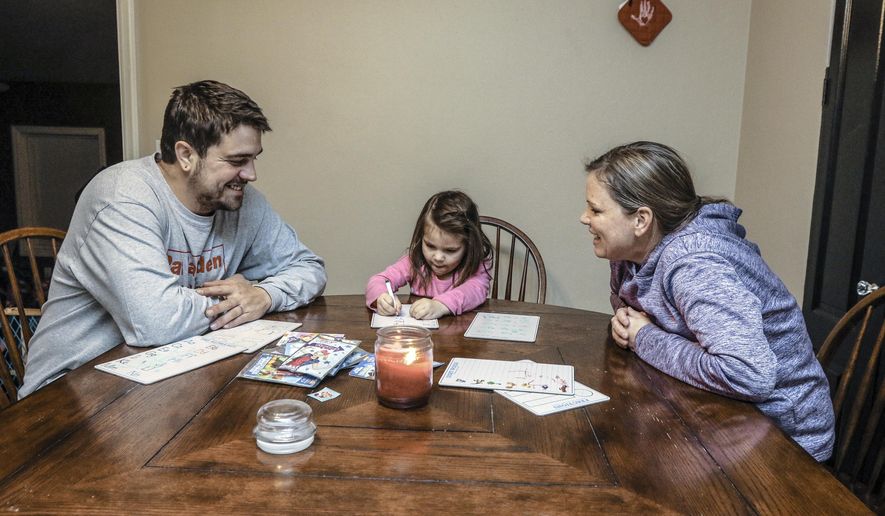
On Dec. 12, the 33-year-old Owensboro man celebrated two years of sobriety. He’s working and living with his fiancée, Amanda Wedding, and their children, Grayson, 5, and Callie, 4, in a nice home on Booth Avenue.
They’ve rented that home since July. They’d like to own it someday.
Two years ago, he moved into St. Benedict’s. He went to the Bouleware Mission for about three months, but returned to St. Benedict’s until space opened in the nonprofit’s transitional home.
“(St. Benedict’s) gave me peace. It gave me quiet. It gave me a place to get my bearings,” Wilhite said.
At the shelter and its transitional home, Wilhite was able to save money, focus on his sobriety and make connections.
It provided a fresh start, he said.
St. Benedict’s and other nonprofits that support the homeless often hit the news when they host fundraisers or expand programs. But their success stories too often go untold.
Take, for example, Stacey Benge of Owensboro, who was homeless for years. She lived at the Daniel Pitino Shelter and Fresh Start for Women. On March 1, Benge became a homeowner.
Atinuke Wilhite moved to Owensboro from Nigeria. After her marriage ended in divorce, Wilhite was homeless and living at OASIS and Daniel Pitino Shelter.
She found full-time work at Wendell Foster and moved into a house of her own.
Owensboro’s shelters not only provide cots, hot showers and meals. They have shown time and time again they can transform lives.
Robert Brey is 63.
At one time, he made big money working at Green River Steel, but it hit a slump in the early ’80s. Brey lost his vehicle. He couldn’t pay rent.
“I lost it all,” he said.
There was no homeless shelter in Owensboro at that time. A married couple who attended church with him allowed Brey to sleep in their business at night.
He became homeless again earlier this year. He chalked it up to not saving enough money for retirement.
This time, Brey went to St. Benedict’s. After living in the shelter a while, he moved into the nonprofit’s transitional home.
Before long, the staff at St. Benedict’s helped him secure a low-income apartment on Dixiana Court.
“It was a really good place for me,” Brey said of St. Benedict’s. “I didn’t have to walk the street or the riverbank or the park.”
St. Benedict’s staff digs deep to find the root cause of each client’s homelessness, such as mental health issues or substance abuse. Then, the focus is on removing those barriers.
The shelter offers life skills training, case management, Bible studies and advocacy. And the nonprofit offers acceptance in a nonjudgmental environment.
“The goal is to get individuals out on their own, become independent members of society, and to become productive and knowledgable about the gifts of serving others,” St. Benedict’s website says.
Ronald Scott, 38, is single and suffers from bipolar disorder. He has a steady income due to his disability.
Scott lived in Elizabethtown until April when he was evicted for allowing people to live at his apartment who were not on the lease. He was estranged from his family, so he had no place to live.
“I came here because of St. Benedict’s,” he said. “Elizabethtown doesn’t have a (homeless) shelter. I didn’t want to go to a big city like Louisville or Lexington. Owensboro was a good fit for me.”
At St. Benedict’s, Scott was assigned a case manager who assisted him with finding services, such as SNAP and public housing. Now, he lives at Lincolnshire Apartments.
“(St. Benedict’s) allowed me to make my life more stable,” he said. “My life was so chaotic when I got here.”

Please read our comment policy before commenting.