



OPINION:
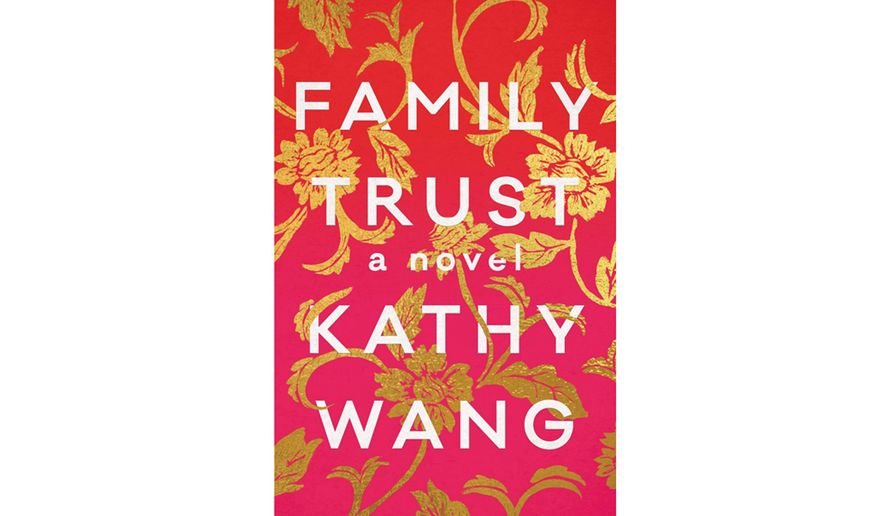
FAMILY TRUST
By Kathy Wang
William Morrow, $26.99, 400 pages
Families and trust — the emotional kind as well as the financial one — are central to Kathy Wang’s first novel, “Family Trust.”
It’s an entertaining account of a Chinese-American family at odds with one another and, to some extent, the world. That world is Silicon Valley, California, where the younger generation of the family is involved, more or less successfully, in venture capital endeavors and investments. Money and status are the touchstones of success.
It’s easy to forget that almost all the characters are Chinese, given their English names, until Ms. Wang reminds with little jabs that all is not in a name. American as they are, her characters have moments when their “otherness” is confronted.
The book is divided into chapters, each bearing the name of one of the characters, and expressing that character’s point of view, told in the third person. It’s a witty romp through marital, parent-child, sibling, professional and ethnic relationships and conflicts.
Stanley, the family patriarch, a weak man given to lying and fits of rage, is dying of cancer. His long-divorced wife, Linda, the mother of his adult children, Kate and Fred, is pushing them to have Stanley make a will, fearing that if he doesn’t, his current, much younger wife, Mary, will inherit everything. Kate and Fred are reluctant to bring up the subject with their father.
Linda “wondered whether she had taught her son anything. Didn’t Harvard Business School have a class in second wife and end-of-life estate planing? For the tuition it charged, it should at least have offered it as an elective.” Linda had always worked and had saved and invested money, cognizant of Stanley’s incompetence and misrepresentation.
Fred was divorced. His current girlfriend, Erika, a tall, striking Hungarian, with “loose hazelnut curls and light filtered through green eyes [was] a trilling contrast to the plain black and dark browns of the Asians he’d mostly dated before.” Erika didn’t like “most ethnic restaurants, and in particular the cheap authentic ones, an admission that in native Bay Area circles was viewed with the same muted horror as Holocaust denial or the use of trans fats.”
Fred had expected to be rich a few years after graduating from Harvard, but had not risen beyond being a minor investor at a smallish firm with few perks. In his zeal for wealth, he agreed to join a colleague in a new sure-fire strike-it-rich venture that turned out to be a fraudulent scheme. When he refused to marry Erika, she sent an email letter accusing him of betrayal, desertion, insults to his bosses and an interest in pornography, which “meandered through a smattering of high school and college acquaintances, as well as what Fred assumed to be the near entirety of his nine-hundred-person Harvard Business School class” before reaching his employers. He was promptly fired.
Linda, meanwhile, had met a Chinese man on the Internet, become close to him, and agreed to meet. “The few strands [of his hair] that remained were obviously dyed, and Winston had made the mistake of selecting the jet-black hue of his youth, which created the unfortunate effect of a large spider tenuously clutching to the top of a beige spotted egg.” He turned out to to be a fraud connected to the same scheme that involved Fred — but not until he had obtained considerable sums of money from Linda.
Kate was dong well in a prestigious Silicon Valley tech company, juggling her career, home (where husband Denny worked in the attic on a start-up), and their two children, until she discovered Denny’s affair with Camilla Moser. Camilla, when confronted by Kate, decided to drop Denny and in a curious turn-about, became Kate’s good friend.
Mary, Stanley’s second wife, had married a man “who owned his own home, who had a pension, who could afford to take her on vacation to faraway destinations and didn’t force her to work.” She was only required to “serve him, delight him in every manner she could imagine, cook foods for him to enjoy, and massage his body each night.”
Then she discovered all was a sham, and Stanley didn’t have the seven million he claimed to possess. Her husband was “a liar who’d promised her an amount beyond her wildest fantasies and made it real, before taking it all away. That’s when Mary finally felt the anger, the resentment she had seen in the eyes of Stanley’s ex-wife and children.” Now she knew the truth “that success in America was less about what you earned than your particular luck on the day you decided to take it for yourself. She would manage things on her own.”
Miss Wang’s portrait of a special world makes “Family Trust” fun to read, but the underlying cynicism regarding Silicon Valley and human ambition leave sobering thoughts on the complexity of human relationships.
• Corinna Lothar is a Washington writer, critic and frequent contributor to The Times.

Please read our comment policy before commenting.