


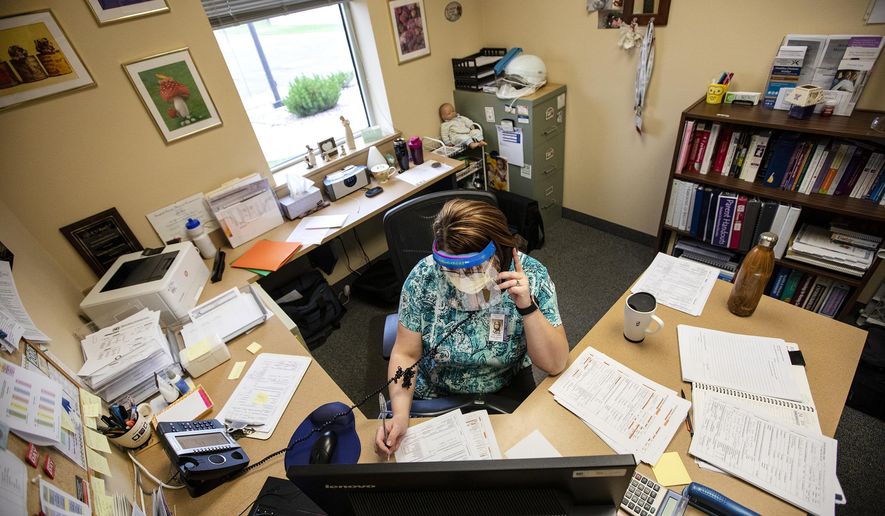

GILLETTE, Wyo. (AP) - Behind a series of locked doors, a temperature screening area and at the back of highly sanitized pathways sits the quaint office of Campbell County Public Health nurse Joli Carr.
Inside, she sits at a desk surrounded by piles of forms with contact tracing notes. It’s her responsibility, and the responsibility of her coworkers as well, to track as much of the spread of the coronavirus in Campbell County as possible through the use of her office phone.
Even as Carr sits alone to call those who have tested positive for the coronavirus, along with anyone they may have recently come in contact with, she wears a mask and face shield.
People were interested in these podcasts
Carr calmly dials the number of someone who has tested positive for COVID-19. A few rings later there’s an answer. The only sound in the room aside from her questions is the scratch of her pen jotting down the answers to her series of questions: When did symptoms show up? Have they gone anywhere since then? Who have they been around?
When Carr finishes the call, she doesn’t have much time to rest. She picks the phone up again and starts calling the patient’s contacts.
Before the pandemic, the public health nurses spent a lot of their time doing community outreach and education. Since the start of the coronavirus pandemic, however, they’ve spent nearly all of their time on the phone, calling people who’ve been exposed to the virus.
They take turns working on weekends to conduct contact tracing for any cases that come in on Saturday or Sunday.
As the number of coronavirus cases continues to climb, both locally and nationwide, contact tracing has become vitally important to track the spread of the virus and how it’s transmitted from person to person, the Gillette News Record reports.
“My ear gets tired by the end of the day. I’m just on the phone all the time,” Carr said.
After a few months of seemingly nonstop calling, the nurses have grown used to the routine.
“I feel like we’re all kind of numb to it now because that’s all we do is take calls and make calls,” Carr said. “We’ve struggled with having enough lines to dial out sometimes.”
Reducing spread of disease
Campbell County Public Health has a wide range of services. It provides immunizations for babies and adults, and it goes to schools to give kids free flu shots. It educates the public on communicable diseases and suicide prevention.
But one of Public Health’s “core functions” is preventing or reducing the spread of disease by contact investigation, said Public Health Director Jane Glaser.
Fortunately, “we haven’t had to do it much, but here we are,” she said.
Campbell County Public Health has been doing contact tracing for years, but nothing on as large a scale as this. It often conducts contact tracing for sexually transmitted diseases, which requires just a couple of calls. It also contact traces for diseases like measles and whooping cough, where a dozen cases qualifies as an outbreak.
With the coronavirus pandemic, contact tracing has become more important than ever. It’s a total team effort for the department, with Glaser, two nurse supervisors and eight public health nurses all making calls.
Since the start of the pandemic, 92 people in Campbell County have tested positive for the coronavirus, and Public Health has had to monitor a total of 761 contacts. That means each positive case has had an average of about 8.5 contacts.
Contact tracing has helped Public Health track the spread of the coronavirus.
Glaser said she was comforted to learn that no cases have been traced back to the community Fourth of July celebration, the state GOP convention or local high school graduations, three events that had a combined attendance in the thousands.
And when a dozen new cases came in over the Fourth of July weekend, Public Health was able to trace those to four private gatherings that happened in mid- to late June.
How does it work?
Public Health is notified whenever a test comes back positive for coronavirus. A nurse will call patients and let them know of positive results. Sometimes they already know, and sometimes they’re hearing it for the first time.
Glaser said it’s important to get as much information from those confirmed positive cases as possible. The most vital piece of information is a list of people they came into contact with three days before their symptoms started.
A person qualifies as a contact if the positive case was within less than a 6-foot proximity for more than 10 minutes.
With the coronavirus, a positive case can have a few contacts or a few dozen, depending on a person’s activity.
There are two outcomes. The nurse can trace the case back to a specific person or event, or the trail can go cold and it’s labeled a “community-acquired” case.
“That’s frustrating for the person who becomes positive, because they don’t know where they got it from,” Carr said, adding that it’s also frustrating for the nurses.
Back in March and April, most people didn’t have a high number of contacts. But as the economy has reopened and more people are out and about, the average number of contacts for each case has increased.
“Now that things are opening up more, people have more contacts,” Carr said. “And we’ve had events like grad parties, funerals and weddings. People can travel more now, so there are going to be more contacts.”
It can be easy to remember family members and coworkers, Carr said. It can be more difficult to remember the friend someone ran into at the store and stopped to talk with for a bit.
Let’s say that someone develops symptoms but waits a couple of days to get tested because the symptoms are minor. He finds out three days later that he’s positive.
“We have to trace them back to when did their symptoms start, then three days before that. That’s over a week ago,” Carr said.
It’s not a perfect system, and Carr said it’s possible some people slip through because they aren’t remembered.
“We probably do miss them, because if they can’t remember, we can’t trace that person,” she said.
“Sometimes there’s no way to tell who they came into contact with,” Glaser added.
If they had an appointment at a hair salon or doctor’s office, that gives the nurses an exact time and place. But other things like a trip to the grocery store can be virtually impossible to trace back to a single person, Glaser said.
The nurse will then call each of the person’s contacts and tell them they’ve been exposed to a positive case of COVID-19. That call can last anywhere from 20 minutes up to an hour. Recently, the calls haven’t lasted as long, Carr said.
“Now that people have a better idea of the symptoms and how to self-monitor, and they have the option to test, it’s easier now to call contacts,” she said. “They don’t have as many questions, we can just check in and see how their symptoms are going.”
Because it can take up to two weeks for the infection to incubate, a contact of a positive has to be quarantined for 14 days.
Contacts monitor their own symptoms and nurses will check on them every few days. If they do end up testing positive, they won’t have to go through the list of people they’ve been around because they’ve been at home the whole time, Glaser said.
The Campbell County people who have tested positive have been cooperative about quarantining, Carr said. The contacts who have to quarantine also have cooperated, for the most part.
“There’s people who are very worried they came in contact, and they want to know everything and do anything they can to prevent any spread,” she said. “And then there’s the people that think this is a scam and it can’t be real, and they don’t believe they need to be quarantined.”
She said she understands the frustration. Having to quarantine “puts their life into chaos,” she said. They have to miss work, reschedule appointments and stay at home for two weeks.
Carr said she wants to avoid making people feel like outcasts for contracting the coronavirus.
“We don’t want people to feel like lepers and feel like they’re horrible because they spread a disease,” she said.
In the battle against the pandemic, contact tracing and quarantining are the most important tools for Public Health, Carr said.
“If we want to open up our economy and have our community be able to function, quarantining … is really the only way to allow opening and still protect people,” she said.

Please read our comment policy before commenting.