


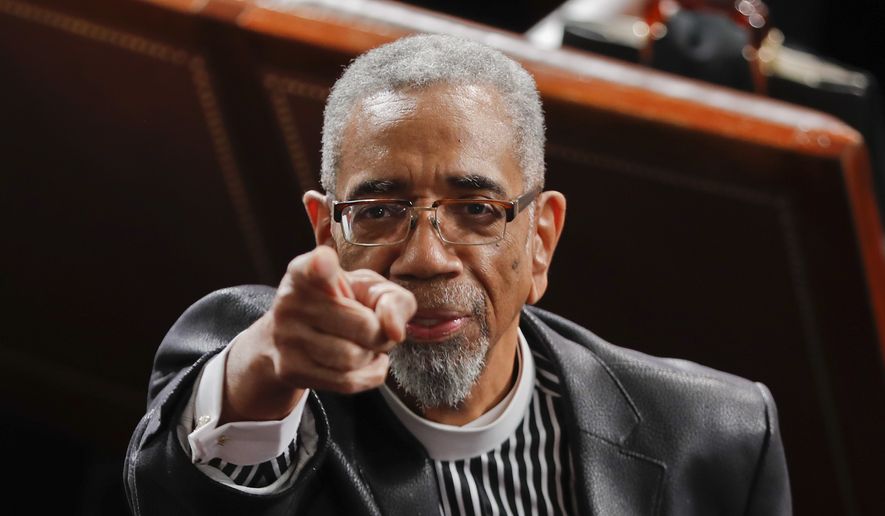

The House is set to formally declare lynching a federal hate crime on Wednesday, putting the historic legislation on a glide path to President Trump’s desk.
The expected passage was scheduled to mark Black History Month and arrives more than 120 years after the first anti-lynching legislation failed to get a vote in the chamber.
Rep. Bobby Rush, the Illinois Democrat who is the lead sponsor of the bill, said the hate-crime designation is long overdue.
People were interested in these podcasts
“For too long, lynching has not been classified as a federal crime, but to borrow a quote from Rev. [Martin Luther] King, ’the arc of the moral universe is long, but it bends toward justice,’” he said. “We are one step closer to finally outlawing this heinous practice and achieving justice for over 4,000 victims of lynching, including Emmett Till.”
The Emmett Till Antilynching Act is named after the 14-year-old black male who was killed by a Mississippi lynch mob in 1955 after being accused of flirting with a white woman.
Richard Semiatin, academic director for politics and policy at American University, said the resistance to anti-lynching legislation has faded with time.
“There are people who are just resistant to it because maybe they see it as a black eye to places where these actions took place and don’t want to be reminded of it,” he said. “But I think it’s actually an opportunity for them to embrace it and say we’ve moved beyond this.”
The anti-lynching legislation also has been snagged in the broader debate over the effectiveness of the hate crime designation, which opponents argue requires prosecutors to decipher the offenders’ motivation.
“There are members of Congress who do not believe in such things as hate crimes because they argue that no one can determine what’s in the mind of an individual,” Mr. Semiatin said.
Those arguments do not appear to be gaining traction this time.
Though murder is treated as the most serious criminal offense throughout the U.S., supporters of hate crime legislation say enhanced penalties for offenses motivated by bias provide added protection for minorities and other vulnerable communities.
According to the NAACP, 3,446 black Americans were lynched from 1882 to 1968, accounting for more than 70% of all lynchings.
While lynching is not as prevalent a threat as it was in the past, supporters of the legislation argue that it sends a strong message denouncing racially motivated violence.
“From Charlottesville to El Paso, we are still being confronted with the same violent racism and hatred that took the life of Emmett and so many others. The passage of this bill will send a strong and clear message to the nation that we will not tolerate this bigotry,” Mr. Rush said.
Since the early 1900s, Congress has attempted to pass anti-lynching legislation more than 200 times.
Most recently, the Senate unanimously passed an anti-lynching bill spearheaded by Sens. Kamala Harris and Cory Booker at the end of 2018, but it was never taken up in the Republican-controlled House. The Senate passed a similar bill last year.

Please read our comment policy before commenting.