



OPINION:
Abe Lincoln cancelled? Abraham Lincoln? How could this be, we wondered?
In this age of divisiveness, you’d think that if there is one person, one president, one national hero who would be immune to the hatred of the cancel culture it would be Old Abe, Abraham Lincoln, the Civil War president, the one who freed the slaves, saved the Union, one of our national heroes, and subject of more books than any American, and in fact any other person except Jesus Christ.
My company, Republic Book Publishers is the publisher of “Old Abe,” a widely-acclaimed historical novel about Abraham Lincoln’s final five years. Taking the reader from the 1860 campaign, through his inauguration, the Civil War and the assassination, the book has been universally praised as a masterpiece of historical fiction, a book that, according to more than a few readers, makes you feel as though you are walking through the White House or across a battlefield with Lincoln — getting to know him as only a well-written work of fiction can do.
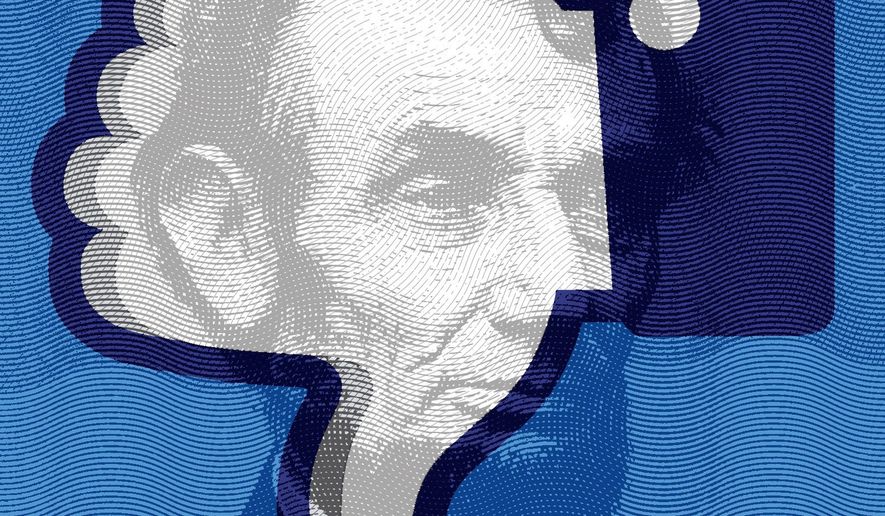
To launch the book we put together a dynamic marketing program and began placing ads on all the right platforms But then came a glitch. Facebook refused to run our ads. We sought their approval four separate times, but each time we were provided a notice stating, “Ad Rejected.” They advised they had developed a new Facebook policy banning advertising about “social issues, elections, or politics” as the reason for rejecting this novel about America’s 16th president, a novel that Vice President Mike Pence called the “best book on Lincoln I have ever read.”
I was curious whether these banalities offered by Facebook really had anything to do with their cancellation or if there might be something else they didn’t want to tell us. So I started poking around the Internet, and voila! Abraham Lincoln, I discovered, meets all the cancel-culture’s tests of being a very bad guy.
White supremacist? You got it, just ask Ebony Magazine. In an article from long ago — 1968 — it asked the question, “Was Abe Lincoln a White Supremacist?”
The article sought to discredit the “mythology of the Great Emancipator” by claiming Lincoln “shared the racial prejudices of most of his white contemporaries.” No other American story, they concluded, is so false as the story about the good Abe Lincoln.
Or how about an article in a University of Michigan journal by somebody named Arthur Zilversmit claiming that “during the celebrated debates with Stephen A. Douglas, Lincoln explicitly supported the doctrine of white supremacy, and he opposed granting civil and political rights to Negroes.”
Systemic racist? Well, pretty close. It was widely reported last summer that students at the University of Wisconsin had demanded that a statue of Lincoln be removed from the campus because he was an unapologetic racist.
One student quoted in UW’s student paper The Badger Herald said about Lincoln’s racism. “I think when people say, okay, Abraham Lincoln freed the slaves … I think that’s looking at a very small piece of his presidency at the time … so you can kind of see, here you freed the slaves, but you also did this and this and this and that. And then when you show that to people, it’s kind of hard to deny those facts in history.” (Full disclosure: I am a graduate of the University of Wisconsin law school).
Lincoln even gets bad press these days, if you can believe it, for signing the Emancipation Proclamation. “I’ve never in my life felt more certain that I was doing right,” he is quoted in “Old Abe,” and “If my name ever goes into history it will be for this act.” But it’s not hard to find criticism — he didn’t go far enough, or his ambivalence about slavery shows through, or it was just a political ploy to win him votes, or even to help win the war.
We heard all these arguments last summer when Black Lives Matter followers wanted to remove the Emancipation statue in Lincoln Park in Washington. And, of course, the criticisms made it into the news reports, and the news reports went on to the Internet, available for all the world — and Facebook algorithms — to see.
So perhaps the reason Facebook refused to take our ads has nothing to do with whether Lincoln actually made racist comments (he probably did) or why much of what he said is irrelevant because it was spoken a century and a half ago. Perhaps the question instead is why does Facebook even try to control what appears on its posts when the results are so stupid, so absurd?
Or perhaps the geniuses at Facebook really do think that Old Abe was out of step on social issues, elections, and politics. Which says a lot more about Facebook than it does about Abraham Lincoln.
• Alfred Regnery, president and publisher at Republic Book Publishers, spent nearly 20 years as president and publisher of Regnery Publishing, his family’s publishing company during which time he expanded sales from under $1 million to $17 million, publishing several hundred titles including 23 New York Times bestsellers.

Please read our comment policy before commenting.