



OPINION:
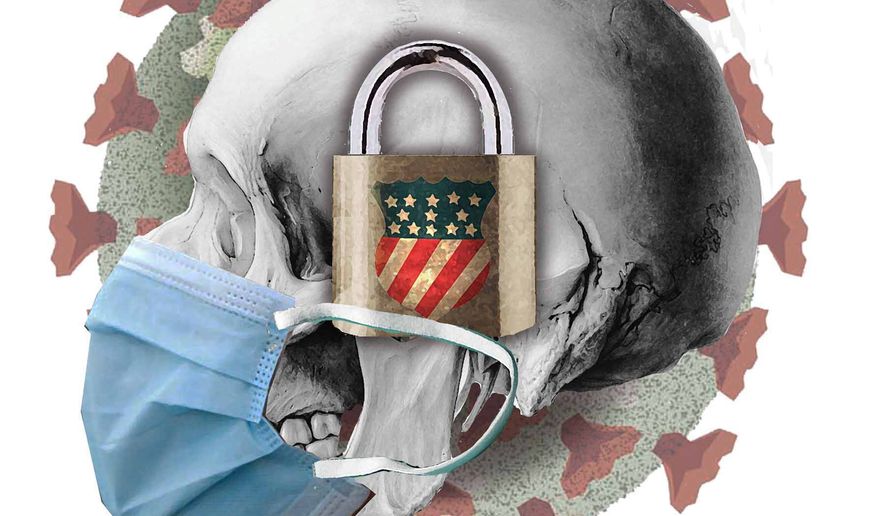
In the pandemic’s earliest days, the American people were told to self-quarantine for 14 days to reduce the rate of COVID-19 infections. This effort to “flatten the curve” was undertaken on the pretext it would prevent the nation’s hospitals from being overwhelmed with new cases.
The curve didn’t flatten, at least not appreciably. The hospitals were largely able to handle the patient load anyway. Remember the U.S. Navy hospital ships made ready in near-record time and sent to New York City and Los Angeles to handle potential overflow? They were hardly used.
What happened? A new study recently released by the prestigious National Bureau of Economic Research shows the proponents of using lockdowns to stop the spread of COVID-19 hit on the wrong strategy. The states that did had no better health outcomes than those that remained mostly open.
People were interested in these podcasts
In “A Final Report Card on the States’ Response to COVID-19,” economists Stephen Moore, Casey Mulligan and Phil Kerpen examined the impact lockdowns had during the pandemic in the 50 states and the District of Columbia, using three metrics: health, by using the death rate in each state from COVID-19 adjusting for comorbidities; economic performance, by using unemployment figures and the growth of output in each state; and education, by measuring the number of days the schools remained open.
What they found is that the places that imposed strict lockdowns fared far worse than those that reopened quickly or never closed at all. Washington, whose regime was one of the country’s toughest, came in 50th out of 51. Its combined score was 4.3 out of 100. Only New Jersey did worse.
The remainder of the bottom five — New York, New Mexico and California — are also run by Democrats. The top five — Utah, Nebraska, Vermont, Montana, and South Dakota — have Republican governors. So does No. 6, Florida, and Republican Gov. Ron DeSantis found himself on the receiving end of devastating criticisms and accusations he allowed the disease to spread nationwide because businesses and resorts in his state had been allowed to reopen with little if any restrictions.
Since its release, some critics of the study have alleged the authors manipulated the data to produce partisan conclusions. There’s no evidence of that. It’s the approach to the pandemic that split along partisan lines. Most Democratic governors, including New York’s Andrew Cuomo, Michigan’s Gretchen Whitmer and New Jersey’s Phil Murphy, whose policies earned his state a 0.0, shut their economies down, vigorously enforced the lockdowns and seemed ready to keep things shuttered until COVID-19 was no longer a threat.
That could have been a long time coming. Even Dr. Anthony Fauci now agrees COVID-19 is likely to never go away. For their efforts, these mostly blue states and the District “had high age-adjusted death rates; they had high unemployment and significant GDP losses, and they kept their schools shut down much longer than almost all other states” according to Mr. Moore, Mr. Mulligan and Mr. Kerpen.
School closures may eventually prove to be the costly mistake the advocates for lockdowns made “in both economic and mortality terms” they wrote, referencing another finding that school closures “at the end of the previous 2019-2020 school year are associated with 13.8 million years of life lost.”
If that were not enough, the National Institutes of Health estimates high school graduates have a life expectancy four to six years longer than high school dropouts while according to the OECD, “the loss of just one-third of a year of learning” has $14 trillion in long-term impact, facts the study also reports.
The bottom line is this: The shutting down by states of their economies was a mistake, the closing of the schools made things even worse, and, in similar circumstances, none of it should ever be allowed to happen again.

Please read our comment policy before commenting.