



OPINION:
Former President Donald Trump, the current Republican primary front-runner, recently released an ambitious plan to rework the federal bureaucracy. While this plan — the centerpiece being Schedule F, which would allow Mr. Trump to fire up to 50,000 federal workers and replace them with loyalists — has been soundly rejected by his Democratic opposition, it does speak to a bipartisan desire to remake the federal government to be more responsive and democratic.
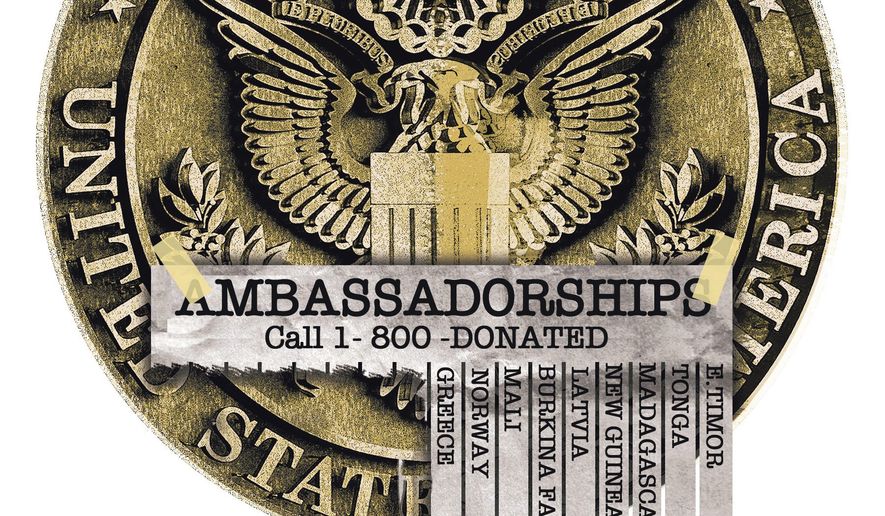
But one area of the federal government has been overlooked when it comes to reform: foreign policy bureaucracy and, in particular, America’s system of ambassadorial selection.
Any future president wishing to truly change establishment foreign policy will need to grapple with a deeply embedded and ideological foreign policy bureaucracy that is predisposed against change. In changing how they select ambassadors, presidents could provide themselves with solutions to this problem.
People were interested in these podcasts
The issues with the method of selecting U.S. ambassadors are well known. Presidents have the unilateral authority to appoint anyone as an ambassador, who is then — barring a temporary recess appointment — subject to approval by the Senate.
When the federal government was relatively small and the United States had essentially no staff abroad, this was a valuable aid. Increasingly, however, presidents have effectively either used ambassadorial positions to award party fundraisers or have simply signed off on whatever State Department careerists are brought to their attention.
In 2014, President Barack Obama appointed George Tsunis, a Democratic fundraiser, as ambassador to Norway, even though the man had never been to the country (his nomination failed). Over 40% of Mr. Trump’s ambassadorial nominees were political — as in noncareer diplomats, the majority of whom were fundraisers — and slightly under 40% of President Biden’s have been likewise.
The rest are “career” officials, State Department employees who have worked their way up the ladder. But even career ambassadors and representatives can cause issues.
Karen Decker, America’s charge d’affaires in Afghanistan, reportedly got a tongue-lashing from Mr. Biden himself earlier this year when she asked on Twitter if women in Afghanistan needed “#BlackGirlMagic” in order to resist Taliban domination.
Compounding these problems is that ambassadorial positions are increasingly being treated as unimportant by administrations on a bipartisan basis.
While the slow pace of confirmations can be chalked up to increased partisanship in the Senate, both Messrs. Trump and Biden were slow to make appointments in the first place. Earlier this year, two years into the Biden administration, Foreign Policy was reporting that a lack of appointments was hurting our nation’s ability to conduct policy.
In a time when Americans want to make government more responsive and are showing an inclination toward new foreign policy paradigms, it is curious why presidents have essentially cast aside what could be an incredible tool: the ability to nominate experts who (a) in effect answer only to them, (b) who have deep knowledge of their assigned countries or regions and (c) whose advice cannot be first funneled through bureaucrats who may try to twist or overrule it.
Supporters of the current system will respond that the president has all sorts whispering in his ear. But many of those whispers come from the same ideological place.
As President Richard Nixon — famous for going around official State Department channels in order to achieve great successes — once wrote, “Foreign service officers get to the top by not getting into trouble.”
Their careers will last longer than any given presidency. They are more or less supportive of the foreign policy of the last 30 years (if they were not, America’s foreign policy would be different).
Therefore, they are going to see things through that lens. This is not to say that the advice they give must be discarded, but the president should use the ability to nominate ambassadors as a way to inject new voices into the conversation.
It is a given that the president needs expert advice when it comes to the minutiae of foreign politics. Once they have reached the level of ambassador, Foreign Service officers may have worked in embassies in many countries. This gives them a wide array of general understanding but may not equip them with knowledge of the minutiae of a given country’s politics (a fundraiser, of course, will also likely lack this).
By selecting ambassadors more carefully, a president can guarantee they are getting advice from someone with their ideological predisposition and who is deeply familiar with the country they are working in. There is no question, for example, that Mr. Obama could have found a good Democrat with intimate knowledge of Norway.
Finally, by picking ambassadors whom the president genuinely trusts for their knowledge and skills — instead of their ability to raise money or get to the top of a bureaucracy — they can have an army of diplomats whose advice cannot be twisted or ignored by official channels.
Right now, ambassadors effectively act as party hosts and spokespeople in foreign countries; the president is not picking up the phone to ask what they think about a given news story. Mr. Tsunis, Mr. Obama’s failed Norway pick of 2014, now serves as Mr. Biden’s ambassador to Greece — and absolutely no one thinks that the president rang him for his opinion in the aftermath of the recent Greek elections.
As a result of this practice, presidents are guaranteeing that when it comes to foreign events, they receive only the opinions of an ideological bureaucracy.
Again, this is not to say that those opinions should be discarded. But any president does himself a disservice when he cuts himself off from alternative ways of thinking.
This is not to suggest that whoever wins in 2024 should appoint cronies as ambassadors. The winner should pick trustworthy and able men and women to do the job.
But if the next president wishes to revolutionize American foreign policymaking, he or she should not leave this tool unused.
• Anthony J. Constantini is writing his doctorate on populism and early American democracy at the University of Vienna in Austria. He received an M.A. in international relations from St. Petersburg State University. In 2016, he was the War Room director for the National Republican Senatorial Committee.

Please read our comment policy before commenting.