


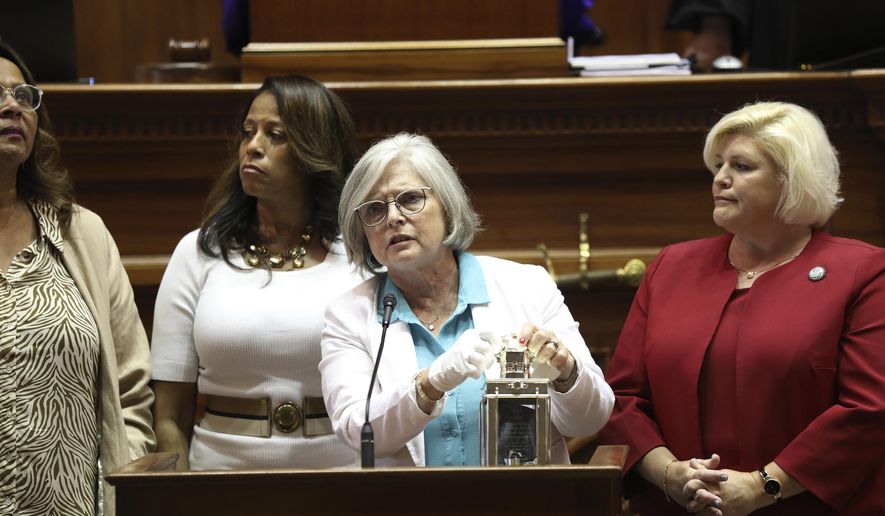

COLUMBIA, S.C. — The only three Republican women in the South Carolina Senate took on their party and stopped a total abortion ban from passing in their state last year. In return, they lost their jobs.
Voters removed state Sens. Sandy Senn, Penry Gustafson and Katrina Shealy from office during sparsely turned out primaries in June, and by doing so completely vacated the Republican wing of the five-member “Sister Senators,” a female contingent that included two Democrats and was joined in their opposition to the abortion ban.
For Republicans, their departure likely means there will be no women in the Senate majority when the next session starts in 2025. It could also mean that women will not wield power for decades in the fiercely conservative state where they have long struggled to gain entry into the legislature.
People were interested in these podcasts
How scant has political influence historically been for women in South Carolina? Small portraits of every woman who has ever served in the 170-seat General Assembly in the 250 years it has met fit on a poster framed just outside the governor’s office.
“Women, somebody else is going to have to stand up. Somebody else is going to have to come and make things right,” Ms. Senn said in her farewell speech on June 26.
Barring a woman winning a race in November in a district dominated by the other party, there will be only two women in the 46-member South Carolina Senate when the 126th session starts in January. No other state in the country would have fewer women in its upper chamber, according to the Center of American Women in Politics. Women make up 55% of the state’s registered voters.
That gap should be alarming to anyone in South Carolina, said Sen. Tameika Isaac Devine, who took her seat this year in a special election and became the sixth member of the Sister Senators. Next year Ms. Devine and fellow Democrat Sen. Margie Bright Matthews will likely be the only women in the chamber.
“No matter how much empathy men can have, they have not had babies. They have not had hysterectomies. They haven’t had some of the health care issues or the community issues we deal with every day,” Ms. Devine said.
Instead of a total abortion ban, South Carolina ended up with a ban once cardiac activity is detected, typically six weeks into a pregnancy.
After that, the three Sister Senators — followed by two Democrats — gained international acclaim. Cover stories and TV appearances culminated with them receiving the John F. Kennedy Profile in Courage award for people who risk their careers for the greater good.
But that attention had another edge. Stringent abortion foes put up billboards and sent out mailers in their districts calling the three Republicans “baby killers.”
“When you’re on CNN and you’re on MSNBC and you’re on the front page of the New York Times and the front page of the Washington Post, you’re repeatedly sticking your finger in the eye of a lot of conservative folks,” Republican Senate Majority Leader Shane Massey said.
Voters in Lexington County, conservative suburbs west of Columbia, said they couldn’t trust Ms. Shealy after electing her three times.
Historically, it’s been worse in the South Carolina Senate for women. There were no women there from 2009 to 2013, when Ms. Shealy was first elected.
In her 12 years in the Senate, Ms. Shealy has made big impacts. Forty-eight of her bills have passed, including those that require a review of every suspicious child death, ban subminimum wages for people with disabilities and require the state to come up with a plan to deal with increasing cases of dementia. No senator has passed more legislation in recent years.
Ms. Shealy has made small differences, too. The women’s bathrooms in the Senate office building were gray and drab when she arrived. She brought in her own art and knickknacks and stocked them with lotions and other items.
On Ms. Shealy’s first day in 2013, the session opened with “Gentlemen of the Senate, please rise.”
Chagrinned, leadership changed it to “gentlemen and lady of the Senate.” Ms. Shealy said that was belittling, too, because it suggested there were different levels of membership. Sessions now open with “members of the Senate.”
Ms. Shealy often looked at the walls of the Senate chambers and saw no women honored with a portrait.
“You can tell how tough it is by some of the comments made by some of the people in the lobby. Things like, ‘Women aren’t fit to serve,’ that ‘God doesn’t want us here,’” Ms. Shealy said during last year’s abortion debate. “Well, God’s pretty smart. If God didn’t want us here, I’m pretty sure we wouldn’t be here.”
A group called SC Women in Leadership is in its sixth year encouraging women to run for office. They train Democrats and Republicans to become better candidates for local and statewide races and support them when they get elected. But they said getting more women in office will take time. Ms. Shealy didn’t win her first race. Neither did Ms. Gustafson.
As she gave her goodbye speech, Ms. Shealy brought out the $36,000 lantern trophy the Profile in Courage group gives to its winners.
“Here it is. And it’s beautiful. And I’m proud of it. I’m proud of losing this senate race just to get this because I stood up for the right thing. I stood up for women. I stood up for children. I stood up for South Carolina. And all these sister senators with me, we’re not ashamed,” Ms. Shealy said.

Please read our comment policy before commenting.