


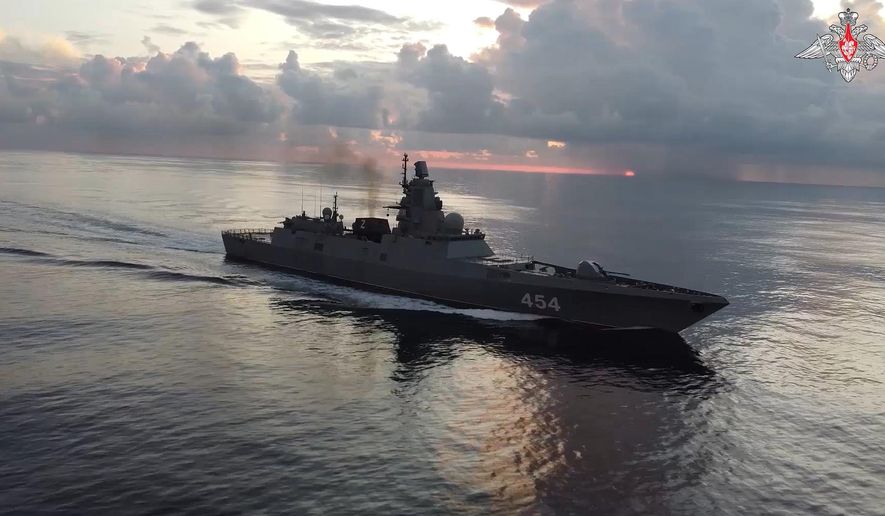

CARACAS, Venezuela — A fleet of Russian warships on Wednesday began entering the Caribbean in what some see as a projection of strength as tensions with the Kremlin grow over Western support for Ukraine.
The first two ships slowly crossed the mouth of the Havana Bay under a downpour. The ships were accompanied by small boats that guided them through the narrow entrance channel.
The U.S. military expects the exercises will involve a handful of Russian ships and support vessels, which may also stop in Venezuela.
Russia is a longtime ally of Venezuela and Cuba, and its warships and aircraft have periodically made forays into the Caribbean. But this mission comes less than two weeks after President Joe Biden authorized Ukraine to use U.S.-provided weapons to strike inside Russia to protect Kharkiv, Ukraine’s second-largest city, prompting President Vladimir Putin to suggest his military could respond with “asymmetrical steps” elsewhere in the world.
“Most of all, the warships are a reminder to Washington that it is unpleasant when an adversary meddles in your near abroad,” said Benjamin Gedan, director of the Latin America Program at the Wilson Center, referring to the Western involvement in Russia’s war in Ukraine. “It also reminds Russia’s friends in the region, including U.S. antagonists Cuba and Venezuela, that Moscow is on their side.”
Although the fleet includes a nuclear-powered submarine, a senior U.S. administration official said on background that the intelligence community has determined no vessel is carrying nuclear weapons. The official said Russia’s deployments “pose no direct threat to the United States.”
U.S. officials last week said the Russian ships were expected to remain in the region through the summer.
Russian ships have occasionally docked in Havana since 2008, when a group of Russian vessels entered Cuban waters in what state media described as the first such visit in almost two decades. In 2015, a reconnaissance and communications ship arrived unannounced in Havana a day before the start of discussions between U.S. and Cuban officials on the reopening of diplomatic relations.
A State Department spokesperson said that Russia’s port calls in Cuba are “routine naval visits,” while acknowledging its military exercises “have ratcheted up because of U.S. support to Ukraine and exercise activity in support of our NATO allies.”
On Wednesday, Russian Foreign Minister Sergey Lavrov hosted his Cuban counterpart, Bruno Rodriguez, for talks in Moscow. Speaking to reporters after the talks, Mr. Lavrov thanked the Cuban authorities for their supportive position on Ukraine.
“From the very beginning, Havana gave an assessment of what was happening outlining the absolutely correct, true reasons for what was unfolding [in Ukraine], and what was being prepared by the West for many years,” Mr. Lavrov said.
Russian military and defense doctrine holds Latin America and the Caribbean in an important position, with the sphere seen as under U.S. influence acting as a counterweight to Washington’s activities in Europe, said Ryan Berg, director of the Americas Program at the Center for Strategic and International Studies.
“While this is likely little more than provocation from Moscow, it sends a message about Russia’s ability to project power into the Western Hemisphere with the help of its allies, and it will certainly keep the U.S. military on high alert while they are in theater,” Mr. Berg said.
The timing of this year’s mission may serve Russia’s purposes, but it is also raising questions of whether Venezuela’s government may use it as an opportunity to shore up President Nicolas Maduro’s bid for a third term in the July 28 election.
Venezuela’s chief opposition coalition is threatening the ruling party’s decades-long grip on power, and engineering a crisis built on simmering tensions with Guyana is among the scenarios that analysts believe Mr. Maduro’s government could use to delay or cancel the vote.

Please read our comment policy before commenting.