


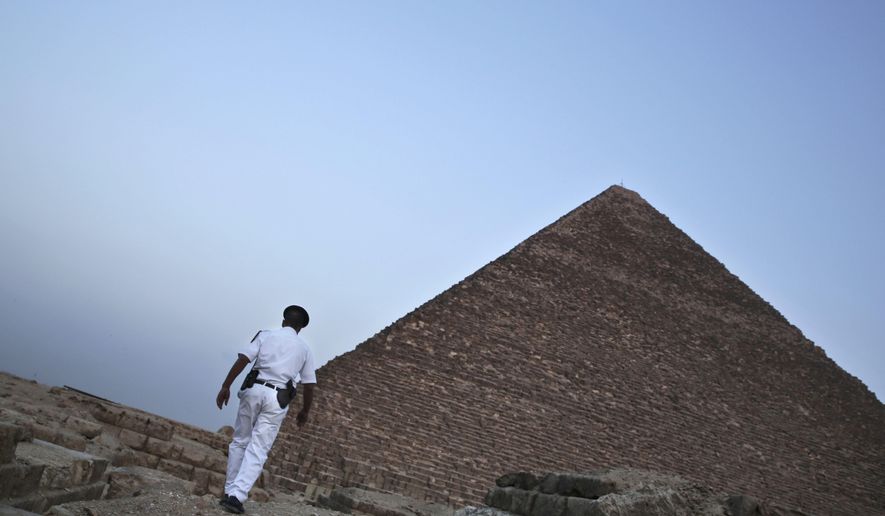

Scientists have long been baffled by the wonders of the ancient world, particularly the Egyptian pyramids. Now a key part of this mystery may have an explanation.
Archaeologists have discovered that these iconic structures might have been built alongside a since-lost branch of the Nile River. This finding could clarify why the pyramids are located in a narrow, harsh desert strip, the Daily Mail reported.
Researchers from the University of North Carolina in Wilmington utilized satellite imagery to identify a potential former river branch running near the pyramids along the foothills of the Western Desert Plateau. They then confirmed the presence of river sediments and ancient channels through geophysical surveys and sediment core analysis.
“The largest pyramid field in Egypt is clustered along a narrow desert strip, yet no convincing explanation as to why these pyramids are concentrated in this specific locality has been given so far,” the archeologists wrote in the journal Communications Earth & Environment.
“Here we use radar satellite imagery, in conjunction with geophysical data and deep soil coring, to investigate the subsurface structure and sedimentology in the Nile Valley next to these pyramids. We identify segments of a major extinct Nile branch, which we name the Ahramat Branch, running at the foothills of the Western Desert Plateau, where the majority of the pyramids lie,” they wrote.
Their analysis revealed evidence of a 40-mile river branch that has since dried up and become obscured by farmland. The study suggests that a buildup of windblown sand, linked to a harsh drought around 4,200 years ago, could have caused the river branch’s disappearance.
The discovery could explain why 31 pyramids, including the Giza pyramid complex, are in this desolate part of the Sahara. At the time of their construction, the pyramids’ location along the river branch would have provided easy access for transporting construction materials.
“Many of the pyramids, dating to the Old and Middle Kingdoms, have causeways that lead to the branch and terminate with Valley Temples, which may have acted as river harbors along it in the past. We suggest that the Ahramat Branch played a role in the monuments’ construction and that it was simultaneously active and used as a transportation waterway for workmen and building materials to the pyramids’ sites,” the archeologists wrote.

Please read our comment policy before commenting.