



OPINION:
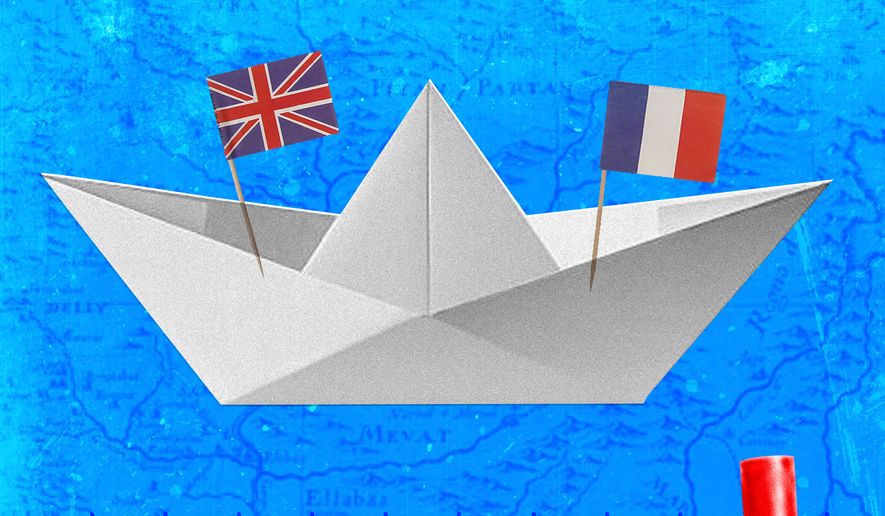
Two of our NATO allies, Britain and France, have sent warships to the Strait of Hormuz, where they will presumably help us reopen the strait.
Given the past conduct of their governments, though, we cannot expect them to help with a blockade of Iran or be of much other use. Two ships are a pitiful representation of those nations’ supposed power.
The problems with these deployments are several. First, they will not be under a unified U.S. command. Second, what will they and we do when — not if — the Iranians attack?
People were interested in these podcasts
The first ship is HMS Dragon, an air defense destroyer that, according to the Royal Navy, is one of the most advanced ships in the world. Normally, we would welcome the assistance of the Dragon, but with the Starmer government still in power — even after its massive losses in local elections — the Dragon’s rules of engagement cannot be relied on.
Remember that the Starmer government refused us the use of our air bases in Britain in attacking Iran.
That is the easier ship to deal with because the other is French. French President Emmanuel Macron refused us the use of French airspace to attack Iran.
The French carrier Charles de Gaulle raises several other issues, such as deconflicting air operations and rules of engagement. Were it under U.S. Central Command, these would be easier to handle. Deconflicting air operations requires constant coordination of where aircraft are flying at any moment.
Certainly, the Charles de Gaulle will want to deconflict its air operations with the U.S. carriers on scene. We have three aircraft carriers — the USS Abraham Lincoln, USS Gerald R. Ford and USS George H.W. Bush — and their battle groups off the coast of Iran. All three will conduct air operations (fighters and helicopters), as well as possible heavy bombers (B-52s, B-1s and B-2s), flying from the U.S. and other bases if the ceasefire ends.
That makes deconfliction of air ops difficult at best.
Both ships can expect to be attacked by Iranian missiles and drones because the Iranians will believe, correctly, that they are aiding President Trump’s Operation Freedom to reopen the strait. What will they do if attacked, and what will we do to respond to any attacks on them?
As long as the ceasefire continues, the French and British ships will have to be wary. When either is attacked, under their respective government’s control, could either withdraw or attack the Iranians? We should respond with attacks against Iran, but will we?
The Dragon, according to the Royal Navy, is purpose-built for anti-missile and anti-aircraft warfare. The effectiveness of its defensive systems is unproven, especially against drones. When the Iranians attack with drones and missiles, the ship may be able to defend itself successfully.
Yet if the Iranians succeed in an attack, the ship would have to conduct offensive operations against Iran or, as noted above, simply withdraw from the scene of battle. Its offensive capabilities are not obvious.
When the Iranians strike at the Dragon or the Charles de Gaulle, we should try to extend our defenses to protect them.
The Charles de Gaulle is France’s only carrier. It is nuclear-powered, and its battle group (two frigates and a refueling ship) is moving to the strait. Our defenses are of relatively short range, which means the de Gaulle and the Dragon will be pretty much on their own unless they are close to our ships.
The Charles de Gaulle has about 30 Rafale-M fighter bombers and two E-2C Hawkeye battle management aircraft.
When it is attacked, the Charles de Gaulle and its accompanying ships should be expected to defend themselves. Yet again, their defenses are untested against the Iranians’ threats. If the French ship responds to the attack by launching its own fighters against Iran, then it would bring the French into the war, which is exactly what the French government does not want.
Or perhaps the French will surrender to Iran.
Iran would be wise to not attack the Dragon or the Charles de Gaulle battle group, but it has not shown such discretion so far.
The Starmer and Macron governments must know the risks they are taking. Iran must be gleeful at the variety of targets it now has.
Whatever the outcome, we should welcome even the unwilling participation in the war by our two NATO allies. NATO is the key to our defense of Europe, and it is much stronger together than apart (if it can ever be brought together again).
• Jed Babbin is a national security and foreign affairs columnist for The Washington Times and a contributing editor for The American Spectator.
Follow the author


Please read our comment policy before commenting.