



OPINION:
Despite their concerted efforts to cultivate likability, university presidents are under siege by critics on both the left and right. The crux of the issue lies in their hypocrisy. Historically, university leaders often spoke with candor and conviction, enjoying the benefits of academic tenure while residing in their ivory towers. Today, however, university leaders epitomize the worst of contemporary political hypocrisy and are beginning to pay for it.
Grievances from the right stem from the recent proliferation of “trigger warnings,” safe spaces, bias response teams, admonitions against microaggressions, and the peculiar notion that both words and silence constitute violence. These and other illiberal constraints on speech are ostensibly designed to shield students from harm. Recent events, however, reveal the hypocrisy behind these presidents’ stated aim of creating inclusive communities where everyone feels safe and valued.
Concern among university presidents for student emotional safety conspicuously excludes Jews. Following the Oct. 7 Hamas attack on Israel, universities’ illiberal speech restrictions were hypocritically abandoned as antisemitic rhetoric proliferated across campuses. This glaring and pervasive duplicity has led to an unprecedented number of elite schools searching for new presidents.
University leaders, long targets of conservative critics, now face harsh criticism from the left, something for which they seem to be wholly unprepared. Universities nationwide have evolved into social justice factories over the past decade, particularly since the summer of 2020 following George Floyd’s killing. Both public and private institutions now market themselves as training grounds for progressive activists. Admissions offices highlight the opportunity and desirability of “bending the arc of history” in their advertising, thereby signaling their alignment with progressive causes.
University presidents now consistently assert that their institution’s mission extends beyond research and teaching to include a central focus on social justice. Humanities and social science professors now routinely indoctrinate students with increasingly radical values, perceiving their roles more as activism trainers than teacher-scholars. Progressive community engagement is extolled by university leaders, with glossy publications valorizing activism over impartial teaching and research. With all this pandering to the illiberal left, why have they, too, turned against their university presidents?
This spring, these same presidents, who have been ardent advocates of social justice, called on the police to break up campus protests. Ironically, in places such as Charlottesville, Virginia, and Berkeley, these demonstrations took place near monuments commemorating past student rallies. The hypocrisy of praising the student activists of the 1960s and 1970s while turning to police to suppress the current generation of student demonstrators has been too much for the leftist faculty.
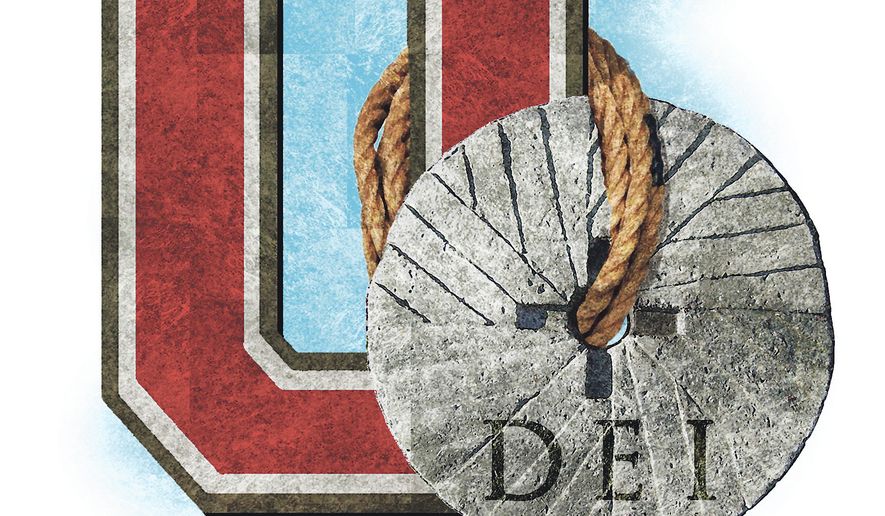
Historically, university leaders tried to appease progressive activists, first with affirmative action in the late 1970s, which courts and state referendums eventually curtailed, and later with speech codes in the 1980s and ’90s, which were similarly struck down. Today, the left’s preferred tools are ubiquitous and costly diversity, equity and inclusion initiatives. These programs include identity-based discrimination, workshops on acceptable behavior, a focus on equal outcomes for all, and mandatory training for students, administrators and faculty.
As with previous attempts to regulate speech and behavior, DEI policies are now facing significant judicial scrutiny. Diversity and inclusion often translate to new forms of discrimination, excluding those who do not adhere to the prevailing ideological orthodoxy. It is only a matter of time before these practices are successfully challenged and dismantled.
The backlash against university presidents highlights a fundamental crisis in higher education. We live in an age where common sense is not only uncommon but also controversial.
It is controversial to argue that children fare better in two-parent families.
It is controversial to argue that someone who swam on the men’s team last year should not be allowed to swim on the women’s team this year.
It is controversial to condemn Hamas’ massacre of Israeli civilians.
And yes, it is controversial to argue that race-neutral policies are preferable to those promoting racial discrimination.
At the root of this insanity is that university faculty prefer incompetent leaders who make no demands on them to competent leaders who require excellence in universities’ core areas of research and teaching.
Universities today struggle with the challenge of balancing competing demands: from the right, a call for the restoration of free speech and academic rigor, and from the left, an insistence on progressive social justice reforms at both local and national levels. The resolution of this impasse lies in restoring a sense of balance and reason to university governance.
University presidents must reclaim their roles as impartial administrators rather than as advocates of progressive causes, returning to supporting their core mission of teaching and research. To accomplish this, university boards must tack back to the center, returning universities to a path that respects free expression and the pursuit of knowledge without yielding to ideological extremism.
• Allan C. Stam is a professor of public policy and politics at the University of Virginia. An earlier version of this column was published by The Jefferson Council.

Please read our comment policy before commenting.