


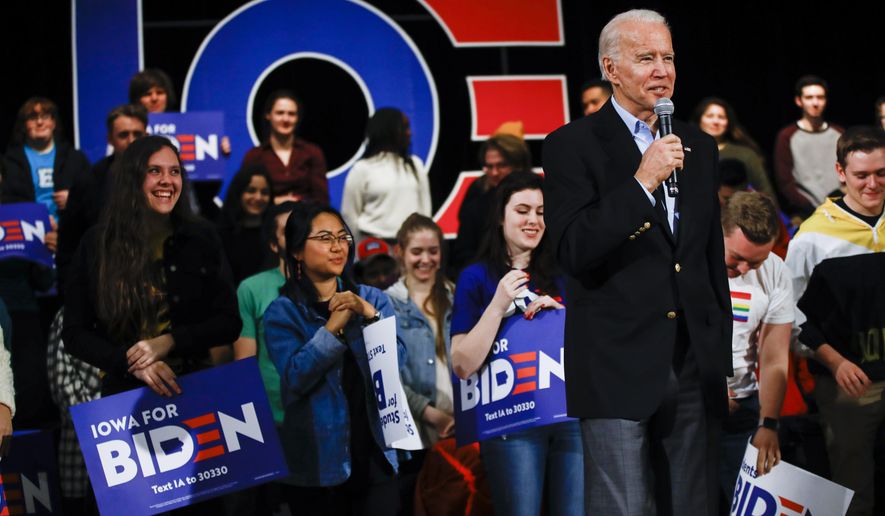

President Biden is trying to save his reelection campaign by embracing policies that matter most to young voters, but their defections now account for the largest drop in his support among any demographic.
In April, Mr. Biden moved to reclassify marijuana as a less dangerous drug, the first step toward federal legalization. He also stepped up his efforts to cancel student loan debt, shifted U.S. policy on Israel, ordered the Justice Department to sue the parent company of Ticketmaster to lower concert ticket prices and made abortion access a central argument for his reelection.
These election-year moves have failed to improve Mr. Biden’s appeal to young voters, who traditionally skew liberal. In 2020, Generation Z and millennials lifted Mr. Biden over President Trump with an overwhelming 60% of their vote.
People were interested in these podcasts
This year looks different. Some polls show Mr. Trump, the presumptive Republican Party nominee, leading Mr. Biden among voters younger than 30. Others show Mr. Biden only slightly ahead.
Pollsters, strategists and younger voters cite Mr. Biden’s age and decline, persistently high housing costs, and failures to deliver on his promises.
Brian Grahe, a 22-year-old college student from Pittsburgh, said he planned to save money by living at home while going to school, but sky-high inflation forced him to also work a part-time job. He voted for Mr. Biden in 2020 but is unsure whether he will go to the polls in November.
SEE ALSO: DNC to nominate Biden in virtual call to ensure Ohio ballot access
“It’s been nothing but unfulfilled promises,” Mr. Grahe told The Washington Times. “If Biden can start addressing the problems young people are concerned about — abortion, student debt and the economy — I think more people will turn out for him.”
A CNN poll released this month revealed that Mr. Biden is 11 percentage points behind Mr. Trump among voters ages 18 to 34 in a head-to-head matchup. Among voters ages 18 to 29, Mr. Biden leads by only 1 point (47% to 46%) over Mr. Trump, according to a New York Times/Siena College poll. A Marist College poll showed Mr. Trump had a 2-percentage-point lead among millennial and Gen-Z voters, including those ages 18 to 27.
The Harvard Youth Poll released in April gave Mr. Biden an 8-percentage-point lead over Mr. Trump.
Complicating matters is the blurry picture of young voters, who are not as liberal as previous generations and reject the monolith of party ideology.
A Gallup poll released last week found that 47% of Gen Z voters identify as Democratic and 39% identify as Republican — an 8-point difference and the narrowest Democratic lead since 2005. In 2019, Democrats had a 23-percentage-point lead with this age group.
“All Americans are results-oriented, and this generation is not any different. They want results and are frustrated because the president has talked a lot but only done some of those things,” said Democratic strategist Brad Bannon.
He said Republicans in Congress have prevented the president from following through on some of his promises.
Ignite National, which researches youth political participation, surveyed 1,300 members of Gen Z across the country and found party affiliation tracked similarly to older voters. Gen Z’s male and White voters split evenly between Democratic and Republican. Black and female voters in Gen Z overwhelmingly identified as Democrats.
The survey found that 90% of Gen Z say they want younger candidates. Mr. Trump, 77, is only four years younger than Mr. Biden.
“They are very disillusioned with the candidates, both of them,” said Sofia Huizar, chief marketing officer at Ignite. “There really wasn’t a partisan difference in terms of feeling, but they want someone who can relate to them in terms of their personal experience. They want someone in their mid-30s or 40s who has experience but is close to them as a generation.”
More than 80% of voters younger than 30 said Mr. Biden is too old to be president, and 61% said the same about Mr. Trump, according to a recent New York Times/Siena College poll.
Despite Mr. Biden’s grab bag of policies aimed at younger voters, none appears to have motivated their support. His Achilles’ heel with Gen Z and millennials is the same as with their parents and grandparents: the economy.
Inflation has cooled considerably since peaking at a 9% annual rate in June 2022, but prices remain higher than before the 2020 election. Although wages have grown, young adults have the lowest earnings-to-assets ratio of any age group, according to the Bureau of Labor Statistics.
High interest rates and rental costs eat up much of their earnings. Apartment rents jumped about 18% from October 2020 to January 2024, according to Redfin. Homeownership is also down. Sky-high mortgage rates affect younger voters more than older voters, who are more likely to already own a home.
“Questions about the economy and the cost of living are really at the top of mind for young voters,” Ms. Huiza said. “They want to know how they are going to afford a home, why the cost of living is so high and what the candidates are going to do about student debt and inflation.”
Student debt and high rental prices weigh on Leslie Keough, a 19-year-old retail worker from Canonsburg, Pennsylvania. She has delayed college for fear of taking on too much debt.
“It’s nearly impossible for my generation to achieve financial stability,” she told The Times. “Biden needs our vote, but what is he doing to lower costs?”
Mr. Biden insists he has fixed the economy and that U.S. growth outpaces other countries’ growth even as prices remain high.
Beyond the economy, Mr. Biden has struggled to deliver on issues most important to young voters.
His promise of widespread student loan forgiveness gave hope to many young voters, but the Supreme Court declared his plan unconstitutional.
Since then, Mr. Biden has approved nearly $167 billion in forgiveness through more narrow methods. He has targeted specific groups, including those with disabilities, some who attended for-profit colleges and public servants who have been repaying their student loans for years.
Mr. Biden and his team were caught off guard by the timing of the 2022 Supreme Court ruling overturning Roe v. Wade, even though the decision to send the abortion issue back to the states had been leaked months earlier.
Since then, the president’s plan to safeguard abortion rights has hit roadblocks. Mr. Biden argues that he needs Democratic majorities in the House and Senate to enshrine abortion rights into federal law.
In 2020, Mr. Biden pledged to decriminalize marijuana on the federal level and issue mass pardons for people in federal prisons on nonviolent marijuana offenses. Though he has issued some pardons, he hasn’t moved to decriminalize marijuana. After three years in office, he took a step forward by moving to reclassify marijuana as a less dangerous drug.
Under pressure from Democrats and young voters, Mr. Biden shifted U.S. policy on Israel to be more sympathetic toward the humanitarian crisis in the Gaza Strip during Israel’s relentless war with Hamas terrorists. Mr. Biden has repeatedly chided Israeli Prime Minister Benjamin Netanyahu and withheld weapons so they couldn’t be used during Israel’s invasion of Rafah. He also reversed his steadfast refusal to call for a cease-fire.
Wassim Kanaan, chairman of the New Jersey chapter of American Muslims for Palestine, told The Times that the moves were “too little, too late.”
“Joe Biden sees the writing on the wall. He’s lost the young progressives,” he said. “His legacy is that of supporting genocide. He can’t do anything to escape that. He dug his hole.”

Please read our comment policy before commenting.