



OPINION:
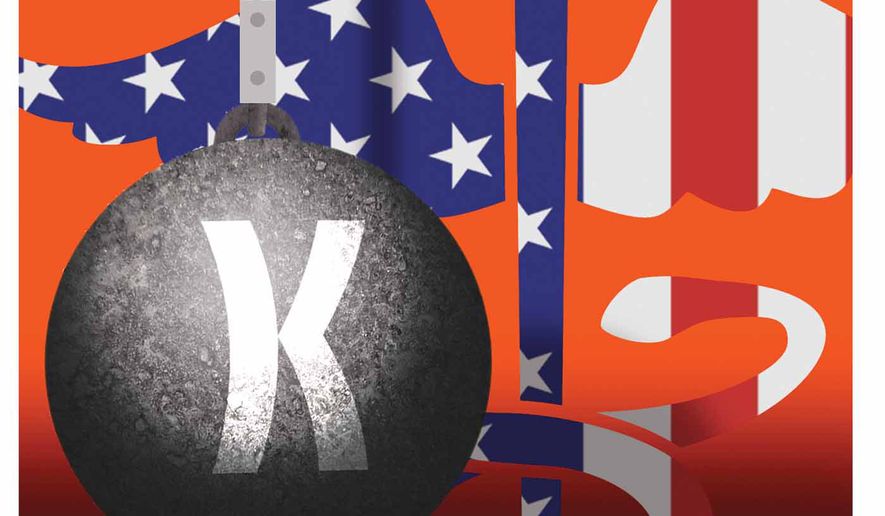
It should come as no surprise that progressive leaders recently called on Vice President Kamala Harris to stop pushing for government-run health care on the campaign trail. They know that the idea is radically unpopular and that she should hold off on advocating it until after the election.
That’s exactly what Ms. Harris is doing. Her campaign recently confirmed that she won’t be pushing for “Medicare for All” as she did while representing California in the Senate or running for president in the 2020 election cycle.
Voters shouldn’t be fooled. While the vice president has been trying to avoid using the phrase “Medicare for All” on the campaign trail, her remarks on health care reform demonstrate that it’s still on her agenda.
People were interested in these podcasts
The two biggest prongs to Medicare for All are making health care free for all and putting the government entirely in charge of drug prices and the health care supply chain. Ms. Harris has advocated both policies in the last several weeks.
In an economic policy proposal shared by Ms. Harris’ campaign in late August, the vice president said that she would cancel medical debt for millions of Americans to “help prevent such debt from accumulating in the future.”
She then said she would impose government price controls on prescription drugs and a “crackdown” on the pharmacy benefit companies businesses use to negotiate lower drug prices for their employees. In other words, the government — not the free market — would control drug costs under her presidency.
Two and two does equal four. It doesn’t matter what Ms. Harris calls it. These policy ideas represent the heart and soul of Medicare for All — and that’s bad news for us all.
We can look to the United Kingdom and its health care bureaucracy run by the National Health Service to see what Ms. Harris’ health care plan would bring about: longer lines and lower quality. By promising free care for all, health care has become costly and less accessible.
As Martin McKee, a professor of public health at the London School of Hygiene and Tropical Medicine, recently said, “the underlying health of the British public has suffered considerably since 2010” when this policy began. The British health care service suffers from a shortage of doctors and nurses, hospital beds and even adequate pay, which led physicians to go on strike earlier in the year. The average wait time to see a doctor is 14 weeks, with a waiting list of 8 million people.
And those are the lucky ones. Some patients must wait up to 18 months. This has created a system of haves and have-nots, where poorer citizens must wait for care while those with more resources will pay for their treatment.
Numerous studies have demonstrated that implementing a British-style health care system in the United States would cost taxpayers astronomical amounts. The Congressional Budget Office estimated that Medicare for All would cost $34 trillion over its first decade. The left-of-center Urban Institute similarly projected paying for it would require a $32 trillion tax increase.
It isn’t easy to wrap your arms around what such large numbers mean. But according to reporting in The Atlantic, a $32 trillion tax increase would represent “almost 50 percent more than the total revenue the CBO projects Washington will collect from the personal income tax over the next decade (about $23.3 trillion)” and “just over two-thirds of the revenue the CBO projects the federal government will collect from all sources over the next decade (just over $46 trillion).”
As former heavyweight boxing champion Mike Tyson once said, “Everybody has a plan until they get punched in the face.” Medicare for All might sound suitable for some, but its lack of feasibility will always come back to hit it in the face.
As Vice President Kamala Harris continues to push for these policies, Americans must recognize that Medicare for All is not a compassionate reform but rather a drastic overhaul that could harm our health care system and economy. The warnings are clear, and the stakes are too high to ignore.
• Joseph R. Pitts, a former Republican member of Congress from Pennsylvania, chaired the House Energy and Commerce Committee’s Subcommittee on Health.

Please read our comment policy before commenting.