


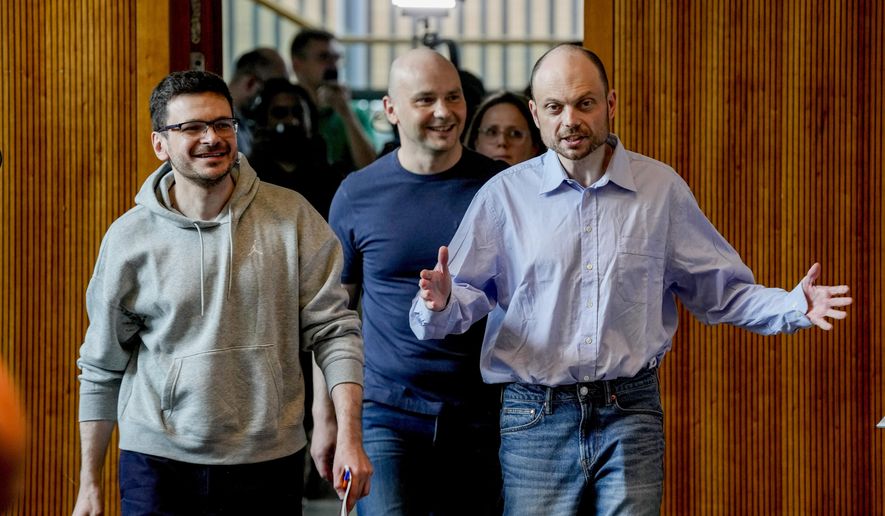

At a news conference with fellow dissidents in Berlin, the Russian oppositionist Ilya Yashin, who had been freed in a historic East-West prisoner swap, said he did not ask to be released. Mr. Yashin made clear that he belonged in Russia, even though he had been jailed for speaking out against President Vladimir Putin’s war of aggression against Ukraine.
“I understood that being in prison was not just an antiwar struggle, but it was a struggle to have the right to live in my country and to be involved in independent politics in my country, and to say what I feel needs to be said in my country. I was defending my right to live and to work in my country. Until the last day, I fought for my right to remain in Russia,” said Mr. Yashin as he sat alongside the political activists Vladimir Kara-Murza and Andrei Pivovarov.
People were interested in these podcasts
In this episode of History As It Happens, historian Michael Kimmage and political scientist Maria Lipman, a Russian exile herself, discuss the difficult position exiles find themselves in Western societies. The emigres have little ability to change Moscow from a distance, and they face pressure to always say the right thing to Western audiences who may have unrealistic expectations about their politics.
“Both Maria and I are very skeptical about diaspora communities or exile communities from Russia serving any kind of political purpose,” said Mr. Kimmage, the Richard C. Holbrooke Fellow at the American Academy in Berlin. “At the same time, we should have care and concern for people living in diaspora communities, we both strongly believe there should be no messianic or any political program attached to them.”
“It is wrong to refer to [the exiles] as the opposition,” said Ms. Lipman, a visiting research scholar at George Washington University who emigrated from Russia in early 2022 — after Mr. Putin ordered the full-scale invasion of Ukraine. “We should be talking about oppositionists and small opposition groups, about people who share antiwar attitudes and are opposed to the current Russian government … but they do not form what might be referred to as the opposition, as a political force with a program, with anything like a political discipline, a recognized leader, a set of goals.”
Mr. Kimmage and Ms. Lipman, in an essay for Foreign Affairs, said some Americans once mistook Aleksandr Solzhenitsyn’s anti-communism as a more general embrace of Western liberalism. Solzhenitsyn loathed Soviet communism but was not a liberal democrat.
History As It Happens is available at washingtontimes.com or wherever you find your podcasts.

