



OPINION:
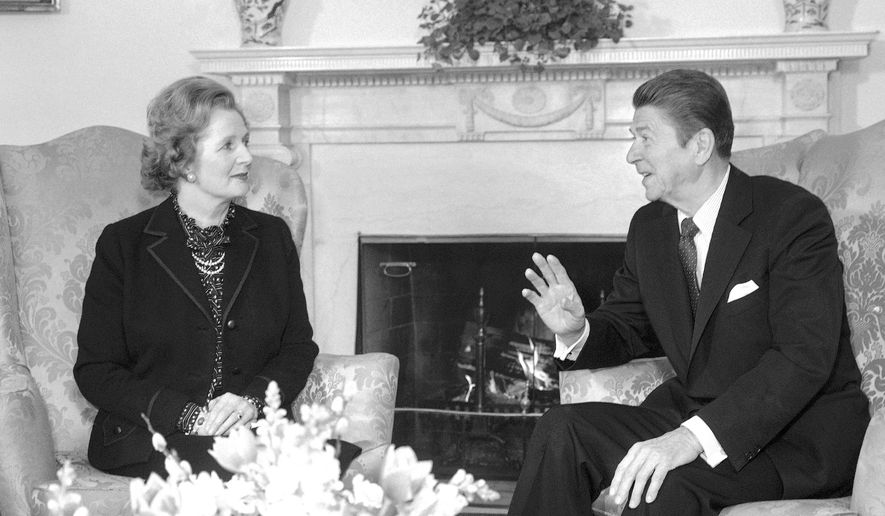
President Ronald Reagan was fond of telling a story about a boy who was assigned to clean a stable filled to the brim with muck. When asked why he was so enthusiastic about the job, the boy replied, “There must be a pony in here somewhere!”
The story illustrates a crucial point: At some level, capitalism has always been associated with optimism.
It takes courage and an appetite for risk to start a business. While preparation and understanding of a market are essential, entrepreneurs who do not approach the task with an optimistic spirit — believing, as in the famous sign on Reagan’s desk that “It CAN be
done” — are likely doomed to failure.
People were interested in these podcasts
Given this linkage between capitalism and optimism, it’s no wonder that the modern term “joint venture” derives from “joint adventure.” While the meaning of the word has evolved somewhat over the years, building a business remains an adventure.
What is true for businesses can be true for societies and governments as well. Reflecting this spirit, David Howell, a member of the British House of Lords and the only member of Parliament to have served under prime ministers Edward Heath, Margaret Thatcher and David Cameron, has written a book: “Avoiding the Coming Anarchy: A Short Book for Optimists in Dangerous Times.”
In it, Mr. Howell contrasts the sense that “the four horsemen of the apocalypse were out at full gallop and working overtime” with his conviction that “[g]reat dangers lie ahead, but they are not inevitable. Avoidance is possible. Tables can be turned.” In particular, he writes, technology “can be made to work our way.”
Mr. Howell calls for a new understanding of human relations distinct from the impact of modern technological revolutions, which he perceives as having a greater influence on society than the earlier Industrial Revolution. He writes of dangers to the family leading to “unsafe foundations at the very roots of the stable society”; the weakening of the local community; and love of the nation often transformed into hatred of the other.
On current trends, this is hardly grounds for optimism. However, for Mr. Howell, the way forward lies not through the expansion of the state or simple confidence in the inevitability of progress. As he writes, technology, fragmenting power into “multipolar mosaics,” reveals a
“weak State” under the “pervasive spread of the big State.” In an age of networks, governments’ ability to shape affairs is sharply reduced.
Further, this big State is “completely overwhelmed with demands that alone it has neither the competencies nor the finances to meet. … It is the enterprise and innovation sector of the modern world which will have to come to the rescue.” In other words, society can be reset through capitalist innovation.
A prime example of this is the global energy transition, which “demands new structures and new politics.” Innovation through new technologies of carbon capture, energy efficiency and increased nuclear power — rather than a relentless focus on reducing emissions alone — is the only path that can both protect the environment and promote economic growth.
Despite the general spirit of optimism, there are cautions along the way as well. Mr. Howell notes challenges that capitalism will have to address, noting that “[d]istribution of life’s goods is the central political question, which so far digital capitalism has spectacularly failed to resolve.” Growing divides in the accumulation of wealth weaken support for the very capitalism that leads to broader wealth; opportunity for younger generations requires a better and fairer sharing of capitalism’s benefits. Similarly, “[t]he relationship of democracy with modern capitalism is essential to the health of each.”
While Mr. Howell writes from a British perspective, he addresses significant issues — the energy transition, revolutionary change in technology, the crises in democracies — that affect the nations of the West and, indeed, the entire world. In geopolitics, Mr. Howell points to the Commonwealth, which developing nations are eager to join, as an example of what a networked world can be, offering “commercial and diplomatic exposure to the Anglophone world of success” and a counterpoint to the lure of Russia and China. In this new world, soft power will be essential.
Mr. Howell’s optimism derives in large measure from the belief that “capitalism is always bound to transform itself.” This is not naive optimism, but rather optimism grounded in capitalism’s ability for self-renewal. In this way, “the same powers pulling parts of society apart can become the threads which stitch it together once again, although with the state playing a new and much humbler role of service and support than in the past.”
But there is a catch: This type of capitalist progress will arise only “if” the dangers of the current situation are rightly understood and addressed. That is the challenge. Will we meet it?
• Daniel A. Witt is president of the International Tax and Investment Center headquartered in Washington. He has
worked on tax policy and administration reforms in transition and developing countries since 1993.

Please read our comment policy before commenting.