


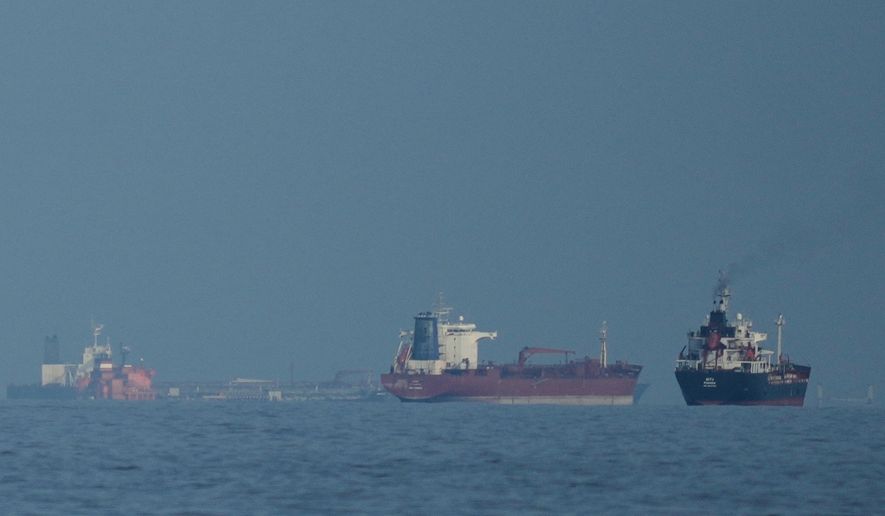

The U.S. Navy interdicted another Iranian-linked oil tanker on Thursday, as the U.S. and Iran continued to trade ship seizures, both near the Strait of Hormuz and in the Indo-Pacific region.
U.S. forces carried out a “right-of-visit” boarding mission on the M/T Majestic X, a sanctioned and stateless vessel in the INDOPACOM area of responsibility, according to the Pentagon. The operation was part of a broader enforcement campaign aimed at disrupting “illicit networks” that provide support to Iran, the Department of Defense wrote in a statement.
“International waters cannot be used as a shield by sanctioned actors. The Department of War will continue to deny illicit actors and their vessels freedom of maneuver in the maritime domain,” the department wrote on X.
The operation is the second of its kind beyond the Strait of Hormuz and underscores the expansiveness of the U.S. Navy’s attempt to strangle Iranian oil exports. Earlier on Thursday, U.S. Central Command said its forces have turned around 33 vessels since the operations began.
President Trump announced a U.S. naval blockade last week and declared that naval forces would intercept any ships attempting to leave or enter Iranian ports. The operation is intended as a pressure tactic, curbing Tehran’s lucrative energy export business.
Mr. Trump expanded his threats on Thursday and declared that the U.S. Navy will “shoot and kill” any boat that lays mines in the Strait of Hormuz.
Shooting at Iranian ships could constitute a breach of the ceasefire agreement between the U.S. and Iran, which Mr. Trump extended indefinitely on Tuesday.
“There is to be no hesitation,” Mr. Trump wrote on Truth Social.
According to reports this week, clearing the strait of Iranian mines could take six months or more. Iranian authorities have also reportedly lost track of the locations of sea mines placed in and around the strait, making the clean-up effort difficult.
Mr. Trump issued the order as the U.S. waits for Iran to submit a unified peace proposal to Pakistani mediators seeking to end the conflict.
Mr. Trump says Iran cannot develop a nuclear weapon and must reopen the Strait of Hormuz, and that so far, Tehran has not offered a proposal that meets his demands. However, the U.S. president is giving Iran space to bring its factions together and submit a plan.
“We have no pressure,” Mr. Trump said Thursday in the Oval Office. “I want to make the best deal.”
Mr. Trump previously threatened to blow up Iran’s power plants, bridges and other infrastructure if Tehran officials did not negotiate. On Thursday, he emphatically ruled out using a nuclear weapon against Iran.
“Why would I use a nuclear weapon when we’ve totally and in a very conventional way decimated them without it?” Mr. Trump said.
“I wouldn’t use it,” he said. “A nuclear weapon should never be allowed to be used by anybody.”
Meanwhile, Iran has reasserted its de facto control over ships attempting to travel through the Strait of Hormuz from the Persian Gulf.
After a brief period of relative calm in the strait, naval forces from Iran’s Islamic Revolutionary Guard Corps have begun seizing commercial vessels in nearby waters. Three commercial vessels came under fire on Wednesday after attempting to traverse the strait, according to Iranian state-affiliated media.
IRGC forces reportedly seized two of the vessels, with a third, a Greek-owned ship, running aground on Iran’s shores after being fired upon.
Iranian officials have cast the interdictions as retaliation for similar moves by the U.S., which they have labeled war crimes and piracy.
Iran has kept the Strait of Hormuz effectively closed since early March, threatening to strike at any Western-linked ships attempting to travel through the waterway.
Its closure has throttled global oil supply and sent international markets tumbling. While oil prices fell and stocks rose after Iran and the U.S. announced a two-week ceasefire earlier this month, both have remained beyond pre-war levels.
Domestic gasoline prices, perhaps Mr. Trump’s largest political hurdle with the Iran war, have also remained above $4 a gallon for over a month.
Iran has also contradicted Mr. Trump’s assertion that Iranian officials are divided over negotiations.
Iranian Parliament Speaker Mohammad Bagher Ghalibaf, who led Iran’s delegation in negotiations with the U.S. earlier this month, said Thursday that “in Iran, there are no radicals or moderates.”
“We are all ’Iranian’ and ’revolutionary,’ and with the iron unity of the nation and government, with complete obedience to the Supreme Leader of the Revolution, we will make the aggressor criminal regret his actions,” he wrote on social media.
Iran’s President Masoud Pezeshkian issued an identical statement on X at the same time.
The post seemed to be a direct response to Mr. Trump’s claim that Iran cannot get on the same page in peace talks.
“The infighting is between the ’Hardliners,’ who have been losing BADLY on the battlefield, and the ’Moderates,’ who are not very moderate at all (but gaining respect!), is CRAZY!” Mr. Trump wrote on Thursday on Truth Social.
Speaking at the White House, Mr. Trump said Iran’s factions are “fighting like cats and dogs.”
“They don’t even know who is leading the country,” he said. “They’re in turmoil.”
• Jeff Mordock contributed to this story.
Contact the author



Please read our comment policy before commenting.