



A version of this story appeared in the daily Threat Status newsletter from The Washington Times. Click here to receive Threat Status delivered directly to your inbox each weekday.
China’s recent test of a submarine-launched ballistic missile without adequate warning prompted the U.S. and 40 countries to demand greater advance notice of such tests, the State Department said in a joint statement.
The joint statement submitted to the U.N. Conference on Disarmament in Geneva by the 41 democratic nations noted recent missile testing in the Pacific — a reference to China’s July 6 flight test of a submarine-launched ballistic missile into the western Pacific.
“Recent missile testing activity in the Pacific area did not follow the standard practices adopted by most states to notify and deconflict [intercontinental ballistic missile], SLBM and [space launch vehicle] launches,” the multi-nation statement said.
People were interested in these podcasts
“Conducting nuclear-capable ballistic missile tests without sufficient advance notice and detail is dangerous and disrupts the peace and security of relevant nations in proximity to these tests.”
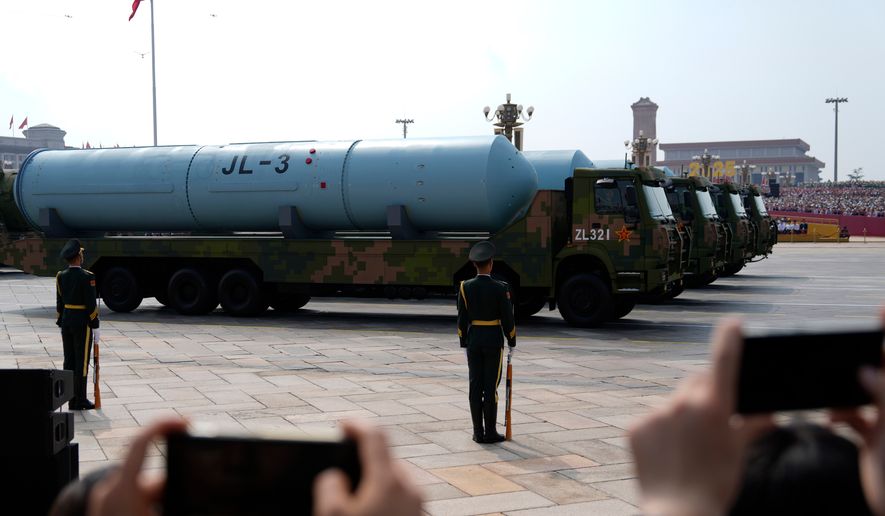
China’s test of what is believed to be a nuclear-capable JL-2 or JL-3 missile from a submarine was carried out after what U.S. officials said was a few hours of warning time and without providing details on the planned launch or flight path.
The statement said failure to provide adequate notification of missile tests increases the danger of miscalculation, undermines global stability and security, and is “incompatible with the responsibilities that come with possessing long-range missile capabilities.”
The statement called on “relevant countries” to follow internationally accepted protocols for long-range missile and space launch vehicles.
A group of 145 nations takes part in the Hague Code of Conduct Against Ballistic Missile Proliferation. The voluntary code calls for all countries conducting long-range missile tests to announce a prelaunch time window, the type of missile to be fired and the location and direction of its flight.
The statement said all nations, notably nuclear weapons powers, should provide a minimum of 24 hours’ advance notice of missile tests and space launches. Prelaunch notification should include the generic class of missile or launcher, planned launch time window, launch location area and direction.
“Countries should also provide clear notices for airmen and mariners consistent with international standards to reduce risk, including in expected impact or landing areas,” the statement said.
China’s Foreign Ministry denounced the 41-nation rebuke.
“The so-called joint statement by the U.S. and relevant countries at the Conference on Disarmament, which brandished the Hague Code of Conduct Against Ballistic Missile Proliferation and alluded to China’s missile test launch, was driven solely by political motives and fully reveals their hypocrisy and double standards,” Foreign Ministry spokesman Guo Jiakun said.
The spokesman urged relevant countries to stop abusing the international arms control measure and replace “irrational confrontation” with dialogue.
The ministry official’s comment follows statements by Li Chijiang, China’s ambassador for disarmament affairs, rejecting the joint statement during a meeting of the United Nations in Geneva on Tuesday.
Mr. Li said China’s defense modernization should not be called into question and its “goodwill” of providing the short advance notification of the missile launch “should not be hijacked by geopolitical calculations,” according to state media.
China is not a party to the Hague code and, as a result, is not bound by its terms.
China’s Defense Ministry announced in July that it had notified relevant countries in advance of the SLBM test.
Reports from Japan at the time said the Tokyo government immediately appealed to the Chinese government not to allow the missile to fly over Japanese territory.
China has not revealed details of the test that U.S. officials say was carried out from waters near the southern coast and traveled an estimated 4,000 miles into the Pacific and passed close to the U.S. island of Guam.
The Chinese Communist Party-affiliated Global Times criticized the joint statement as a U.S. effort to rally 40 other nations to pressure China, asserting “the U.S. has once again exposed its familiar playbook of double standards, bloc-building and confrontation.”
The State Department called the test “irresponsible.”
“Launching nuclear-capable missiles without participating in a regularized mechanism for advance notification is irresponsible,” a State Department official said days after the SLBM test.
“China’s notification to the United States came only a few hours before the launch and failed to provide sufficient detail, falling considerably short of standards adopted by all other P5 nuclear weapon states,” the official said, referring to the five U.N. Security Council permanent member nations: the United States, France, Russia, Britain and China, all nuclear powers.
The test was criticized or condemned by several states in the region, including Japan, Taiwan, Australia, New Zealand and South Korea.
Those states, not including Taiwan, signed the joint statement along with Albania, Belgium, Bulgaria, Canada, Croatia, Czechia, Denmark, Estonia, Finland, France, Germany, Greece, Hungary, Iceland, Italy, Latvia, Lithuania, Luxembourg, the Marshall Islands, Montenegro, the Netherlands, North Macedonia, Norway, Palau, Philippines, Poland, Portugal, South Korea, Moldova, Romania, Slovakia, Spain, Sweden, Turkey, Ukraine and Britain.
Contact the author


Please read our comment policy before commenting.