


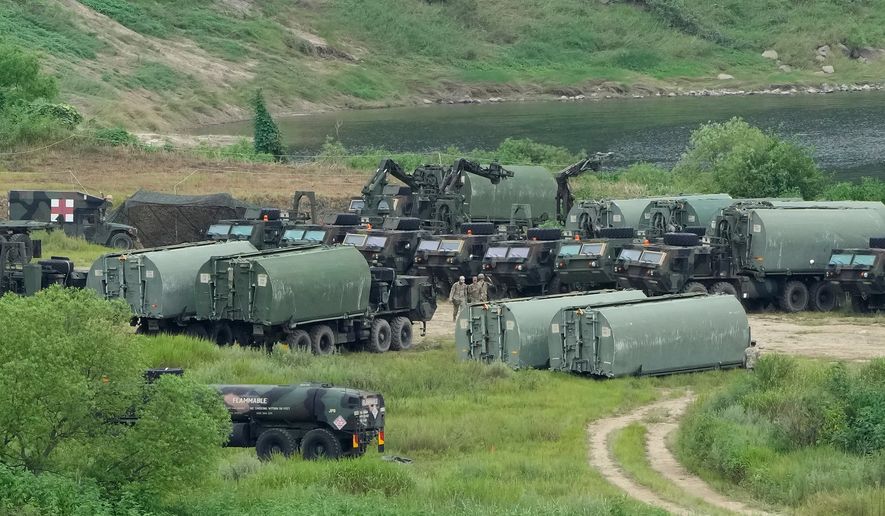

SEOUL, South Korea | South Korea on Monday expressed hopes for resumption of diplomacy between the U.S. and North Korea to ease animosities on the Korean Peninsula, as U.S. President Trump’s order to cut military exercises with South Korea caused concerns it might hurt the allies’ readiness against North Korean threats.
Mr. Trump cited his good relationship with North Korean leader Kim Jong-un for the decision, a likely bid to reengage with Mr. Kim, who views U.S.-South Korean military exercises as invasion rehearsals. But experts say the North Korean leader, now emboldened by his advancing nuclear arsenal and expanding military cooperation with Russia, won’t likely return to talks unless he is assured of serious U.S. concessions.
The 11-day, summertime Ulchi Freedom Shield exercises began Monday morning as scheduled and it wasn’t known which parts of the training were being downsized. Mr. Trump’s announcement baffled many in South Korea, a key U.S. ally in Asia where national security is a top priority due to threats from nuclear-armed North Korea.
People were interested in these podcasts
Mr. Trump said in a social media post that the exercises are not only costly but “send a signal that is totally inappropriate and hostile” to North Korea, which he said “has been unthreatening and respectful” during his time in the White House.
Mr. Trump instructed Defense Secretary Pete Hegseth to “substantially reduce” the exercises. He added that he recently asked President Lee Jae Myung if South Korea would join the U.S. in the “denuclearization” of Iran, “and they said, ‘No thanks!’”
Mr. Trump’s move is the latest example of the American president appearing to turn against an ally in favor of a leader cast by previous administrations as an adversary. Mr. Trump and others in his administration also have railed against NATO allies over a perceived lack of support for his war against Iran, even as they seek to confront an increasingly aggressive Russia in the Baltic region.
The trust many South Koreans have in the U.S. has eroded following a tariff war instigated by Mr. Trump’s administration and his transactional approach to security.
The office of South Korea’s president said later Monday that the government hopes “friendly relationship” between Mr. Trump and Mr. Kim would lead to “meaningful dialogue” between the U.S. and North Korea and start discussions on promoting peace and stability on the Korean Peninsula. It said that South Korea will make necessary diplomatic efforts for that.
South Korea and the U.S. are closely discussing practical and military contributions that can be made to restore freedom of navigation in the Strait of Hormuz, according to South Korea’s presidential office.
Mr. Lee is a liberal who espouses improved ties with North Korea. Since taking office last year, his government has taken proactive steps to improve ties with North Korea, including turning off front line loudspeakers that blared K-pop music and world news. On Saturday, Mr. Lee offered to hold talks to formally end the 1950-53 Korean War, which ended with an armistice, not a peace treaty.
The conservative People Power Party, the main opposition party, lambasted Mr. Lee for allegedly “turning a blind eye on the public’s security concerns” caused by Mr. Trump’s announcement and prioritizing hopes for U.S.-North Korea diplomacy.
North Korea has shunned any talks with South Korea and the U.S. and accelerated weapons testing activities since Mr. Kim’s high-stakes nuclear diplomacy with Mr. Trump broke down in 2019. Mr. Kim also has bolstered his diplomatic credentials by aligning with Russia over its war against Ukraine and taking steps to deepen cooperation with China.
In September 2025, Mr. Kim suggested he could resume talks with the American president if the U.S. drops “its delusional obsession with denuclearization” of North Korea. Experts say Mr. Kim likely aims to use his enlarged nuclear arsenal to win major concessions like extensive sanctions relief.
This is not the first time Mr. Trump has sought to suspend the drills. After his first summit with Kim in 2018, Trump unilaterally announced the suspension of the U.S.-South Korean summertime exercises, calling them “very provocative” and “tremendously expensive.”
Kim Dong-yub, a professor at the University of North Korean Studies in Seoul, said North Korea feels less urgency to return to talks with the U.S. and South Korea now than when it entered talks with its rivals in 2018, but is unlikely to completely ignore Mr. Trump’s overture.
He predicted North Korea will likely say it has noted Mr. Trump’s post but will wait for further action showing the U.S. intends to drop hostilities against North Korea.

Please read our comment policy before commenting.