


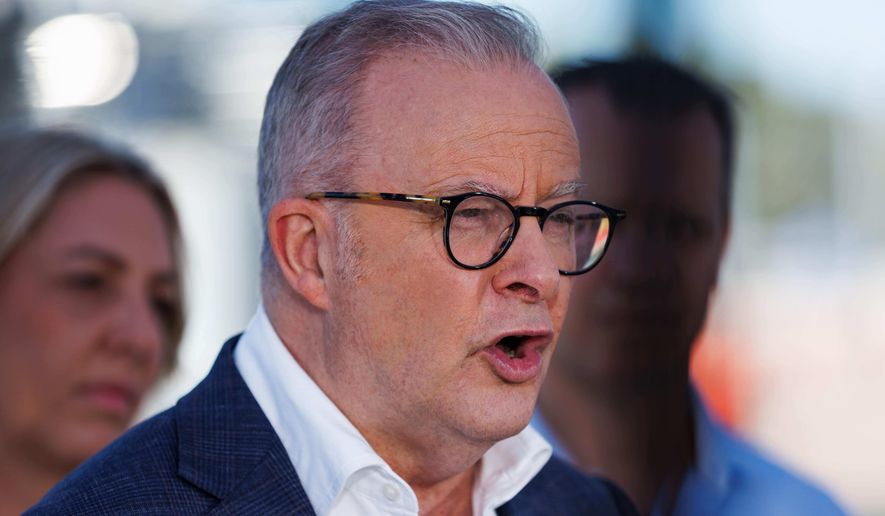

Australian Prime Minister Anthony Albanese criticized several states over the weekend for declining to join his government’s national gun buyback program, arguing that inconsistent state licensing systems were undermining the effort to get firearms off the streets.
“I think it is somewhat farcical that some states were still … having paper licences that therefore couldn’t be traced,” Mr. Albanese said Sunday, according to the Australian Broadcasting Corporation, after New South Wales became the first state to formally launch its portion of the buyback.
New South Wales’ scheme, developed jointly with the Commonwealth government, is set to begin Nov. 2 and will target roughly 274,000 firearms — about a quarter of the state’s registered guns — held by an estimated 50,000 license holders, according to a joint statement from Mr. Albanese’s office. Owners will receive between $450 and $1,000 per surrendered firearm in the program’s first phase, with payouts capped at $10,000 for higher-value weapons once a second phase begins in early 2027. Compensation payments and program administration costs will be split evenly between the state and federal governments; the Commonwealth will separately cover the full cost of destroying the surrendered firearms.
People were interested in these podcasts
“We must do everything we can to make sure the antisemitic terrorist attack in Bondi doesn’t happen again,” Mr. Albanese said in the statement. That includes, he said, “meaningful nationwide gun reform.”
New South Wales remains the only jurisdiction to sign on. South Australia’s treasurer, Tom Koutsantonis, said the state won’t contribute funding to a model that relies on state co-financing rather than full Commonwealth funding, as was the case with the 1996 Port Arthur buyback. Queensland, Tasmania and the Northern Territory have also declined to participate, and Western Australia — which completed its own two-year buyback in January — has said it has no plans for a second scheme tied to the Bondi attack. Victoria’s position remains unsettled: former Premier Jacinta Allan had balked at joining before resigning, and her successor, Ben Carroll, said Sunday he would wait for police advice before deciding, with the state’s Nov. 28 election adding pressure. The Australian Capital Territory had signaled support in principle as of mid-August, though funding talks were still underway.
Rep. Kevin Hogan, deputy leader of opposition business in the House of Representatives and a National Party member, blasted the plan in a post on X Sunday, saying, “NSW is the only state signed up, it’s a joke.”
Mr. Hogan claimed in the same post that the program would cost taxpayers roughly $500 million in its first year — money he said could instead fund cost-of-living relief — and separately argued gun dealers and law-abiding owners were being penalized for the actions of terrorists while government aid for affected businesses fell short.
The buyback stems from the Dec. 14, 2025, terrorist attack at a Hanukkah celebration on Bondi Beach, in which a father and son opened fire on the crowd, killing 15 people and wounding roughly 40 others before the father was shot dead by police and the son was wounded and arrested. The father, Sajid Akram, was an Indian national from Hyderabad and an Australian permanent resident; his son, Naveed, was born in Australia. Islamic State claimed responsibility for the attack.
The program is Australia’s largest firearms buyback since the one enacted after the 1996 Port Arthur massacre in Tasmania, which killed 35 people and wounded 23 others and led to a nationwide ban on certain semi-automatic and pump-action firearms.
This article was constructed with the assistance of artificial intelligence and published by a member of The Washington Times' AI News Desk team. The contents of this report are based solely on The Washington Times' original reporting, wire services, and/or other sources cited within the report. For more information, please read our AI policy or contact Steve Fink, Director of Artificial Intelligence, at sfink@washingtontimes.com
The Washington Times AI Ethics Newsroom Committee can be reached at aispotlight@washingtontimes.com.

Please read our comment policy before commenting.