


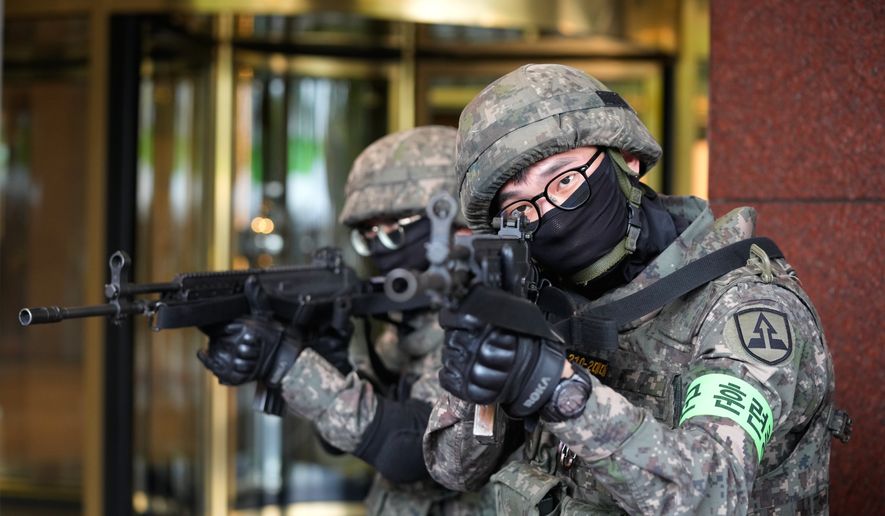

SEOUL, South Korea — The U.S. Marine Corps called off biennial drills with South Korea on Monday, one week after President Trump unexpectedly ordered the downscaling of separate Ulchi Freedom Shield drills last week.
While Ulchi Freedom Shield 2026 saw its duration cut in half hours before its commencement last Monday, due to Mr. Trump’s apparent desire to reopen communications with North Korea, the U.S. Marine Corps cited force constraints due to Middle Eastern deployments, according to a Korean military briefing this Monday.
The cut to the drills represents just the latest impact the Middle Eastern conflict has had on U.S. forces in the Indo-Pacific.
People were interested in these podcasts
Middle East or Indo-Pacific?
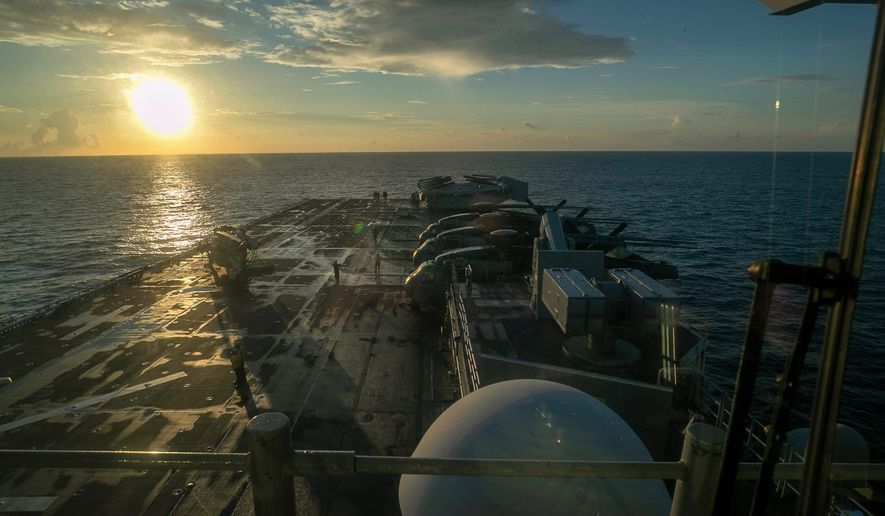
The Ssangyong (“Double Dragon”) drills are large-scale amphibious drills held on South Korea’s eastern seaboard.
U.S. Marines, South Korean Marines, naval and air assets and sometimes specialist contingents from foreign forces, such as Britain’s Royal Marines, deploy.
The drills were halted due to diplomatic outreach to North Korea from 2019 to 2022, but they returned on their largest scale ever in 2023 and then again in 2024.
The cuts to this year’s drills irk some South Koreans.
“Military training is not a show; it’s directly related to readiness,” said Chun In-bum, a retired South Korean general. “This can’t go on continuously; it will degrade readiness.”
However, America remains deeply engaged in the Iran conflict, which started in February with expectations of just weeks of action.
Despite losing its senior leadership, massive amounts of military assets and huge economic opportunity costs, Tehran has proven both its resilience and its continued ability to hinder transits through the Strait of Hormuz.
Some say the Iranian leadership wants the unpopular conflict to continue through to the U.S. midterm elections in November to damage Mr. Trump’s Republican Party’s chances.
It is certainly dragging U.S. forces away from positions farther east.
In March, some 2,000 U.S. Marines of the 31st Marine Expeditionary Unit based in Okinawa, Japan, along with the amphibious assault ship USS Tripoli, were sent to the Middle East.
In the same month, South Korea-deployed Terminal High Altitude Air Defense interceptors, which shoot down ballistic missiles, were also sent to the operational theater.
In addition, two carrier strike groups — centered around the USS George Washington and the USS Abraham Lincoln — were rerouted from East Asian stations to the Middle East in August and January, respectively.
According to the U.S. Naval Institute’s Fleet Tracker, updated on Aug. 17, the USS Tripoli had returned to Japan, while the USS George Washington was in the western zone of the Indo-Pacific, in the Indian Ocean.
The nuclear-powered aircraft carrier is now reportedly in the Arabian Sea, having transitioned from Pacific Command to Central Command.
The redeployments, and the reported write-down of U.S. stand-off weapons and air-defense systems, are raising questions about the ability of U.S. forces to fight two conflicts in two geographies simultaneously.
While the Middle East is home to one U.S. strategic competitor — Iran, as well as multiple terrorist groups — East Asia is where China and North Korea, as well as considerable portions of Russian strength, are massed.
The Middle East is important for global fossil fuel supply. However, East Asia — home to manufacturing powerhouses China, Japan, South Korea and Taiwan — is central to the global supply chain in such high-value added sectors as autos, computer chips, electronic goods, ships and telecommunications equipment.
Still, the region is not nearly as destabilized as the Middle East.
Despite an ongoing civil war in Myanmar, Chinese hybrid offensives against the Philippines in the South China Sea and Chinese threats to Taiwan, the Indo-Pacific remains currently peaceful.
Even so — given the importance of U.S. allies in the region and its massive economic importance — some U.S. figures say American commitment to the region needs to be stronger.
“I think we want to pivot to the Pacific, but the sucking sound of the Middle East is dragging us down,” retired U.S. Lt. Gen. Michael Flynn, who briefly served as Mr. Trump’s national security adviser in his first term, told The Washington Times in July.
Contact the author


Please read our comment policy before commenting.