


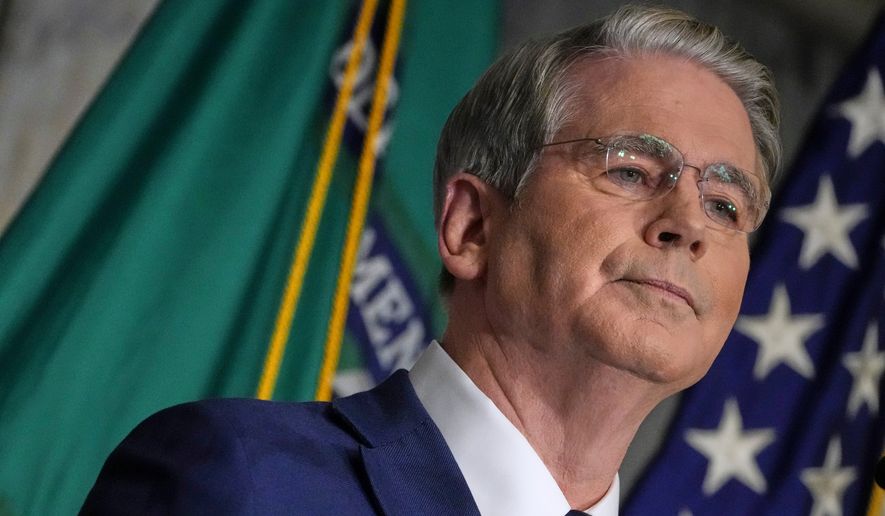

Treasury Secretary Scott Bessent announced secondary sanctions Monday targeting businesses that maintain relationships with Iran as the Trump administration ramps up its efforts to economically isolate the Islamic regime.
The new sanctions are intended to force businesses and countries to sever their remaining economic ties to Tehran and facilitate a faster collapse of the Iranian economy. The goal is ambitious, given Iran’s proven ability to withstand financial pressure from Western nations.
Speaking at a news conference, Mr. Bessent said the U.S. military operation had created the conditions for the administration to wage economic pressure against Iran. He insisted that the sanctions would further isolate Tehran from the world economy.
People were interested in these podcasts
“Our objective is to sever every economic lifeline that sustains this tyrannical regime until Tehran stands alone,” he said. “Iran now faces a very clear choice with only two paths before them: complete global isolation and a subsistence economy, or a path back to normalcy with an opportunity to rejoin the global economy.”
The new sanctions, dubbed Operation Economic Outcast, specifically target Iran’s ability to exploit digital assets, technology, gold, aviation and shipping, Mr. Bessent said. The determinations build on earlier Treasury actions targeting Iran’s financial, petroleum and petrochemical sectors.
Treasury’s Office of Foreign Assets Control is also sanctioning more than 60 individuals, entities and vessels for assisting Iran in obtaining nuclear material, conducting cyber operations and generating oil revenue, Mr. Bessent said.
The Trump administration also suspended licenses previously authorized by the Treasury, thereby restricting remittance payments to Iran and Iranian participation in U.S. cultural and academic exchanges. It also warned shipping companies that they could face sanctions if they complied with Iranian demands in the Strait of Hormuz.
Iranian officials have repeatedly threatened to charge tolls on commercial vessels in the strait under the guise of “service fees.”
Mr. Bessent said President Trump was calling world leaders to insist that they work to sever all financial ties with Iran or risk facing severe consequences. When pressed, Mr. Bessent declined to clarify which leaders Mr. Trump was calling.
However, he indicated that the United Arab Emirates, which publicly suspended its trade relationship with Iran last week, was a positive sign.
“The president is making phone calls to world leaders with specific requests to cease their interactions with the regime,” he said. “We are already seeing results. Over the weekend, comments from Iranian leadership clearly acknowledged the effect of this campaign.”
Mr. Bessent also indicated that an unidentified financial institution would face sanctions “by the end of this week.”
Mr. Trump announced last week that a sweeping new economic campaign — which he termed an “economic D-Day” — was coming, and Mr. Bessent separately expanded on that framing in a Sunday op-ed in the Financial Times, previewing a new round of sanctions intended to move the pressure campaign into its next and most intense stage.
The sanctions add to an already suffocating set of tactics, including a comprehensive naval blockade of Iran’s ports, which aims to eliminate Tehran’s ability to export its oil.
Iran for decades has avoided a total economic collapse through a sophisticated network of land and sea smuggling routes that has enabled it to remain a global player in international energy markets and to coordinate with its small collection of allies.
It was unclear whether the new sanctions, and indeed the transition from military operations to economic pressure, would force the Iranian regime to fold. Iranian officials have insisted that Iran’s blockade of the Strait of Hormuz is causing far greater economic pain than the U.S. sanctions and that Washington would be the first to cave.
“We’ve been down the maximum pressure road with Iran many times. What we’ve learned is that President Trump can impose extensive economic pain on Iran, but ordinary Iranians overwhelmingly bear the cost. The ruling elite in Iran remains largely insulated, while Tehran has repeatedly refused to capitulate to Washington’s demands. Trump’s gamble is that this time, amid the destruction of war, and with the reinforcement of a blockade, time is on his side and ultimately Iran will be forced to concede defeat,” Ryan Costello, policy director with the National Iranian American Council, wrote in a statement.
The U.S. and Israel launched a joint war on Iran at the end of February. Mr. Trump insists that Tehran cannot be allowed to obtain a nuclear weapon.
In retaliation, Iran effectively closed the Strait of Hormuz, a narrow but critical waterway connecting the Persian Gulf and the Gulf of Oman, with a combination of small boats, drones and missiles. At least one-fifth of the world’s oil and natural gas moves through the strait each year, and its closure has driven up energy prices globally.
Brent crude oil, the standard international benchmark, stood at about $92 a barrel on Monday afternoon, up from $90 a week earlier.
The U.S. and Iran traded military strikes for weeks after fighting restarted in earnest in July, but Washington shifted to an economic pressure campaign after Mr. Trump called off another round of strikes earlier this month.
Iran has insisted that it will escalate the conflict well before it concedes defeat at the hands of an economic pressure campaign. Regional powers that go along with the Trump administration’s plans to isolate Tehran could face military reprisals from Iran.
Iraq, the UAE, Oman, Turkey and Pakistan all have relatively extensive economic ties to Tehran, mostly through oil imports and the export of manufactured goods.
Also unsaid in Mr. Bessent’s sanctions announcement was how the restrictions would affect U.S. relationships with China, Russia and North Korea, three of Iran’s most important allies.
Notably, several of the individuals and front companies designated Monday are based in Hong Kong and mainland China.
China buys at least 90% of Iran’s crude oil exports, and Russia, although a smaller economic partner than Beijing, provided about $5.8 billion in trade in 2025. Moscow and Tehran have cooperated closely on security for years. The Kremlin reportedly shared tracking data with Iran’s military during the first weeks of the war with the U.S.
Contact the author


Please read our comment policy before commenting.