


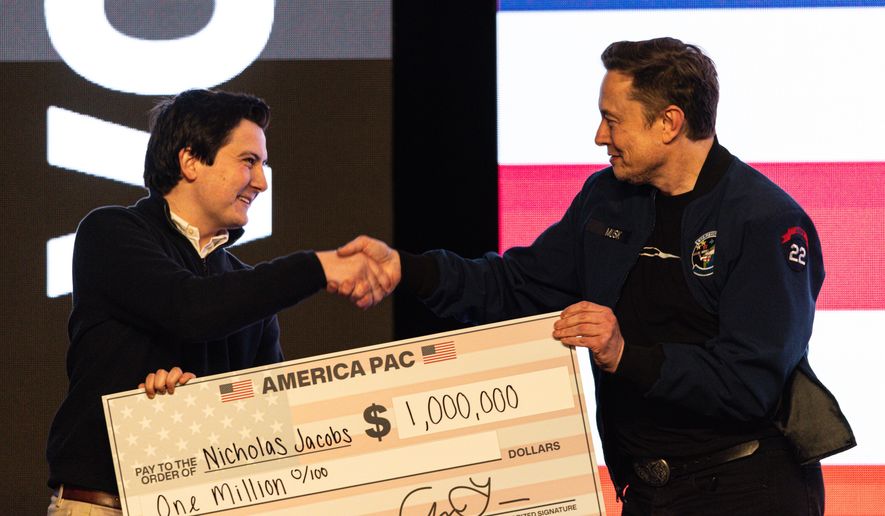

Elon Musk will not face criminal charges for alleged election bribery over promising to dole out $1 million checks to voters during Wisconsin’s Supreme Court election last year, a state prosecutor said Tuesday.
La Crosse County District Attorney Tim Gruenke said in a statement that his office decided against pressing charges because he would not be able to convince a jury that the world’s richest man committed a crime, considering “nothing of value was ever given to anyone for voting.”
At issue are social media posts from 2025, in which Mr. Musk offered to “personally hand over two checks for a million dollars each in appreciation for you taking the time to vote.”
People were interested in these podcasts
Hours later, he wrote on social media, “To clarify a previous post, entrance is limited to those who have signed the petition in opposition to activist judges. I will also hand over checks for a million dollars to 2 people to be spokesmen for the petition.”
He eventually handed out two checks during a campaign rally in Wisconsin.
Mr. Gruenke, a Democrat, concluded that in the end, “nobody was paid anything of value for voting or promising to vote.”
He said that Mr. Musk’s first post could be viewed in one of two ways: “the possibility of winning a lottery at a town hall by voting” or “giving entry to a free town hall.”
“Under either view, the second post apparently recognized that potential violation and corrected it,” Mr. Gruenke wrote.
The money awarded was a “predetermined payment for people selected as ’spokesmen,’ therefore not a reward for voting,” the district attorney said.
Disregarding Mr. Musk’s upper echelon status and the $1 million price tag attached, Mr. Gruenke said, “It is a simple case of a poorly worded statement that was corrected and brought into compliance with the law.”
This comes after the bipartisan Wisconsin Elections Commission voted 5-1 last month that the two posts likely broke the state’s election bribery law.
Later, Wisconsin Attorney General Josh Kaul sued Mr. Musk. After lower and appellate courts declined to block the $1 million check giveaways, the Democrat asked the state’s Supreme Court to step in.
In the Wisconsin Supreme Court election, Republican Brad Schimel lost to the Democratic favorite, Susan Crawford, letting liberals retain a 4-3 majority.
Mr. Schimel was heavily tied to national conservative figures, receiving endorsements from President Trump and massive financial support from Mr. Musk, which Ms. Crawford used to frame him as beholden to outside wealthy influence.
Contact the author


Please read our comment policy before commenting.