



A Glimpse Beyond the Public Halls
As the Smithsonian Institution marks its 180th anniversary, the numbers behind the scenes are staggering: roughly 155 million artifacts, artworks and specimens are held across its museums, galleries and off-site facilities, occupying more than 11 million square feet, primarily in Washington, D.C., Maryland, and New York City. Despite this immense collection, only about one percent is ever on public display at any time. The rest remains hidden, until you step into the labyrinth of back rooms where the nation’s quiet treasures are kept.
Inside the National Museum of American History, the sense of discovery feels endless. One storage cabinet might hold Ray Bolger’s original Scarecrow costume from The Wizard of Oz, while another drawer contains Jerry Seinfeld’s infamous puffy shirt alongside Mister Rogers’ iconic red sweater. Nearby, you can find the now-silent stopwatch that once ticked through every episode of 60 Minutes. The sheer variety surprises even the most seasoned visitor.
People were interested in these podcasts
The People Behind the Hidden Collection

None of this is a result of random hoarding. The Smithsonian’s curators are anything but careless collectors. “Of course, we don’t take everything that people offer us. We’d never be able to store it all,” explained Ryan Lintelman, curator of entertainment, during a rare tour of the storerooms documented by National Geographic. Some artifacts, like Phyllis Diller’s personal joke catalog, were nearly overlooked until a curator’s curiosity intervened. Others, such as a crate labeled “Gremlin. Fragile.” hiding a creature from Gremlins 2, are discovered only after prying open boxes in storage bays beneath relics like Lance Armstrong’s bicycle.
Lintelman and collections manager Hanna Bredenbeck Corp have described the deliberate thought behind every acquisition. Even childhood icons, like Captain Kangaroo’s Mr. Moose and Bunny Rabbit puppets, receive meticulous care, right down to tying Mr. Moose’s mouth shut to prevent deterioration. Sharing shelf space with the likes of the Swedish Chef and Charlie McCarthy, these artifacts aren’t just remnants of television. They’re links to personal history and shared memory.
Glimpses into cabinets and boxes sometimes astound even the curators. From Ella Fitzgerald’s collection of autographed baseballs (she was an avid fan) to a display of thermos bottles sporting images from Dick Tracy to Fireball XL-5, it’s clear not everything can, or should, be displayed at once. Generous offers pour in daily, from vintage toys to old magazines. Most are politely declined, reflecting a careful and selective approach rather than indiscriminate accumulation.
A World Measured by Insects
Beyond pop culture memorabilia, some rooms house scientific marvels. Alma Solis, an entomologist at the National Museum of Natural History, stands among floor after floor packed with cream-colored cabinets. She pulls out a tray and smiles: “This is the world’s largest collection of sloth moths.” Each specimen is pinned, labeled, and cataloged with the precision of an archival database. Despite the whimsical name, sloth moths are so called not for their sluggishness but for their unique relationship with tree-dwelling sloths, in whose fur they live.
The entomology collection, numbering around 35 million specimens, forms a rich database for tracking environmental changes. Beetles alone make up the largest portion. Entomologist Floyd Shockley has noted that the collection reveals “how species distribution is changing with time,” driven not only by climate shifts but also by human-mediated habitat destruction. He points out that while the showy insects, glimmering butterflies or giant beetles, draw the eyes, most biodiversity is hidden in the small brown and black things, like humble ants, which collectively outweigh all vertebrates on earth.
Letting the Public Peek Inside
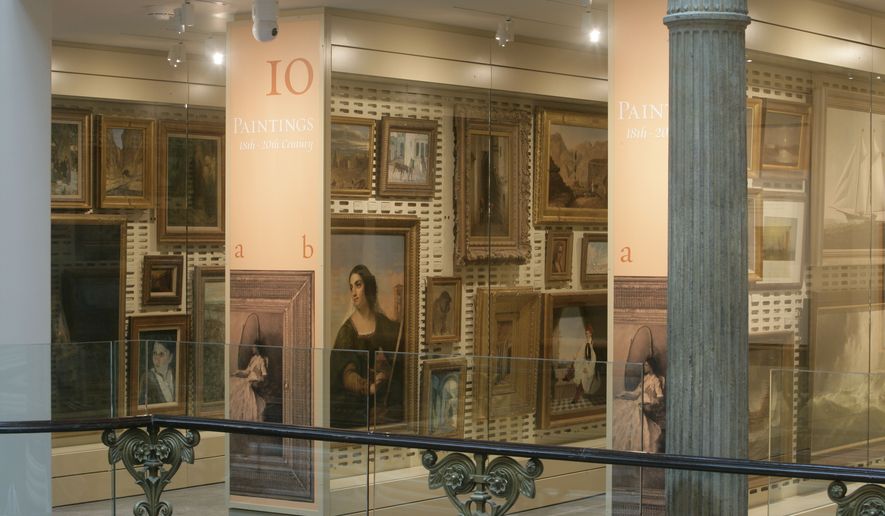
For those who wonder why more isn’t visible, there’s a rare exception. The Smithsonian American Art Museum’s Luce Foundation Center has opened its storage area to the public, filling a grand top-floor gallery with shelved paintings, sculptures, carvings, and folk art. It’s a living archive, a place where organized chaos puts American creativity within arm’s reach, if only you have the time to browse the inventory numbers for context.
Senior curator Eleanor Harvey enjoys these moments of serendipity. She guides visitors through seemingly anonymous racks to discover art deco sculpture models, outsider art works by Howard Finster, or the smaller siblings of monumental statues like “Man Controlling Trade.” Glassed-in storage cases reveal handmade walking sticks and a wall full of Native American portraits, painted mostly by Europeans like George Catlin in the 19th century. Hundreds of Catlin’s works, produced from years of travel across the American West, hang or rest in drawers here, offering researchers invaluable historical insights.
Yet Harvey is candid about the questions these works raise. Many were produced by outsiders viewing non-White subjects as curiosities. “There’s a lot of discussion right now about voyeurism and taking advantage of your subject,” she has said, standing before Joseph Henry Sharp’s painting of a Montana Crow chief’s burial, for which a local woman posed reluctantly. Curators are grappling with the ethics of past displays, hiring Native American consultants to help shape future narrative choices.
The Ongoing Responsibility of Stewardship
Despite the visual feast at the Luce Center, roughly 70 percent of the Smithsonian American Art Museum’s collection remains tucked away. Some argue these hidden treasures ought to be sold or displayed, but Harvey disagrees. “That undercuts everything that a museum is about. We’re here to tell the whole story of American art. And to do that we often can’t rely solely on the works on display.”
The Smithsonian’s unseen rooms aren’t warehouses of forgotten curiosities. They are living, working archives: meticulously organized, carefully curated, and constantly evaluated. What remains hidden is not lost, but protected for the day when its story is ready to be told, or when a question arises that only it can answer.
This article was constructed with the assistance of artificial intelligence and published by a member of The Washington Times' AI News Desk team. The contents of this report are based solely on The Washington Times' original reporting, wire services, and/or other sources cited within the report. For more information, please read our AI policy or contact Steve Fink, Director of Artificial Intelligence, at sfink@washingtontimes.com
The Washington Times AI Ethics Newsroom Committee can be reached at aispotlight@washingtontimes.com.

Please read our comment policy before commenting.