



OPINION:
Suppose China were to reach Mars with a manned mission before the United States.
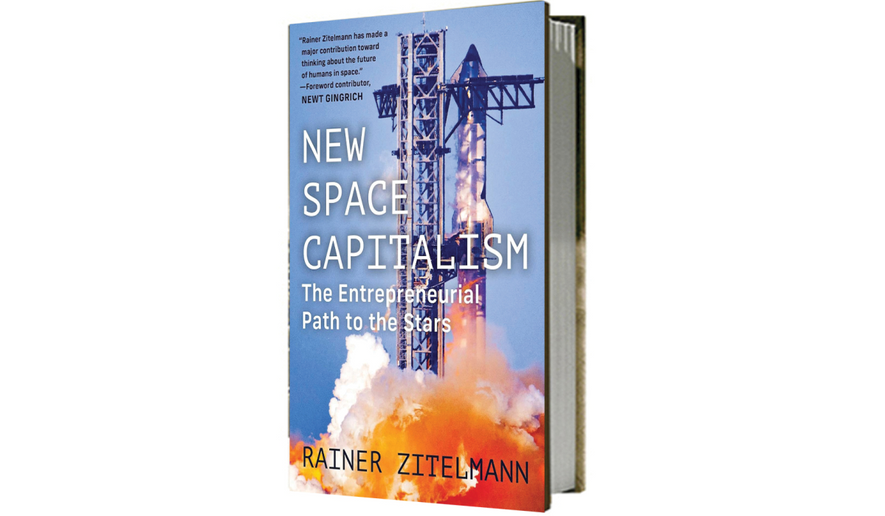
That scenario is ugly and one that Rainer Zitelmann — historian, sociologist, author — dangles before readers toward the end of his latest book, “New Space Capitalism: The Entrepreneurial Path to the Stars.”
Mr. Zitelmann fears that China could declare the entire planet its own if it were to get boots on the ground. Or, at the very least, declare large plots of Martian territory its own.
People were interested in these podcasts
However, Mr. Zitelmann is also quick to acknowledge that the outcome of the current space race is far from certain and that, for the moment, the U.S. probably has a lead, thanks in part to SpaceX, the rocket and spaceflight company founded by billionaire businessman Elon Musk in 2002.
That is where the good news ends.
Unfortunately, as Mr. Zitelmann argues, an opportunity may have been missed in the late 1980s or early 1990s to revisit existing outer space treaties when socialism was on the wane and private property rights were gaining traction in countries such as China and Russia.
At that time, there was a widespread belief in the superiority of a society based on private property and free enterprise over socialist ideologies. Now, Mr. Zitelmann doubts that any consensus could be reached on a new treaty because the geopolitical landscape has shifted.
Xi Jinping’s China is no longer Deng Xiaoping’s China, and Vladimir Putin’s Russia is no longer Mikhail Gorbachev’s version of “glasnost.” In 2020, the head of the Russian space agency made clear: “We will not, in any case, accept any attempts to privatize the moon. It is illegal; it runs counter to international law.”
So there. Diplomatic niceties are out, and Americans had better get where they are going in space first — and had better not rely on the government.
According to Mr. Zitelmann’s recently released book, space capitalism is the only way humanity can colonize Mars and mine asteroids. Unless it becomes possible to own, buy and sell land on other celestial bodies, Mr. Zitelmann says, humanity can never truly become a multiplanetary species.
What is needed is the right set of economic conditions.
“New Space Capitalism” makes a compelling case that it is high time to move past anachronistic international agreements that could complicate future exploration. We must, Mr. Zitelmann writes, instead double down on financial incentives that will attract innovative companies and individuals.
The new space race is on in full force, and the competition between the U.S. and China is fierce. NASA plans to land astronauts on the moon again in 2028 as part of the ongoing Artemis missions. China is expected to follow up shortly thereafter.
The next steps would involve permanently manned bases on the moon. Then on to Mars.
Still, there are hurdles. Mr. Zitelmann devotes an entire chapter to the problems and opportunities associated with colonizing Mars. He touches on the vast logistical challenges, including long voyages, cosmic radiation and extreme surface conditions.
However, as he observes, there are also opportunities and resources, such as liquid water and elements in Martian soil, that can support plant growth. Controlled greenhouse environments and regulated temperatures would be needed, but they are feasible.
Still, the right incentives are required to set all this in motion.
Mr. Zitelmann asks: “What would possibly motivate people and companies to develop and settle on Mars if they cannot acquire private property or are forced to hand over a portion of their profits from its cultivation and development?”
The question becomes, “Who will embrace space capitalism?”
“Today, if I were to place a bet on which spaceship will be the first to take humans to Mars, I would bet on Starship,” Mr. Zitelmann writes. That is because its design is revolutionary, breaking down the barriers between aerospace and shipbuilding, according to space program analysts cited in the book. Starship is big, versatile and cost-effective.
The big breakthrough came in 2017, when SpaceX began to relaunch previously used Falcon 9 rockets for the first time. As of this month, SpaceX’s most-flown Falcon 9 booster (B1067) has completed a record 37 missions.
“If SpaceX were a country,” Mr. Zitelmann writes, it would rank first, followed by China, with 66 successful launches. Without the company, the U.S. would rank fourth, after Russia, China and New Zealand.
Apparently, the U.S. is ahead in the race to get back to the moon and then Mars, but purely because of private enterprise.
The release of the book is perfectly timed. Mr. Zitelmann wants Americans to understand that America’s lead is tenuous and dependent on future U.S. leadership.
• Kevin Mooney is an investigative reporter with Restoration News and The Daily Signal.
• • •
New Space Capitalism: The Entrepreneurial Path to the Stars
Rainer Zitelmann
Skyhorse, $32.99 304 pages

Please read our comment policy before commenting.