


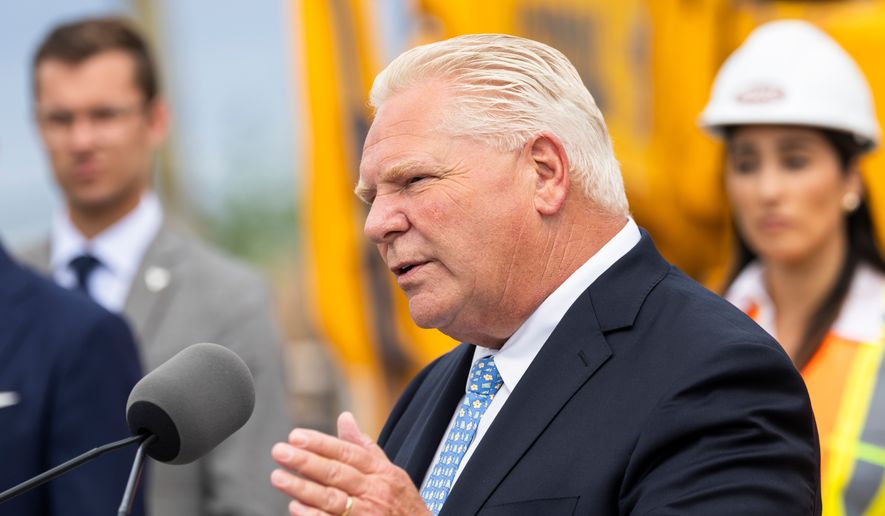

Ontario Premier Doug Ford said Wednesday he’s willing to cut off electricity exports to the U.S. if the trade war between Canadian Prime Minister Mark Carney and President Trump escalates.
Mr. Ford said it would have to be a nationwide approach that involves all of Canada’s provinces.
“I’m not the only province that ships electricity down to the U.S. We need a Team Canada approach,” he said during a visit to Vaughan, 25 miles north of Toronto.
People were interested in these podcasts
If Mr. Trump “keeps coming after us, all options are on the table, in my opinion. But I can’t do it alone,” Mr. Ford said. “We all have to be on the same page.”
Canada, led by Ontario and other provinces such as Quebec, Manitoba and British Columbia, sends millions of megawatt-hours to the U.S., mainly border states, each year. It’s a smidgen of overall American electricity supplies, though important for balancing the electricity grid.
Using electricity as leverage would be a mixed bag, since provinces enjoy revenue from power exports, and Canada receives some electricity from the U.S. side. But it’s a live wild card in the trade war that erupted over the weekend and shows no sign of abating.
Electricity exports to the U.S. totaled $3.3 billion in 2025, while electricity imports from the U.S. totaled $1.4 billion, according to the Canadian government.
Canada on Tuesday unveiled a package of “dollar for dollar” retaliatory tariffs on U.S. products after Mr. Trump imposed 50% tariffs on roughly $20 billion in Canadian goods over the weekend.
Mr. Trump said the tariffs are a necessary response to trade treatment he considers discriminatory.
“They are one of the worst countries in the world to deal with,” Mr. Trump told radio host Glenn Beck on Wednesday. “They have taken advantage of the United States for many decades.”
He added, “I just said, ‘We’re taking them on. We’re gonna stop it.’”
Mr. Ford, another blunt-talking politician who leads Canada’s most populous province, said Mr. Carney made the right choice in walking away from the U.S. talks.
“Try to make a deal with Howard Lutnick and President Trump,” Mr. Ford said, referring to the U.S. commerce secretary. “They kept moving the goalposts on the prime minister, and he did the right thing, and he has overwhelming support across the country.”
Mr. Ford proposed a series of steps to help Canada deal with Mr. Trump’s tariffs.
He said Ottawa should direct any revenue from counter-tariffs on U.S. goods to the sectors affected by Mr. Trump’s levies. Mr. Ford also wants to waive greenhouse-gas emission standards for Canadian-made vehicles.
Trade tensions between the U.S. and Canada have heightened since the start of Mr. Trump’s second term.
The president said Canada taps into the rich American market without buying many American products in return, resulting in a trade deficit that can reach $60 billion.
“They take advantage of us as though they were a state, and they’re not a state,” Mr. Trump said. “The farmers can’t sell anything in there because the tariffs are so enormous, and yet they want to sell to us without any tariffs.”
Mr. Carney offered an oblique critique of Mr. Trump on Wednesday by reposting an excerpt from a January speech in which the prime minister encouraged middle powers to band together and stop pretending the powerful will abide by the “old order” of economic relations.
The speech went viral and grated on Mr. Trump, since it seemed like a direct swipe at the U.S. approach.
“The powerful have their power. We have something, too — the capacity to stop pretending, to name reality, to build our strength at home and to act together,” Mr. Carney told the World Economic Forum in Davos, Switzerland. “That is Canada’s path, and it is a path wide open to any country willing to take it with us.”
Contact the author


Please read our comment policy before commenting.