


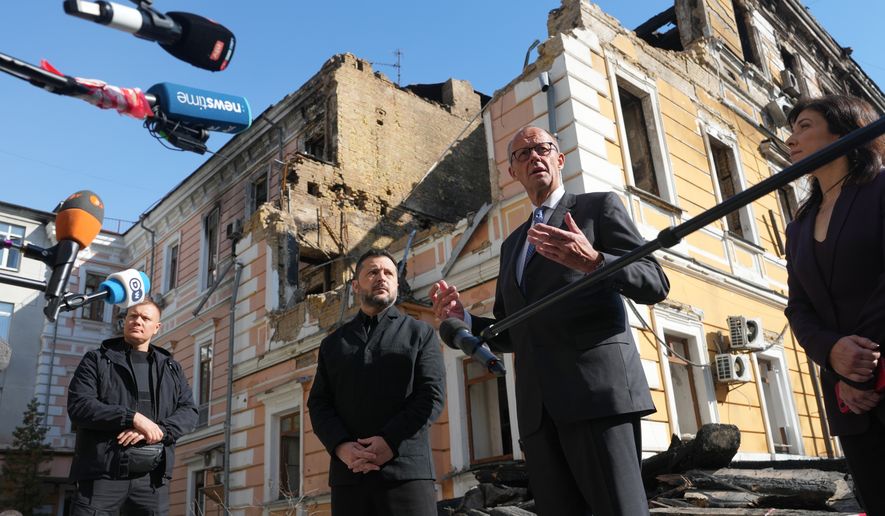

German intelligence officials warned of a widening conflict in Europe with Russia on Monday after attacks on Kyiv during German Chancellor Friedrich Merz’s visit to the Ukrainian capital on Sunday.
Leadership from German intelligence services told the country’s government on Monday that the Kremlin’s tactics pose a risk that it could be “drawn into a violent conflict with Russia.”
The shift comes as Russia prepares an all-out assault against Ukraine and its economy in an attempt to crush the nation’s population during the depths of winter. Germany is providing $395 million in energy aid ahead of winter for generators, substations and repair work.
People were interested in these podcasts
“The confrontation we face with Russia has taken on a new, more dangerous quality,” Martin Jager, the head of Germany’s Federal Intelligence Service, told his country’s parliament during a Monday address. “No other country currently poses such a direct, comprehensive and concrete threat to Germany.”
The shift by Russia to targeting European countries supporting Ukraine is now moving to include targets that could include potential civilian casualties. The spoiled plot by Russian agents at the Leipzig airport in Germany using a drone strapped with explosives is just one example, Mr. Jager said.
The risk, the spy chief said, is that these threats could lead to full-scale conflict with NATO.
“Germany is at risk of becoming drawn into a violent conflict with Russia,” he said.
A direct attack on a NATO nation could result in the invocation of Article 5, the collective security guarantee that is the alliance’s base principle — an attack on one is an attack on all.
The rule has only been used once before, by the U.S. after the Sept. 11 terrorist attacks, which resulted in involvement by European militaries in the U.S.-led “War on Terror.”
Teija Tiilikainen, the director of the European Centre of Excellence for Countering Hybrid Threats, said in an exclusive interview for Threat Status at The Washington Times that the center is seeing a drastic uptick in more lethal sabotage by Russia.
Operations conducted by Russia’s Federal Security Service — known as the FSB and the modern Russian successor to the Soviet Union’s KGB — can cost much less than traditional warfare. The fairly inexpensive way to sow havoc has, according to analysts, become especially useful as Russia’s economy struggles with the minuscule gains from its full-scale military efforts in Ukraine.
“It is in their strategy that they use tools that are different from our toolset,” Ms. Tiilikainen said. “They are using these covert tools, in the Soviet vocabulary they had the term ‘active measures’… They just went back to their old toolbox but took the new technologies to use.”
The goal of these sabotage plots is more than just destroying materials bound for Ukraine, she said. The older KGB-style approach is “to subvert, undermine, manipulate public opinion, manipulate the information space” and affect the actual resources allies have available to them.
The Russian military intelligence services — colloquially known by its old Soviet name of the “Main Intelligence Directorate” or GRU — is also routinely blamed for these inexpensive bribes for sabotage.
“So this is about the struggle for global leadership and the norms in the global order. There is a lot at stake,” Ms. Tiilikainen said. “They want to change the global balance of power.”
That shift is starting to leach out into more direct affronts by the Kremlin to other countries besides Ukraine, with Kyiv as a central pivot point.
During a visit to the Ukrainian capital city on Sunday by the German chancellor, Mr. Merz experienced an airstrike firsthand. An attack on the city prompted air-raid sirens to ring out as Mr. Merz and a group of German businessmen visited in a show of support, according to local reports.
The German political leader announced a new aid package of $1.5 billion, over $1 billion of which will be military aid, during his visit. The package will include long-range strike weapons, combat drones and other support, Mr. Merz said.
“This is weaponry that will help right now,” Ukrainian President Volodymyr Zelenskyy wrote on X, adding they also discussed the need for air defense, which he called “key” at this time.
Germany is Ukraine’s largest European donor, sending Kyiv more than $48.8 billion since the war began, along with equipment and weapons.
— This article was based in part on wire service reports.
Contact the author


Please read our comment policy before commenting.