



A version of this story appeared in the daily Threat Status newsletter from The Washington Times. Click here to receive Threat Status delivered directly to your inbox each weekday.
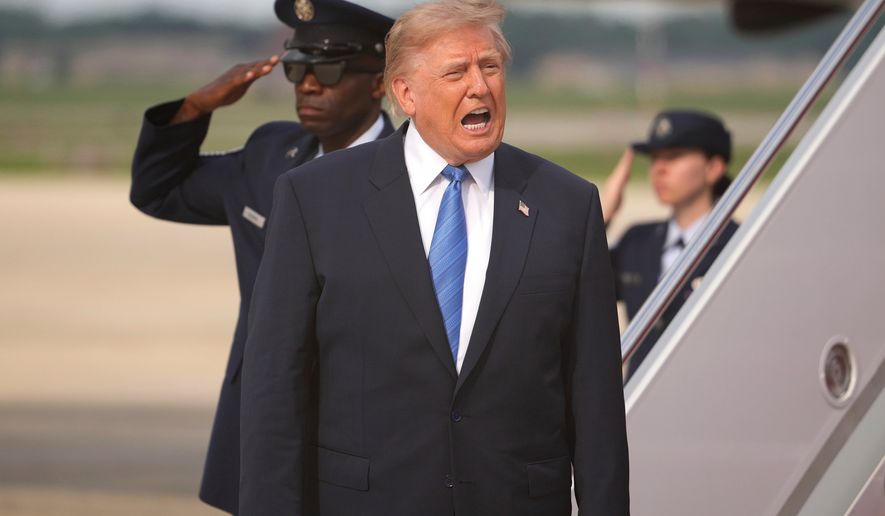
President Trump appeared to dismiss U.S. national security concerns over large-scale Chinese intelligence collection, espionage and cyberattacks in a recent exchange with reporters noting similar U.S. practices.
“Somebody was saying about China, ’What about China? We hear they’re spying.’ We spy on them too. So it goes,” Mr. Trump said Thursday.
He made the comments during a meeting with reporters in announcing the renaming of Lake Ontario to Lake America.
People were interested in these podcasts
The president was asked about reports that Russian President Vladimir Putin will meet with Iranian President Masoud Pezeshkian next week in Kyrgyzstan at a meeting of the China-led Shanghai Cooperation Organization.
A reporter asked Mr. Trump if there is concern in the Trump administration that Russia and other nations are not taking the U.S. economic pressure campaign against Iran seriously and whether he would punish Mr. Putin or Russia if the support continues.
“Well, it depends,” Mr. Trump said. “It depends. So far, I think Russia has behaved quite well having to do with the Strait of Hormuz. And you have to understand, for everything they do, we do also.”
He then made the comment about Chinese spying being similar to U.S. activities.
The president was also asked why his administration has not imposed tough sanctions on China as part of the new Iran financial pressure campaign, which critics say provides a loophole for Tehran to obtain financial support.
In response to a reporter’s question asking why not sanction Chinese banks, Mr. Trump said: “Well, who said I’m not? You said why not? I mean, who said I’m not? You don’t know if I’m doing it? Well, I don’t have to announce everything, do I?”
He made his comments a day after the Justice Department announced the dismantling of a major Chinese hacking operation and just weeks before Mr. Trump is set to host Chinese President Xi Jinping in Washington.
The Justice Department said Wednesday that the FBI had seized computer domains involving state-sponsored Chinese hacking platforms that were used to target critical U.S. infrastructure and other sensitive networks.
“State-sponsored malicious hackers preying on America’s critical infrastructure will be stopped and prosecuted,” said Attorney General Todd Blanche. “We are here to ensure security for the American people and will use every tool we have to keep that promise.”
FBI Director Kash Patel said of the hacking shutdown: “Today’s action is just the latest technical operation against PRC-sponsored hacking — and in support of President Trump’s Cyber Strategy for America, the FBI is surging efforts to shape adversary behavior and defend the homeland in cyberspace,” he said, referring to the People’s Republic of China.
Aggressive Chinese technology theft and espionage remain a major target of several U.S. national security agencies despite efforts to warm bilateral relations following Mr. Trump’s visit to Beijing in May.
The FBI website carries a page called “The China Threat” that states confronting the threat is the bureau’s top counterintelligence priority.
“The counterintelligence and economic espionage efforts emanating from the government of China and the Chinese Communist Party are a grave threat to the economic well-being and democratic values of the United States,” the FBI website says.
The Director of National Intelligence annual threat assessment, made public earlier this year, placed China as the most significant strategic threat confronting the U.S. and noted the threat has moved beyond espionage dangers to potential sabotaging of critical infrastructure with prepositioned cyberattacks.
“China is the most active and persistent cyber threat to U.S. government, private-sector and critical infrastructure networks,” the assessment states.
Chinese state-sponsored hacking groups known as Volt Typhoon and Salt Typhoon gained access to U.S. information technology networks and can now bring down the networks based on the covert access.
Jay Clayton, the new director of national intelligence, said in response to questions from the Senate Intelligence Committee that China’s attempts to dominate global food production and supply chains are threatening U.S. farms and food security. Mr. Clayton promised to work with the panel to counter the threat.
CIA Director John Ratcliffe has called China “our greatest geopolitical threat” and not simply a competitor. He has also said the CIA, through Chinese-language videos, has sought to recruit spies inside the Chinese Communist Party.
The Justice Department on a near-weekly basis has announced prosecutions and other legal action against Chinese agents — people working for Chinese intelligence and security services in conducting spying and illicit technology acquisition and through transnational repression — targeting dissidents and CCP opponents in the United States.
Mr. Patel said in his nomination hearing in January 2025 that Chinese spying operations were “running rampant” in the United States. The FBI, as a result, is “laser focused” on countering foreign espionage under a Trump directive, he said.
Last month, Mr. Patel shared a video on social media announcing that the FBI had forced 62 removals of Chinese spies this year, which, he said, “completely shattered Beijing’s deep cover operations.”
“We are arresting people nearly every week on espionage matters,” Mr. Patel said.
Justice Department press releases between Jan. 1, 2025, and the present show at least 28 cases involving Chinese intelligence and espionage matters, including theft of national defense information, hacking operations, economic espionage, smuggling export-controlled goods and acting as unregistered foreign agents.
Secretary of State Marco Rubio told Fox News that China is seeking to dominate the world at the expense of America, “and we’re not going to allow that to happen.”
Mr. Rubio said he supports Mr. Trump’s bid to manage U.S.-China relations as needed to avoid a conflict but there will be “a lot of areas of friction and competition.”
Contact the author

Please read our comment policy before commenting.