


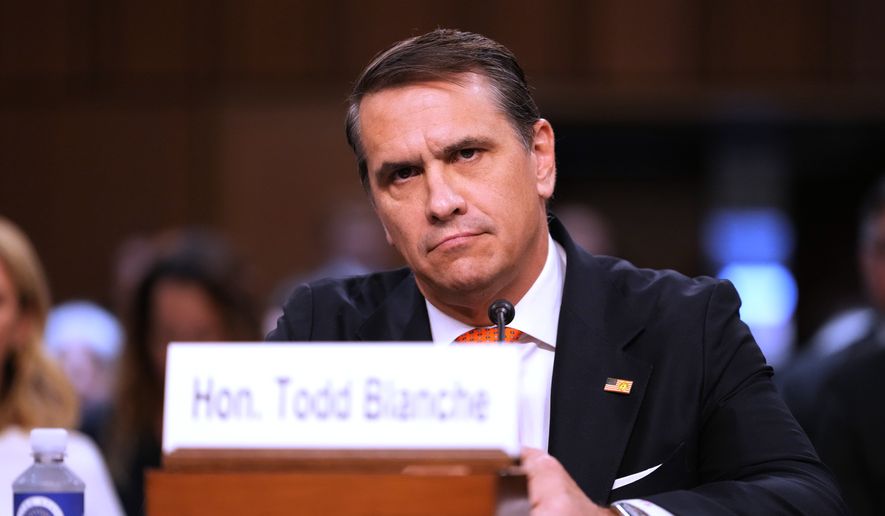

Todd Blanche appears to have enough support to advance through the Senate Judiciary Committee after he reached an agreement to fully revoke President Trump’s anti-weaponization fund and clarify Mr. Trump’s limited immunity from prosecution over past tax malfeasance.
Key Republican senators had been withholding their support from Mr. Blanche, and forced the committee to postpone a vote last week.
Sens. John Cornyn and Thom Tillis feared Mr. Trump could revive the weaponization fund later, and questioned the scope of the immunity Mr. Blanche promised as part of a settlement of the president’s $10 billion lawsuit against the IRS.
On Monday, they issued a statement saying they were satisfied now that Mr. Blanche has put the commitments in writing.
“We want to express our gratitude to Mr. Blanche and his staff for working with us on this, and we look forward to voting to advance his nomination out of the Senate Judiciary Committee soon,” said Mr. Cornyn, from Texas, and Mr. Tillis, from North Carolina.
Mr. Trump voiced his unhappiness with the decision, saying the fund could have helped victims of partisan prosecutions, including some of those charged with rioting at the U.S. Capitol on Jan. 6, 2021.
“These people were treated horribly and [the proposed fund] could have given them some solace,” Mr. Trump told reporters in the Oval Office. “So I view the fund as a positive and a lot of Republicans do too. Not so many Democrats.”
Mr. Blanche, in a memo posted on social media, said his May 18 order establishing the $1.776 billion weaponization fund “is rescinded and shall have no force or effect.”
He said no members were ever appointed and no money paid out, but he said “frivolous” lawsuits persisted, and this latest move is meant to deliver finality to the fund’s demise.
“This order establishes, beyond any doubt, that there is no fund,” he wrote.
And the Justice Department, in another statement, said the grant of immunity that was part of the IRS-Trump settlement only applies to “the named parties in the lawsuit.”
Those parties were Mr. Trump, his two older sons, their Trump Organization firm, and the IRS and Treasury Department. Mr. Blanche had previously clarified that the immunity was only retroactive.
Senators had worried the immunity could have been expanded beyond those contours.
Mr. Trump’s unprecedented lawsuit against the IRS stemmed from the leak of his personal tax information by an IRS contractor during his first term in the White House.
The lawsuit meant a president was suing his own administration, then negotiating a settlement with his own Justice Department.
Mr. Blanche, who has been acting attorney general since the ouster of Pam Bondi, signed off on the weaponization fund and personally issued the immunity order. The fund was supposed to compensate “victims” of an overzealous Biden Justice Department.
The fund was derided by both Democrats and Republicans, and Mr. Blanche quickly said it wouldn’t be made operative. But senators said as long as it was part of the court settlement with Mr. Trump, there were ways it could be revived.
Mr. Trump fueled those fears, defending the fund as recently as Friday, saying people deserved the compensation.
“Perhaps there has never been a group of people treated so badly in our Nation’s history. They are suffering still, many ruined, and I felt that they should be given compensation for what has been done to them,” the president said on social media.
At one point he suggested he would keep Mr. Blanche as acting attorney general until Mr. Cornyn and Mr. Tillis leave office at the end of this year, then revive the nomination. Mr. Tillis is retiring and Mr. Cornyn lost his primary to a Trump-backed opponent.
Mr. Trump also said he would “push hard” to get the weaponization fund written into law.
Mr. Tillis said those kinds of comments were the reason why senators had to have Mr. Blanche take more deliberate steps to destroy any prospect of the fund being revived.
The federal judge overseeing Mr. Trump’s IRS lawsuit has also issued a ruling declaring the settlement nullified. She said the proceeding was a sham, with the president and his own administration colluding on the outcome.
Mr. Trump on Friday filed a notice appealing her ruling.
Democrats said Mr. Blanche’s new memo and order don’t settle the questions surrounding the fund.
Rep. Jamie Raskin of Maryland, the top Democrat on the House Judiciary Committee, called them “laughably flimsy.” Sen. Adam B. Schiff, a California Democrat who sits on the Senate panel, said the Justice Department could revive the fund at any time.
He said the only answer is to write a law firmly squelching the fund.
• Jeff Mordock contributed to this story.
Contact the author


Please read our comment policy before commenting.