


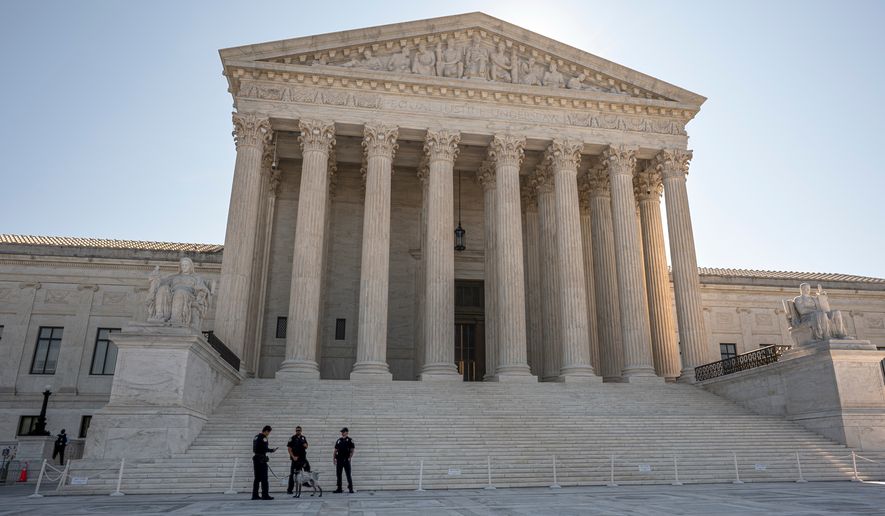

Republican committees are asking the Supreme Court to block a lower court ruling that effectively raised the rates they must pay for campaign ads, in a case that could affect the winners of several key congressional elections.
At issue is whether political parties are entitled to what’s known as the “lowest unit charge,” the low-rate guarantee that applies to broadcast ads purchased by candidates themselves, in the weeks just before an election.
The Federal Communications Commission staff issued a notice in March urging broadcasters to offer the lower rates, but Democratic candidates sued, saying the policy unfairly benefits the better-funded Republican Party committees and went beyond the requirements of campaign law. The 4th U.S. Circuit Court of Appeals last week agreed and blocked the new rules.
People were interested in these podcasts
Democratic campaign committees called the ruling a real boost for them this year and a “major blow” to the GOP.
“Democratic candidates’ strong grassroots fundraising amplifying the voice of everyday Americans remains a fundamental advantage in the midterms, and our stronger candidates and better campaigns will secure us House and Senate majorities in November,” Democrats’ House and Senate campaign committees said.
The National Republican Senatorial Committee and National Republican Congressional Committee now want the justices to step in and clear the way for the lower rates ahead of Friday, which is when they are supposed to kick in.
In their petition to the high court, added to the docket on Monday, the NRSC and NRCC said when campaign committees and candidates act in coordination on ads, they should be treated the same as a candidate acting alone.
They also said the staff-issued notice wasn’t ripe for judicial review. Democrats have an appeal pending before the FCC itself, and the Republicans said the courts should wait for that process to finish before intervening.
The Republicans pointed out that Democrats benefited from the lowest unit charge policy in the past, and just because the finances are different this time shouldn’t affect the legal issues.
“That respondents can’t leverage a statutory benefit as effectively as their opponents does not mean the benefit injures them, much less irreparably injures them,” the Republican committees argued in their petition to the high court.
The 4th Circuit ruling was a 2-1 decision, with two Democratic appointees siding with the Democrats and a GOP pick, Judge J. Harvie Wilkinson III, siding with the Republican committees in dissent.
He said the majority’s ruling “assaults” the First Amendment and the two-party system of government the U.S. uses.
He pointed to the Supreme Court’s ruling earlier this year allowing greater spending coordination as evidence that the Constitution supports the party-candidate relationship and its spending.
“In an odd way, democratic speech needs both the party and the maverick. Political systems that blend and draw upon individual and collective speech are healthier in First Amendment terms than those that prize a single element of speech alone,” Judge Wilkinson said.
Contact the author


Please read our comment policy before commenting.