


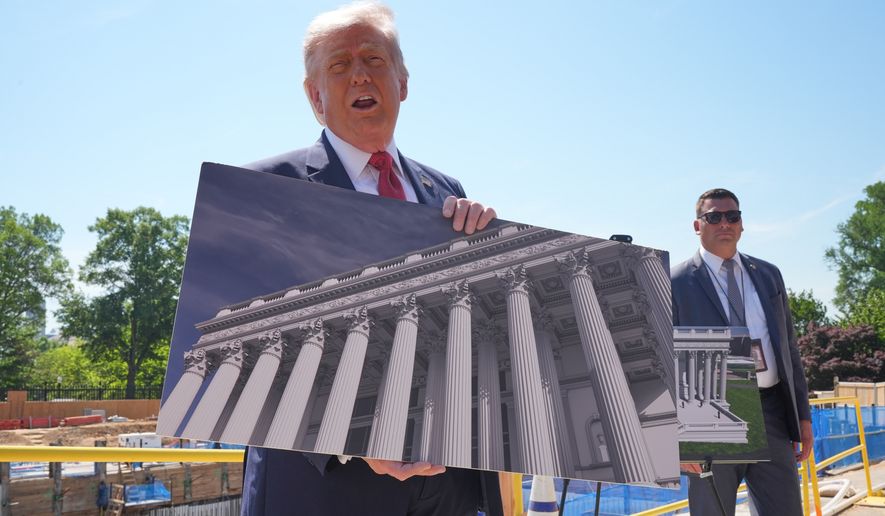

The Supreme Court on Monday gave President Trump permission to continue building his ballroom at the White House, lifting lower-court injunctions that would have halted aboveground construction.
The justices said in a 5-4 decision that the National Trust for Historic Preservation, which brought the lawsuit, likely lacks legal standing to sue. The majority also said that statements by military and intelligence leaders that the ballroom is critical to security supported allowing the work to continue.
“Today, we do not pass upon the legality of the government’s East Wing project. We conclude only that, based on the submissions before us, the government is likely to prevail in showing that the Trust lacks Article III standing to challenge the project in federal court and that the remaining stay factors favor relief,” the court said in an unsigned opinion.
People were interested in these podcasts
Dissenting were Chief Justice John G. Roberts Jr. and the court’s three liberal justices: Justices Sonia Sotomayor, Elena Kagan and Ketanji Brown Jackson. Mr. Roberts is a Republican appointee.
The ruling clears the way for construction to continue and may effectively end the legal challenge.
Mr. Trump appears determined to outpace the judges, with a 250-member crew working 20 hours a day in two shifts, seven days a week, according to court filings in the case.
Mr. Trump initially defended the project by saying the White House needs a world-class gathering space to welcome foreign leaders and host major conferences and dinners.
Increasingly, however, he has cast it as a security matter and now labels it “the Ballroom/Military Complex.”
That includes a “drone-proof” ceiling, blast-proof glass, bomb shelters, missile-resistant columns and “top secret military facilities.”
The court majority said the case raised important legal questions that are unsettled, and so halting construction now would hinder the president.
The main legal question is whether the president can undertake a major renovation of the White House without congressional permission.
Chief Justice Roberts, writing the dissent, said he thinks that question is settled and “construction is likely unlawful.”
“The ballroom is a building or structure being erected on federal park grounds — President’s Park — in the District of Columbia. Yet Congress has not passed any law resembling ’express authority’ for the Executive’s construction of it,” he wrote.
He dismissed the national security concerns, saying that although below-grade construction — which has been allowed by lower courts — affected security, the early arguments to the court did not make that same claim about aboveground construction.
The ballroom has become a major test of presidential powers — and a prestige project for Mr. Trump.
Legal briefs filed in the case — heavy with adverbs and superlatives — often read as if taken from Mr. Trump’s social media feed, or even written by the chief executive himself.
He also devoted portions of his speech at the White House Correspondents’ Association dinner to defending the project.
Mr. Trump says the $400 million, 90,000-square-foot building is being funded by private donations, which puts it beyond Congress’ spending power.
He said on social media Monday that the completion date is “summer 2028,” calling the building under budget and ahead of schedule.
“We are living in the Golden Age of America, and this Building will be one of the Greatest ever constructed in Washington,” he said.
He had the old East Wing demolished last fall without seeking outside approval.
The National Trust, a private organization, had sued on the grounds that one of its board members, Alison Hoagland, likes to walk by the White House, that her “aesthetic” interest was injured by the demolition of the old East Wing, and that she finds the replacement ballroom distasteful.
The court majority said Monday that it had not granted legal standing on that sort of reasoning before.
“To the contrary, we have repeatedly held that mere offense, disagreement or distaste does not qualify as a concrete and particularized injury under Article III,” the justices said.
The majority said if aesthetic objections were enough to grant standing, it would open the floodgates because “nearly any government action or project offends someone’s sensibilities.”
Chief Justice Roberts, though, said that was unfair to Ms. Hoagland.
He said the court has, in fact, allowed “mere aesthetic interests” to be sufficient for standing in cases involving environmental policy.
The majority said in those cases, the plaintiffs used a river for swimming or fishing — something beyond just looking at it.
“But the principal way a person enjoys a historic building or object is by looking at it,” retorted the chief justice.
He repeatedly indicated that the White House was a special building and quoted Winston Churchill’s admonition, “We shape our buildings, and afterwards our buildings shape us.”
“All the more reason to ensure that those responsible follow the rules in deciding what to tear down and what to build up at the People’s House,” the chief justice concluded.
The continued construction creates some tricky questions for the future.
Should the chief justice’s sense that the project is unlawful eventually prevail, it is unclear what the courts could do.
The old East Wing was razed, and although some of the historic objects and furnishings have been stored, the structure is gone.
Contact the author


Please read our comment policy before commenting.