



It’s been a bull market for laurel leaves this summer, as the country crowned a quartet of new U.S. champions in recent days.
In what one hopes will become an annual tradition, organizers staged a midsummer extravaganza, with the U.S. Junior, U.S. Junior Girls, U.S. Senior and U.S. Senior Women’s Championships held concurrently for the first time last month at the St. Louis Chess Center. There’s almost no break in the packed American summer chess calendar as nearly 500 players are already registered for the 126th U.S. Open, which kicked off Monday in Grand Rapids. Michigan.
In St. Louis, GM Andy Woodward and WGM Zoey Tang successfully defended their U.S. Junior and U.S. Junior Girls’ titles, respectively, although in very different fashion: Tang cruised to a 2-point victory over WGM Rachael Li, WGM Rochelle Wu and FM Jasmine Zhixin Su, while Woodward had to grind out a tough last-round win over GM Kirk Ghazarian to outpace co-leader GM Abhimanyu Mishra, who was upset in his Round 9 game against IM Bach Ngo.
In the women seniors’ battle, WGM Anjelina Belakovskaia reclaimed the title she won three years ago, edging WFM Natalia Tsodikova by a half-point.
The toughest fight came in the U.S. Senior Championship, which went to extra time before GM Vladimir Akopian overcame GM Alexander Onischuk in a rapid and blitz playoff. Onischuk surged in the final rounds, with a burst of three wins and a draw in his last four games, while Akopian ran up the score early, boosted by a tough Round 1 win over GM Igor Novikov from the White side of a Scheveningen Sicilian.
With the players set up attacks on opposite flanks, Akopian gets in the first shot after 15. hxg5 Nb6?! (g6 makes White work harder for the break) 16. g6! Nbc4 17. gxf7+ Kxf7 18. Bxc4 Nxc4 19. Qg2!, and already Black dare not take the free piece as 19…Nxe3?? 20. Qg6+ Kg8 (Ke7 21. Qxe6 mate) 21. Qxe6+ Kh7 22. Rh1+ leads to mate.
Novikov hangs tough after 22. Nf5 d5 23. Qf2!? (f4! poses more problems for the defender) Bc5, and emerges with three pieces for his queen after 24. Ned4!? exd4 (the engines prefer 24…Rcg8!, bolstering g7 for the storm to come) 25. Be7 (and here 25. Bh4! serves White’s purpose better as the bishop does not hang in the coming combination) Qxf5 26. exf5 Bxe7 27. Rxd4 Bf6 — Black has managed to fight off the mating attack, but the queen is always dangerous in such open positions.
As often happens in such positions, one small lapse by the defender has big consequences: 28. Kb1 Rh5 (Black dare not give up the defensive bishop; e.g. 28…Bxd4? 29. Qxd4 Rhg8 30. b3 Nd6 31. Qe5 Rd8 32. Qe6+ Kf8 33. f6 and wins) 29. Rdg4 Rxf5? (fatally weakening the kingside; strongly indicated was the retreat 29…Rhh8 30. Qg3 Rhg8) 30. Qg3 (already threatening 31. Rxg7+!) Kg6 32. f4 Ne3 33. Rxg5+!, with a decisive breakthrough.
White cleans up on 33…Bxg5 34. fxg5 Rf7 (Rf1+ 35. Rxf1 Nxf1 36. Qh5+ Kf5 37. Qf7+ Kxg5 38. Qxb7; or 34…Rxg5 35. Qd6+ Kf5 36. Qd7+ Kf4 37. Re1 Rc6 38. Qe7) 35. Qh6+ Kf5 36. g6! (hitting the rook and the loose knight on e3; the passed pawn is just gravy for White’s attack) Re7 37. Qg5+, and Black resigned as he loses major material in lines such as 37…Ke6 38. Qxe3+ Kd6 39. Qb6+ Bc6 40. g7 Rg8 41. Rg6+ Re6 42. Rxe6+ Kxe6 43. Qxc6+.
—-
What with superstrong computer-playing programs, massive databases and ever-improving coaching practices, young players today are stereotypically booked to the gills when it comes to opening theory. Top grade-school players these days often are into their 10th move or later before encountering a new move in the latest trendy opening.
But some of the game’s most ancient positions still contain a drop of poison for the unwary or unready, as can be seen in Mishra’s miniature win over New York GM Nico Chasin from the U.S. Junior Championship.
The Petroff Defense (2…Nf6) is one of Black’s most venerable and deeply analyzed defenses, and the position after 7. 0-0 Nc6 8. Nc3 has been reached thousands of times before in master-level chess. Chasin as Black chooses the less popular but still very playable 8…Bf5 line — 8…Nxc3 is the more popular choice here — but perhaps misremembers his preparation with dire consequences just two moves later.
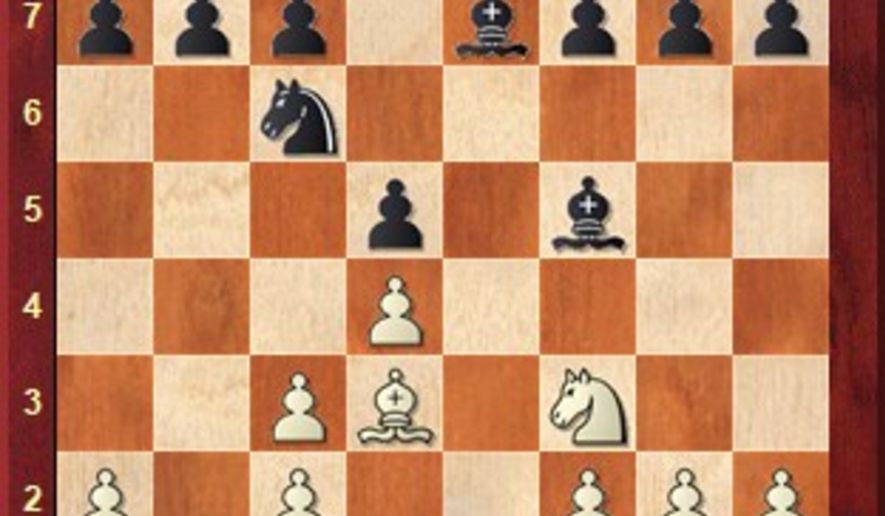
Thus: 9. Re1 Nxc3 10. bxc3 (see diagram), and now Black has a perfectly reasonable game after 10…Bxd3 (Qd7 is also feasible) 11. Qxd3 0-0.
Instead, it’s over in a blink after 10…Qd7?? 11. Ne5! Nxe5 (no better was 11…Qc8 12. Nxc6 bxc6 13. Bxf5 Qxf5 14. Ba3) 12. Bxf5! (precise, and deadly; 12. Rxe5?? lets Black wriggle free with 12…Be6) Qxf5 13. Rxe5 (the attack on the queen leaves Chasin with no time to free his pinned bishop) Qf6 14. Ba3, and Black resigned. White’s dominance was so complete that, in addition to the game move, 14. Bg5, 14. Qe2, 14. Qe1 also won Chasin’s unfortunate bishop on e7.
(Click on the image above for a larger view of the chessboard.)
Akopian-Novikov, U.S. Senior Championship, St. Louis, July 2026
1. e4 c5 2. Nf3 d6 3. d4 cxd4 4. Nxd4 Nf6 5. Nc3 a6 6. f3 e6 7. Be3 b5 8. Qd2 Nbd7 9. g4 h6 10. a3 Bb7 11. O-O-O Ne5 12. Rg1 Rc8 13. h4 Nfd7 14. g5 hxg5 15. hxg5 Nb6 16. g6 Nbc4 17. gxf7+ Kxf7 18. Bxc4 Nxc4 19. Qg2 Qf6 20. Bg5 Qg6 21. Nce2 e5 22. Nf5 d5 23. Qf2 Bc5 24. Ned4 exd4 25. Be7 Qxf5 26. exf5 Bxe7 27. Rxd4 Bf6 28. Kb1 Rh5 29. Rdg4 Rxf5 30. Qg3 g5 31. Qh2 Kg6 32. f4 Ne3 33. Rxg5+ Bxg5 34. fxg5 Rf7 35. Qh6+ Kf5 36. g6 Re7 37. Qg5+ Black resigns.
Mishra-Chasin, U.S. Junior Championship, St. Louis, July 2026
1. e4 e5 2. Nf3 Nf6 3. Nxe5 d6 4. Nf3 Nxe4 5. d4 d5 6. Bd3 Be7 7. O-O Nc6 8. Nc3 Bf5 9. Re1 Nxc3 10. bxc3 Qd7 11. Ne5 Nxe5 12. Bxf5 Qxf5 13. Rxe5 Qf6 14. Ba3 Black resigns.
• Got a hot tip or a cool game to share? David R. Sands can be reached at davidrsands18@gmail.com.

Please read our comment policy before commenting.