



A version of this story appeared in the daily Threat Status newsletter from The Washington Times. Click here to receive Threat Status delivered directly to your inbox each weekday.
OPINION:
Watching the war in Ukraine, it feels as if drones have rewritten warfare.
Every day brings another video: a quadcopter chasing a tank, a first-person-view drone weaving through buildings, a fiber-optic system striking far behind the line while jamming fills the air.
It is easy to think the drone itself is the revolution, but that misses the point.
People were interested in these podcasts
What changed the battlefield was not a platform. It was the ability to generate surveillance, electronic warfare and precision strike effects cheaply, continuously and at enormous scale.
Drones are simply the most disposable delivery mechanism available. When radio-frequency control becomes vulnerable to jamming, operators switch to fiber-optic guidance. When that becomes vulnerable, autonomy and onboard seekers follow.
The delivery system evolves, but the competition stays the same: Who can sustain combat effects for longer, more cheaply and in greater numbers?
If drones are the lesson, militaries simply buy more drones. If scalable effects are the lesson, planners must ask harder questions, because the answer in eastern Ukraine is not necessarily the answer in the Pacific.
Russia, with China’s help, is closing the gap
For much of the conflict, Ukraine held the innovation advantage, adapting commercial technology at remarkable speed and low cost. Moscow struggled early on, but that gap is shrinking, especially in fiber-optic drones that operate in jammed environments and reach farther behind Ukrainian lines.
The fiber-optic drone runs on inputs that increasingly trace back to China. Analysts tracking the supply chain report that Beijing has dramatically increased exports of fiber-optic cable and lithium-ion batteries to Russia, components critical to Moscow’s mass production of the tethered drones that are overwhelming Ukrainian defenses.
Ukrainian intelligence has observed Chinese-manufactured components, including chemicals, gunpowder and other essential materials, flowing to Russian production plants.
So Russia has not become more innovative than Ukraine. It has become better at scaling production, and much of that scale can be traced back to China. This is not wartime improvisation.
The Council on Foreign Relations argues that the China-Russia partnership is deep and durable rather than a temporary axis of convenience, and that the bond is unlikely to break.
China has spent more than a decade as Russia’s largest trade partner and has actively helped Moscow circumvent export controls, supplying advanced technologies from chips to drone parts.
The lesson: Authoritarian states with massive industrial capacity can absorb good ideas and produce them in enormous quantities.
It is a preview of what the United States will face whenever it confronts either power.
The Pacific will demand a different mass
China is watching closely, but its challenge is different from Russia’s. Fiber-optic drones that work over a few miles of contested terrain do not solve the problem of finding and destroying maneuvering ships hundreds of miles from shore.
That is why the United States should be careful about adopting Ukraine’s lessons too quickly. Affordable mass is part of the answer, but the Pacific may require different types of mass.
The United States and its allies will need long-range precision fires to reach ships, airfields, logistics hubs and hardened targets across enormous distances, plus surveillance and targeting networks resilient enough to withstand electronic and cyberattacks and pressure on space-based systems.
Cheap drones still matter as decoys, seekers, reconnaissance and saturation systems, but they are supporting players, not the center of gravity.
If the deciding factor in Ukraine has become industrial endurance and China is the partner supplying that endurance to others, then the U.S. will be fighting the very advantage it watched Russia borrow.
In a straight contest of mass against the world’s largest manufacturing power, on its own terms and near its own shores, the United States may not hold the advantage for long. So the real question is not how many drones to buy, but which types of mass to surge and whether industrial options complicate China’s ability to scale.
That second path is worth exploring. It might mean fielding long-range effects whose critical components China cannot easily choke off or replicate. It might mean production resilience: distributed manufacturing, allied industrial depth across Japan, South Korea and Australia, and supply chains routed away from Chinese inputs.
It might mean imposing cost on China’s scale rather than matching it, forcing Beijing to defend a kill chain and industrial base it assumes are sanctuaries.
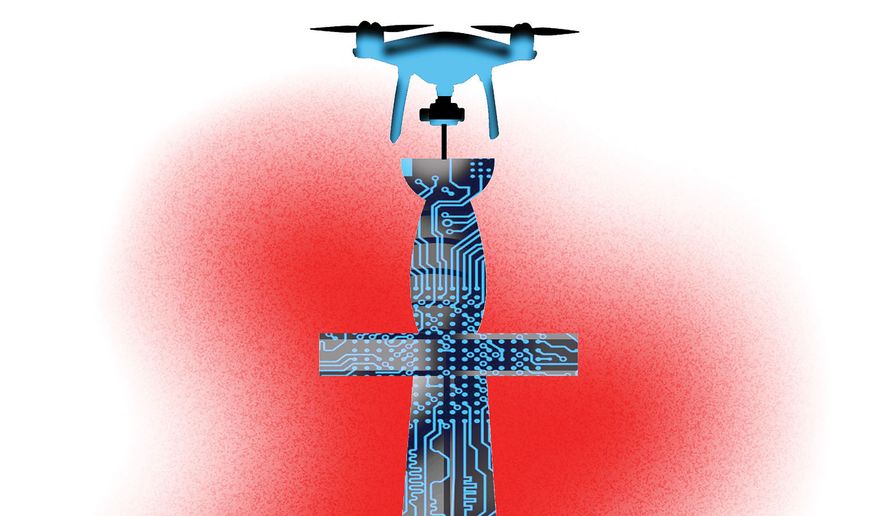
The real story is not the drone. It is the return of mass, affordability, adaptation and industrial endurance, and the uncomfortable fact that in the Pacific, that endurance may be on the other side.
If the U.S. mistakes the platform for the underlying idea, it may build an impressive arsenal optimized for a battlefield its adversaries never intended to fight on, only to learn that the factory floor, not the front line, was where the war was decided.
• David Harris is a retired lieutenant general in the U.S. Air Force. The views expressed are his own and do not reflect the official guidance or position of the United States government, the Department of Defense, the U.S. Air Force or the U.S. Space Force.

Please read our comment policy before commenting.