


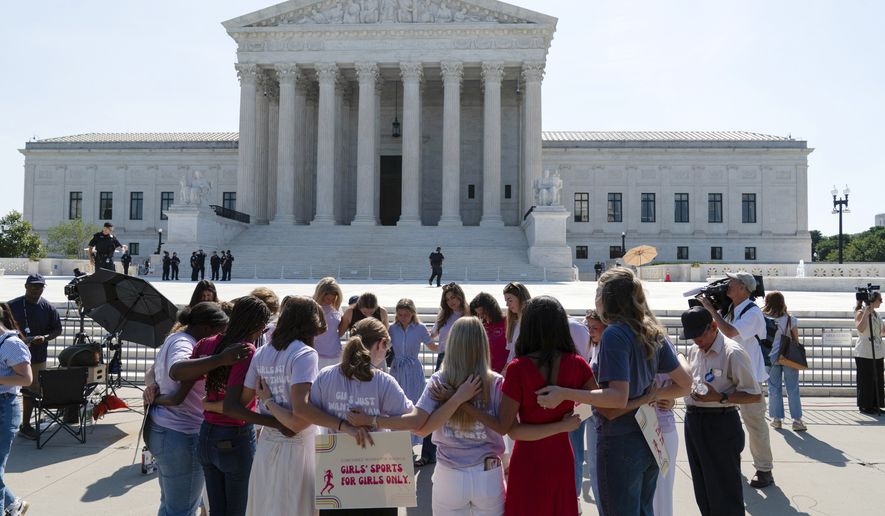

The Supreme Court may have obliterated the Title IX case for transgender athletes in female sports, but don’t be surprised if biological males continue to show up on girls’ varsity volleyball, soccer and basketball teams.
The court found that states may separate scholastic sports by sex without violating Title IX or the Equal Protection Clause of the 14th Amendment — not that they must.
As a result, the 23 Democrat-led states that permit male-born students to compete in girls’ sports based on gender identity may continue to enforce their laws and policies, meaning the battle over same-sex sports isn’t over.
People were interested in these podcasts
“There’s much work to be done,” said May Mailman, director of the right-of-center Independent Women’s Law Center. “This ruling merely says women’s sports are legal, but it doesn’t preserve their right to them.”
The court did provide clarity on the Title IX debate. The ruling said the 1972 civil-rights law “cannot plausibly be interpreted to refer to anything other than biological sex,” torpedoing the left’s argument that the law’s ban on sex discrimination in education also applies to gender identity.
“The ordinary meaning of the term ’sex’ at the time of enactment in the early 1970s was biological sex and not gender identity, particularly in the sports context,” said the high court in the Tuesday decision.
Women’s sports advocate Riley Gaines said “sex always meant your biological sex. That’s the good news.”
“Title IX has officially and finally been cleared up by highest courts, meaning that states can pass legislation to have a protected category for women in sports,” she said in a statement. “The bad news is it doesn’t mean that they must, which unfortunately means that the Supreme Court ruling doesn’t really reach every single state. Despite what the headlines really make it seem, the fight continues.”
Conservatives expressed hope that the ruling will persuade blue states to reevaluate their policies, but Democratic attorneys general were as adamant as ever in defending their gender-identity laws following the decision.
Maine Attorney General Aaron Frey called the ruling “yet another disturbing affront to personal liberties,” adding that his state has no intention of prohibiting transgender students from competing in girls’ sports.
“The Court was clear that this decision had no bearing with respect to a state’s choice to include transgender athletes and as such, will not implicate the Department of Justice’s case against Maine,” said Mr. Frey. “We will continue to defend Maine’s law.”
Massachusetts Attorney General Andrea Joy Campbell said allowing “blanket policies that exclude transgender children … marginalizes and harms vulnerable students.”
“Massachusetts law continues to protect transgender students, including student athletes who play sports in accordance with their gender identity,” said Ms. Campbell in a Tuesday statement.
New York Attorney General Letitia James said the decision “ignores fact, science, and decency in favor of abandoning young trans people nationwide.”
“I will continue to fight for trans New Yorkers against discriminatory policies and am proud to stand with the LGBTQ+ community today and every day,” said Ms. James.
The NCAA and National Association of Intercollegiate Athletics, the two main collegiate sports governing bodies, have essentially banned biological males from female sports, as have multiple athletic organizations and the International Olympic Committee.
At the same time, junior colleges and high schools have seen a rising number of transgender athletes playing under blue-state laws prohibiting discrimination based on gender identity.
Democratic officials such as California Gov. Gavin Newsom have defied President Trump’s executive order, “Keeping Men Out of Women’s Sports,” prompting calls for federal legislation.
“[T]hose leaders in blue states like Gavin Newsom still suffer from the crippling diagnosable disease of TDS [Trump Derangement Syndrome],” Ms. Gaines said. “They’re going to continue to defy federal law. But I’m here to say those girls deserve fair competition too. So what do we need? We still need federal action, meaning we need Congress to act.”
West Virginia Attorney General J.B. McCuskey, a Republican, said the Supreme Court’s 9-0 decision on the Title IX issue should embolden congressional lawmakers to “right this wrong.”
“We are immensely proud of the work that we’ve done and we are very, very hopeful that Congress specifically will step up, read this decision, and say, it’s time for a national policy on this issue,” said Mr. McCuskey on a Tuesday press call. “This is just common sense.”
Contact the author


Please read our comment policy before commenting.