


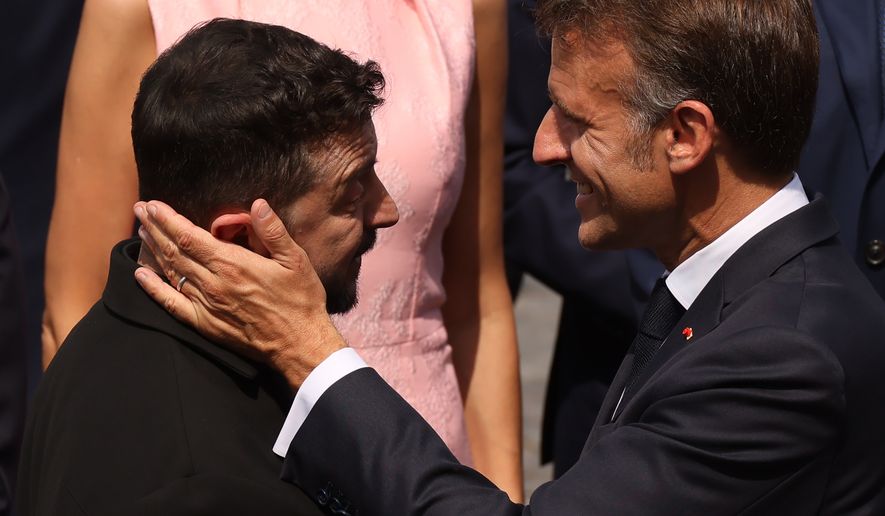

PARIS — Ukrainian soldiers marching down the Champs-Elysees drew some of the loudest cheers Tuesday as France turned its Bastille Day parade into a show of European military support for Kyiv.
About 25 Ukrainian troops took part in the procession. Two Ukrainian co-pilots flew alongside French pilots overhead aboard French Mirage 2000B fighter jets, while President Volodymyr Zelenskyy watched from the reviewing stand alongside French President Emmanuel Macron and roughly 30 other leaders.
Some 500 troops from Coalition of the Willing countries opened the parade. The Ukrainian contingent marched separately afterward. Aircraft from several European nations joined the flyover, carrying the political message of the previous day’s summit into the skies over Paris.
People were interested in these podcasts
For Mr. Macron, presiding over his final July 14 parade before leaving office next year, the display was meant to show what France called Europe’s “strategic awakening.” For Mr. Zelenskyy, whose troops received an ovation from the crowd, it offered recognition of Ukraine’s role in defending the continent.
“It is a true recognition of Ukraine’s strength and the strength of our armed forces,” the Ukrainian president said.
Although the parade supplied the spectacle, the meeting Monday at Les Invalides was intended to show that the coalition could produce something more tangible.
Created under French and British leadership, the group has spent much of the past year discussing security guarantees for Ukraine and the formation of a multinational force that could deploy after a ceasefire.
The Paris gathering broadened that effort. European leaders announced plans to develop a shared anti-ballistic missile capability, increase arms production and hold exercises for a possible future deployment to Ukraine.
The main initiative was the creation of an Integrated Anti-Ballistic Missile Coalition involving Ukraine and nine European countries: France, Britain, Germany, Italy, Denmark, the Netherlands, Norway, Spain and Sweden.
The group will work on Freyja, a planned missile-defense system that officials say will draw heavily on Ukraine’s combat experience. Its members agreed to establish common military requirements, technical working groups and a road map toward an initial operational capability.
Representatives of major European defense companies attended the first meeting. Mr. Zelenskyy named Thales, Diehl Defense, Saab, Kongsberg, Leonardo, MBDA, Eurosam, Safran and Ukrainian missile manufacturer Fire Point among the participants.
The project addresses an immediate weakness in Ukraine’s defenses: Russian ballistic missiles are fast and difficult to track and can be intercepted by only a small number of advanced systems.
Ukraine relies mainly on American-made Patriot batteries and Franco-Italian SAMP/T systems, but both launchers and interceptor missiles are in short supply.
“The reality in Ukraine right now is that sometimes we do not have the missiles needed to intercept ballistic missiles,” Mr. Zelenskyy said.
The new European system will not be ready soon enough to solve that shortage. Designing, testing and producing an interceptor typically take years, and European arms manufacturers are already struggling to fill a growing backlog of domestic and Ukrainian orders.
Still, the agreement reflected an effort to move away from a model in which Europe simply buys American weapons or transfers equipment from its own stocks.
Ukraine has spent more than four years studying Russian missiles, drones and electronic warfare in combat conditions. Its defense companies frequently develop or modify weapons in a matter of months. European governments want access to that experience while building up their own industrial base.
A separate Franco-Ukrainian declaration went further.
Ukraine announced an initial order for 16 Rafale fighter jets as part of a broader plan to acquire up to 100. Meanwhile, France said Ukrainian pilots and mechanics could begin training this year.
Paris and Rome also authorized licensed production in Ukraine of Aster 30 air-defense missiles. France separately authorized licensed production of SCALP cruise missiles and AASM-guided bombs, to be finalized by the end of the year.
Ukraine plans to order four next-generation SAMP/T batteries, while two existing systems could be sent as an interim measure, according to the Franco-Ukrainian joint declaration. France and Italy also pledged to accelerate previously announced deliveries of Aster interceptors.
Many details, however, remain unresolved, as the program is dependent on European financing, factory capacity and training schedules. The first Rafale aircraft are not expected to arrive immediately, and setting up licensed missile production inside a country under regular Russian bombardment will present its own risks.
Even so, manufacturing weapons in Ukraine could shorten supply lines and place maintenance facilities closer to the fighting. It would also give European companies direct access to Ukrainian engineers accustomed to rapidly adapting their designs after battlefield use.
The summit also returned to plans for a multinational force.
The coalition said the force would be ready to operate on land, at sea and in the air after a “credible cessation of hostilities” and at Ukraine’s request. Military exercises are planned in the coming months to test how quickly participating countries could deploy personnel and equipment.
No country announced plans to send combat troops into Ukraine while the war continues, and the proposed force remains tied to a ceasefire that Russia has shown little interest in accepting.
That leaves Europe working on two clocks.
Ukraine needs interceptors, artillery ammunition and long-range weapons now. The coalition is also preparing for the day after the shooting stops, when Western forces could help train Ukrainian troops and deter Russia from attacking again.
Mr. Macron acknowledged the costs involved in his address ahead of the parade.
“Yes, peace is our goal,” he said. “Yes, we cherish freedom and the rule of law, and yes, we stand ready to fight to defend them, even at the cost of blood if necessary.”
The Kremlin called the countries gathered in Paris “hostile” and said it was closely following the meeting.

Please read our comment policy before commenting.