


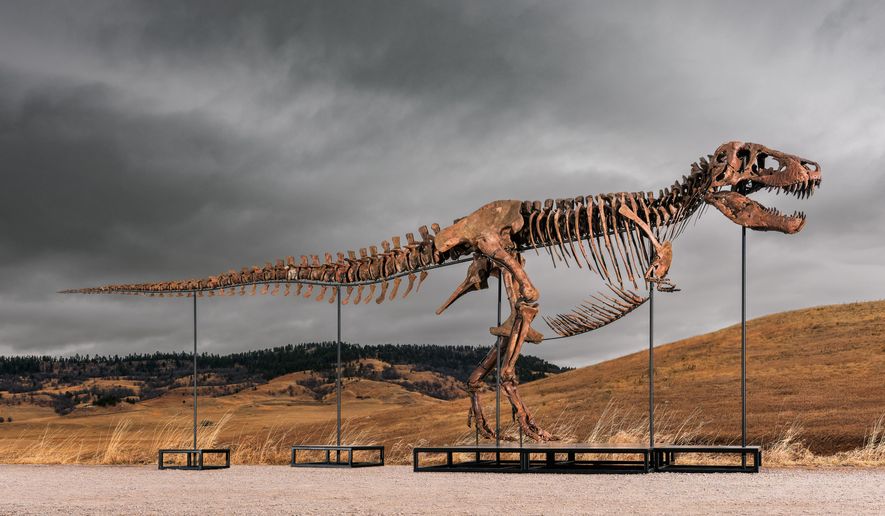

Sotheby’s sold a Tyrannosaurus rex skeleton for over $50 million Tuesday, setting a record for the most money ever paid at auction for a fossil.
The $50.13 million paid for the fossil, called Gus, outstripped the pre-auction estimate, which was between $20 million and $30 million.
It beat the $44.6 million record set by the Stegosaurus skeleton Apex, which was sold by Sotheby’s to billionaire Ken Griffin in 2024.
People were interested in these podcasts
Sotheby’s has not disclosed the identity of Tuesday’s buyer.
The fossilized dinosaur’s remains date back 67 million years and were found in the Hell Creek fossil formation in South Dakota between 2021 and 2023, according to the Sotheby’s lot listing.
The Gus skeleton features 61% of the bones found in a full Tyrannosaurus rex and 75% to 80% of the total bone mass, making it “firmly among the most complete T rex ever found,” per the Sotheby’s lot page.
Some scientific groups argue Gus should be displayed in public and accessible to scientists, like the T. rex skeleton Sue, which Chicago’s Field Museum bought for a then-record $8.4 million in 1997.
The Society for Vertebrate Paleontology, which opposes fossil sales, said in a release ahead of the auction that “scientifically significant vertebrate fossils should be permanently curated in accredited museums, universities, and other public research institutions where they remain available for scientific investigation, education, and public exhibition.”
Sotheby’s Vice Chair Cassandra Hatton, who handled the sales of Apex and Gus, told CNN that the promise of paydays helps pay for the cost of digging fossils out of the earth.
“Nobody can dispute the fact that if these fossils are not excavated, they are lost. There aren’t people going out there to dig these up. It is the commercial paleontologists who are spending their own money and their own time to go,” Ms. Hatton said, adding that she hopes Gus ends up “somewhere that I could take my son to see it.”

Please read our comment policy before commenting.