



1. Who designed the World Cup trophy, and why was a new one needed?
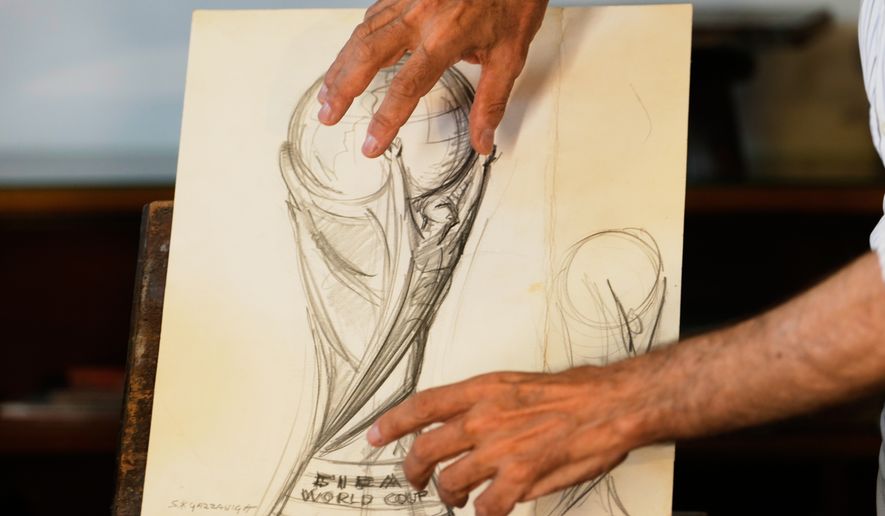
Italian sculptor Silvio Gazzaniga designed the current trophy in his Milan studio after FIFA held an open competition for a new design. A replacement was needed because Brazil earned permanent possession of the original trophy, the Jules Rimet Trophy, by winning its third World Cup in 1970.
2. What happened to the original World Cup trophy?
People were interested in these podcasts
The Jules Rimet Trophy, introduced in 1930 and depicting the Greek goddess Nike, was stolen twice. It was recovered in 1966 after a dog named Pickles found it under a hedge in south London, but after being stolen again in 1983 from Brazilian Football Confederation headquarters, it was never recovered and is widely believed to have been melted down.
3. What does the current trophy’s design represent?
The design features two figures spiraling up toward an orb representing the Earth, meant to capture an athlete’s struggle, their body rough and rugged from fighting for victory, along with arms raised like wings symbolizing both triumph and fan jubilation. Gazzaniga was the only entrant among more than 50 proposals to submit a full model, which helped the judging jury understand both the trophy’s form and its story.
4. Do World Cup winners keep the actual trophy?
No. The official trophy, 36 centimeters tall and cast in 18-carat gold with a base of green malachite, returns to FIFA after each tournament and is stored at its Swiss headquarters; the winning team instead takes home a gold-plated replica. FIFA no longer allows three-time winners to keep the original.
5. How long has this design been used, and what comes next?
This year’s tournament marks the 14th World Cup to use Gazzaniga’s design, which debuted at the 1974 final between West Germany and the Netherlands. FIFA has decided to keep this trophy design in use at least through the 2038 tournament, and on Sunday, either Spain or Argentina will be the latest nation to lift it after the 2026 final.
For more on this report, read “How an Italian sculptor created the World Cup trophy that became an icon” from The Associated Press, published on The Washington Times.
This article was constructed with the assistance of artificial intelligence and published by a member of The Washington Times' AI News Desk team. The contents of this report are based solely on The Washington Times' original reporting, wire services, and/or other sources cited within the report. For more information, please read our AI policy or contact Steve Fink, Director of Artificial Intelligence, at sfink@washingtontimes.com
The Washington Times AI Ethics Newsroom Committee can be reached at aispotlight@washingtontimes.com.

Please read our comment policy before commenting.