


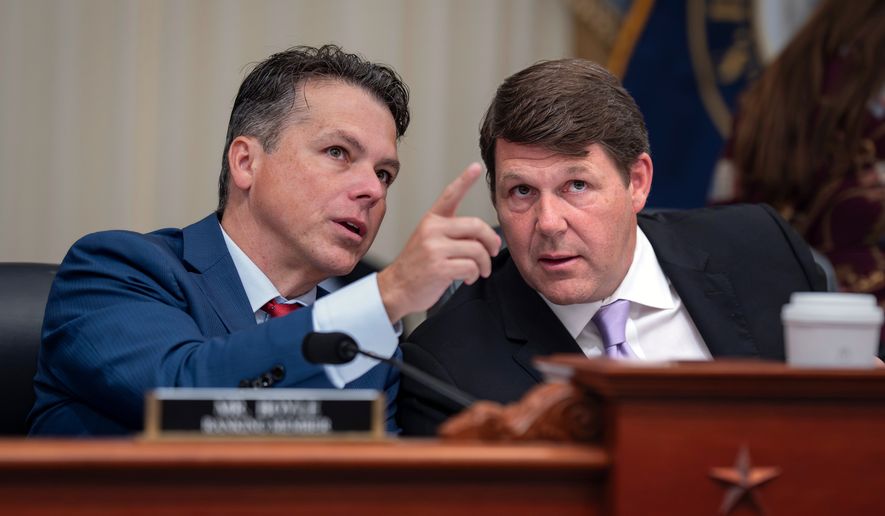

The House Budget Committee on Thursday advanced Republicans’ budget blueprint with instructions for crafting a filibuster-proof bill focused on defense funding, farm aid and voter ID requirements.
However, the measure does not yet have enough support to clear a vote of the full chamber that GOP leaders want to hold next week.
Several Republicans are opposed to the budget resolution because it would allow for up to $95 billion in new spending without a plan to offset any of it.
People were interested in these podcasts
“There’s plenty of places we can find the fraud and the waste to pay for it,” said Rep. Eric Burlison, Missouri Republican. “I don’t know why we’re not trying to do that.”
Republicans can afford no more than two defections if they hope to adopt the budget next week.
Rep. Thomas Massie, Kentucky Republican, said he is likely to vote in opposition because the budget is “the vehicle for the slush fund to fund the Iran war.”
The budget instructions allow for up to $73 billion in defense spending to address operational costs incurred in the Iran war.
The measure also provides for up to $12 billion in economic aid to farmers and up to $10 billion for implementing the SAVE America Act’s proof of citizenship and photo ID requirements for voting.
The numbers in the budget resolution are ceilings. It will be up to the four committees instructed to draft the actual reconciliation bill to decide how much to actually spend and any policy details associated with the funding.
The House Budget Committee advanced the budget resolution in a party-line 20-14 vote.
“It was most important to establish a framework and get it to get the ball rolling,” Budget Chairman Jodey Arrington, Texas Republican, told The Washington Times after the committee vote.
He said there is room for further debate to address remaining GOP concerns about the plan as the budget resolution heads to the House floor and eventually the Senate.
“There are a few stops on the way to our destination,” Mr. Arrington said. “We just started the car today and made sure that we were committed to taking the journey.”
Adopting a budget resolution is the first step in the filibuster-proof budget reconciliation process Republicans have used twice already this Congress to pass top party priorities.
This latest effort, dubbed “reconciliation 3.0,” is focused on passing defense funding for the Iran war, economic assistance to farmers, and as much of the SAVE America Act election integrity bill as will pass muster under the budget rules.
“Given the Democrats’ absolute refusal to work with us on the nation’s top priorities – and that includes election integrity and strengthening our nation’s defense – we’re moving forward with a narrow, streamlined package,” House Speaker Mike Johnson said.
The Louisiana Republican said the House plans to adopt the budget resolution next week and send it to the Senate to approve before the August recess.
Senate Majority Leader John Thune, South Dakota Republican, said he has not committed to that timeline and views the reconciliation 3.0 effort as “a risky proposition.”
“Is the juice worth the squeeze?” he said, citing uncertainty over whether Senate Republicans would have the 50 votes needed to clear another budget reconciliation bill.
Several GOP senators have already raised concerns with the House plan, including fiscal conservatives who want to offset any new spending and defense hawks who want more military funding.
Sen. Thom Tillis, North Carolina Republican, said he will vote against any budget blueprint or reconciliation bill that includes pieces of the SAVE America Act.
“It’s a waste of time,” he said. “It’s an exercise of futility.”
Contact the author


Please read our comment policy before commenting.