


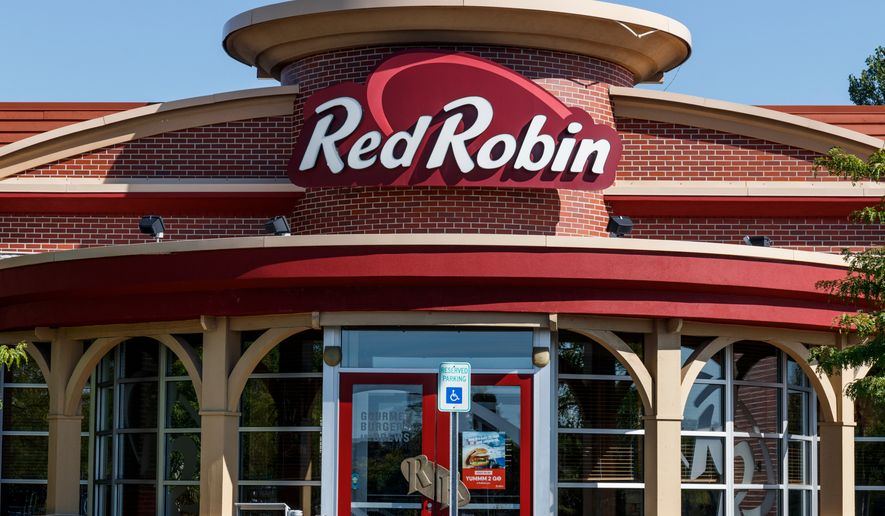

Red Robin Gourmet Burgers has closed another restaurant as part of a broader plan to shutter underperforming locations, pay down debt and position the company for refinancing.
The chain is closing its restaurant at Crossroads in Cary, N.C., in the coming weeks after agreeing to sell the property to Birmingham, Ala.-based commercial developer Capital Growth Buchalter for $3.3 million, according to Triangle Business Journal. Red Robin did not immediately respond to a request for comment.
The 57-year-old casual dining chain launched its “First Choice Plan” in July 2025 with the goal of refranchising stores, cutting expenses and reducing debt following its fourth-quarter and full-year 2024 results. Approximately 20 locations have since been pulled off that list thanks to improved performance and profitability. The company says there is no confirmed number of locations expected to close as it continues to work on boosting performance.
In all, Red Robin closed 23 locations in 2025 as leases expired and repaid $20.3 million in debt by midyear. The moves helped push adjusted earnings before interest, taxes, depreciation and amortization up 53% to $69.7 million in 2025, according to trade publication Restaurant Business.
Red Robin’s restructuring has also allowed it to pull about 20 locations off the original closure list. But the company still expects to close roughly 20 additional locations in 2026 as leases expire, and it has said as many as 27 more closures could follow in subsequent years — keeping the overall total at up to about 70.
“We’ve moved them off the closure list to where we think we can operate them,” Red Robin CEO Dave Pace said on the company’s fourth-quarter 2025 earnings call, referring to the 20 restaurants that improved enough to be spared. The company has not released a list of locations still slated to close.
The Cary property wasn’t Red Robin’s only transaction this year. The company sold 69 units across eight states to OP Burgers LLC for $62.5 million and 17 units in Oregon and Washington to Kuber Oregon LLC and Kuber Washington LLC for $10 million, the company said in a June 15 statement.
Red Robin also sold 30 restaurants in Washington and western Idaho to multi-unit operator Evergreen Dining LLC for $23.5 million, according to a May 28 statement. Those locations will continue operating under the Red Robin brand.
“We are confident Evergreen Dining is the right partner to accelerate growth at these locations,” Mr. Pace said in the statement announcing that deal. Evergreen Dining has operated more than 100 restaurants across multiple national brands over nearly three decades.
The building that houses the original Red Robin dates to 1940, when it opened in Seattle as Sam’s Tavern. The company traces its official founding to 1969, when restaurateur Gerry Kingen bought the tavern, dropped the “Sam’s” and began building it into a burger chain — the same year cited in the chain’s “57-year-old” description. Red Robin now operates more than 500 locations in the U.S. and Canada, with the large majority company-owned, according to the company’s investor relations site.
Other casual dining chains have fared worse this year, with some shutting down entirely. FAT Brands Inc., which filed for Chapter 11 bankruptcy on Jan. 26, 2026, had already moved to close 15 underperforming Smokey Bones locations and convert 19 units to its Twin Peaks brand. By late April, every remaining Smokey Bones restaurant was listed as closed on the chain’s website, and a FAT Brands spokesperson confirmed to a Columbus TV station and other outlets nationwide that all locations had ceased operations.
On The Border Mexican Grill & Cantina has undergone two separate bankruptcy proceedings in little more than a year. The chain first filed for Chapter 11 protection in March 2025 and immediately closed nearly 80 locations before Pappas Restaurants bought the brand out of bankruptcy in May. That rescue proved short-lived: OTB Hospitality, the Pappas-owned operating company behind On The Border, closed all of its company-owned locations in early June 2026 and then filed for Chapter 7 liquidation on June 19, according to a company statement. Pappas Restaurants itself is not part of the Chapter 7 filing and continues operating its other brands.
“It became clear that OTB would require substantial ongoing investment,” said Chris Pappas, a spokesperson for OTB Hospitality. Franchise locations in South Dakota, Florida, Nevada, California and South Korea continue operating independently and were not part of the filing.
This article was constructed with the assistance of artificial intelligence and published by a member of The Washington Times' AI News Desk team. The contents of this report are based solely on The Washington Times' original reporting, wire services, and/or other sources cited within the report. For more information, please read our AI policy or contact Steve Fink, Director of Artificial Intelligence, at sfink@washingtontimes.com
The Washington Times AI Ethics Newsroom Committee can be reached at aispotlight@washingtontimes.com.

Please read our comment policy before commenting.