



House Republicans say they limited their ambitions for a third party-line spending package to make it easier to get through the Senate, but the ploy does not appear to be working.
Senate GOP leaders are still cautious about jumping into the “reconciliation 3.0” effort ahead of the fall midterm elections, as rank-and-file Republican senators raise conflicting demands for what should and should not be included.
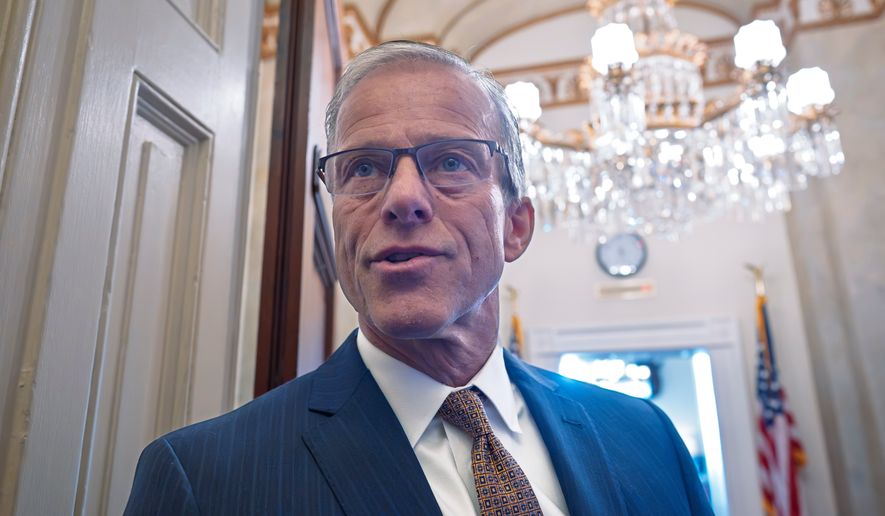
“It’s a risky proposition,” Senate Majority Leader John Thune said, questioning whether the juice of a $95 billion defense, farm aid and voter ID package is worth the political squeeze it will take to pass it.
People were interested in these podcasts
“Can we get 50 on anything?” the South Dakota Republican said. “And even if we get 50 to pass it, can we defeat all the poison-pill amendments?”
The budget reconciliation process that Republicans would use to pass the legislation along party lines takes away Democrats’ ability to filibuster the bill but gives them the power to offer unlimited amendments.
Democrats would undoubtedly use the process to put Republicans on record on a series of politically charged issues ahead of the November midterm elections.
The majority of the funding Republicans plan to include in the package, roughly $70 billion, is for defense needs related to the politically unpopular Iran war.
There are a handful of GOP senators who do not support the Trump administration continuing the war without congressional approval. They may refuse to back the funding or could be susceptible to Democratic amendments to distance themselves from the conflict.
While most Republicans will support the Iran war funding, some believe that if they use the budget reconciliation process to approve it, they should also include other defense funding that President Trump has requested.
“In terms of a small defense increase, it probably is not enough to take care of the problem,” said Sen. Mike Rounds, South Dakota Republican.
He said the package needs to include more defense funding if Congress is going to fulfill Mr. Trump’s plan for a $1.5 trillion military budget.
The president’s budget request to Congress envisioned that $350 billion of that amount would come in the form of mandatory appropriations passed through the budget reconciliation process.
Republicans are trying to advance defense bills that would provide the other $1.15 trillion through the annual discretionary appropriations process, but Democrats are objecting to even that amount.
House Republicans started negotiations on their third reconciliation package of the Congress, envisioning it would provide the $350 billion in defense funding Mr. Trump requested.
However, they ran into obstacles identifying enough offsets that could earn support from Republicans across the conference, particularly swing-district members concerned about potentially politically toxic spending cuts.
Republicans had planned to target government fraud but the Congressional Budget Office does not count all of those potential savings as deficit reduction, presenting another obstacle to offsetting the spending in the package.
Ultimately, House Republicans proceeded with a budget resolution — the first step in unlocking the reconciliation process — that would allow for up to $95 billion in deficit spending without mandating any offsets.
In addition to the $70 billion in defense funding, the budget allows for up to $12 billion in economic assistance to farmers and $10 billion to fund the implementation of election requirements for voters to provide proof of citizenship to register and photo ID to cast a ballot.
Four committees were tasked with developing the policies that will go along with the funding. Including offsets would have required instructing more committees to get involved, which opens the package to more potent Democratic attacks in the Senate.
“Given the short time frame and the challenges of the Senate, we thought it was best to keep it narrow for this, if we were going to be successful,” House Budget Chairman Jodey Arrington told The Washington Times.
But the narrow approach is still running into Senate opposition, as several Republicans in the upper chamber say they cannot support a budget-reconciliation package that adds to the deficit.
“I think all new federal spending should be offset by cutting spending somewhere else,” said Sen. Rand Paul, Kentucky Republican.
Sen. Bill Cassidy, Louisiana Republican, agreed: “Obviously our country is having a problem with deficit spending, so it should be offset.”
Sen. Rick Scott said it is important that the package at least be paid for and that he would prefer to use it to reduce the deficit.
“What I’d like to see is how are we going to crack down on all the fraud that’s going on in the country,” the Florida Republican said.
Sen. Thom Tillis, North Carolina Republican, said the reconciliation package should be limited to providing defense and other government funding that Democrats will not support in the annual appropriations process.
“If we keep on [adding] layers of complexity, like another bogus attempt at the SAVE Act, then we’re never going to get it done,” he said.
While Mr. Tillis said he will vote against the package if the proof of citizenship and photo ID election requirements of the SAVE America Act are included, a bill without them is unlikely to get Mr. Trump’s support.
“Addressing this crisis of election security demands that Congress must pass the SAVE America Act,” the president said in a Thursday night address to the nation discussing election vulnerabilities.
Mr. Thune said the changes to the election measure that would have to be made to fit within the restrictions of the budget reconciliation process may not “be sufficient to scratch the itch of the people who want the full SAVE Act.”
“If you make it anything that is principally policy as opposed to budgetary, it’ll get Byrded out,” he said, referring to the “Byrd rule” that governs the reconciliation process.
Given the strict Senate rules and the differing opinions in his conference, Mr. Thune said he has “to be the realist” about the prospects of passing a third reconciliation bill before the midterms.
“I’m not pooh-poohing it,” he said. “But I’m just saying people need to think long and hard about what it entails.”
Contact the author


Please read our comment policy before commenting.