


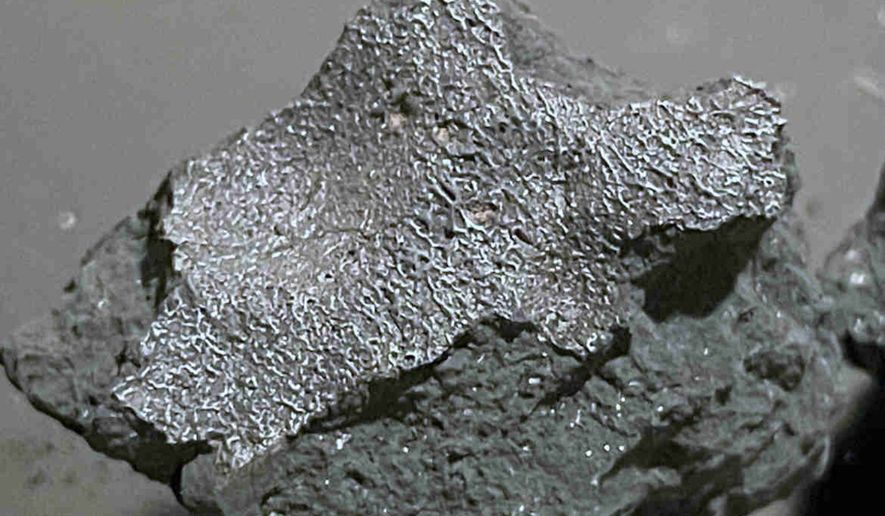

A meteorite that crashed through the roof of a Hillsborough, New Jersey, home in 2024 has turned out to be one of the most scientifically valuable space rocks ever recovered, according to a new peer-reviewed study.
An international team of researchers, writing in the journal Science Advances, determined that the roughly 2-pound rock — nicknamed the Hillsborough meteorite — is only the second confirmed fall of a rare, primitive material known as CM1/2 carbonaceous chondrite. The finding stems from a chance bit of good luck: the homeowner who found the fragments preserved them almost immediately in glass jars using disposable gloves and aluminum foil, giving scientists an unusually pristine sample to work with.
The rock’s short but dramatic journey began July 16, 2024, when a daytime fireball produced a sonic boom over the New York City area, passing just south of the Statue of Liberty before breaking apart over New Jersey. Lead author Peter Jenniskens, a meteor astronomer with the SETI Institute and NASA’s Ames Research Center, said in a statement from the institute that the object entered the atmosphere at roughly 32,000 miles per hour before fragmenting, with only one piece recovered — the one that struck the New Jersey house.
People were interested in these podcasts
Analysis of the fragments turned up evidence that the rock’s parent asteroid had once been coated in concentrated salty fluids, or brine — a process never before documented on that type of primitive asteroid. Researchers said the discovery points to a period when the parent body held liquid water that later evaporated, concentrating salts near its surface.
Scientists say that kind of brine chemistry matters because it can help produce some of the molecular building blocks associated with life. Cosmochemist Queenie Chan of Royal Holloway, University of London, said isotope studies of carbon and nitrogen in the meteorite support the idea that primitive carbonaceous chondrites like this one delivered organic matter to the early Earth.
The rock also contained a range of soluble organic compounds, including amino acids and magnesium-based organic molecules similar to those found in blood and used in photosynthesis by living organisms. Researchers say it remains unclear whether those compounds were produced by the brine itself or were left over from earlier impacts on the parent asteroid.
Some of the recovered fragments will now be curated by the American Museum of Natural History in New York City, whose curator, Denton Ebel, said the museum was fortunate that “nature delivered such a precious asteroid sample” so close to home, according to CBS News, which first reported on the study’s findings.
This article was constructed with the assistance of artificial intelligence and published by a member of The Washington Times' AI News Desk team. The contents of this report are based solely on The Washington Times' original reporting, wire services, and/or other sources cited within the report. For more information, please read our AI policy or contact Steve Fink, Director of Artificial Intelligence, at sfink@washingtontimes.com
The Washington Times AI Ethics Newsroom Committee can be reached at aispotlight@washingtontimes.com.

Please read our comment policy before commenting.