


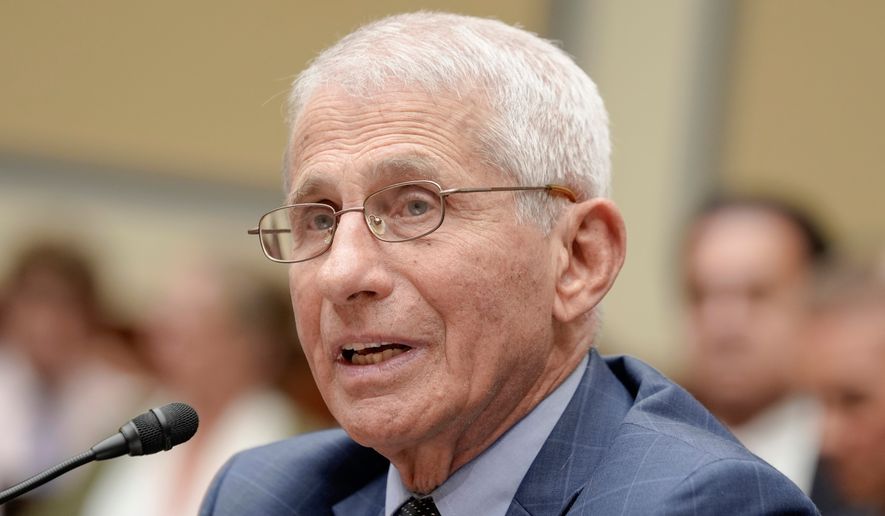

The stunning pandemic-era notes of White House COVID-19 adviser Dr. Anthony Fauci were released this week by Sen. Rand Paul, Kentucky Republican, after Health and Human Services Secretary Robert F. Kennedy Jr. unearthed them.
Mr. Kennedy said the COVID-related, almost-daily musings of the doctor, amounting to 1,141 pages, were located in 11 government servers, where “they had been sequestered and secreted.”
Here are five takeaways from the Fauci diaries:
Dr. Fauci believed the ’lab leak’ theory but called it far-fetched in public
On television, Dr. Fauci condemned the claim that SARS-CoV-2 escaped from a lab in Wuhan, China, as a conspiracy theory, insisting that the virus likely emerged naturally, possibly from a wet market in Wuhan, where animals were slaughtered.
However, diary entries from the early weeks of the pandemic show that Dr. Fauci, then the head of the National Institute of Allergy and Infectious Diseases, considered a lab leak possible and ruled out the wet market as the origin.
SEE ALSO: Fauci pleads the Fifth, refuses to answer questions to Congress
Dr. Fauci participated in a call on Feb. 1, 2020, with a dozen scientists to discuss the emerging virus, his notes reveal. Ten of the 12 scientists on the call said they felt deliberate insertion of the virus was possible, according to Dr. Fauci’s notes.
“They bring up the possibility that this could have been deliberately inserted and either accidentally released or deliberately released by a crazy person in the lab, the former being the most likely,” Dr. Fauci wrote after the call. “Now we know the market was not the source, it was the amplifier.”
Despite this acknowledgment, Dr. Fauci publicly maintained as late as June 2024 that the data and the scientific community supported the theory that the origins of COVID-19 centered on the wet market, not a leak from the Wuhan lab.
He pushed for school closures while denying involvement
Dr. Fauci publicly insisted that he had no role in the prolonged school closures that kept children out of the classroom for months or, in some cases, longer than a year.
Yet in his diary entries, Dr. Fauci said he told New York City Mayor Bill de Blasio and California Gov. Gavin Newsom’s chief of staff, Ann O’Leary, on March 15, 2020, to shut down the schools — and they did — keeping more than 7 million children out of the classroom for a year or longer and setting off chain-reaction closures of school systems across the nation.
Meanwhile, he told ABC’s “This Week” in October 2022 that he had “nothing to do” with school closures and insisted that he had always said, “We’ve got to do everything we can to keep schools open.”
He stifled disclosure of the vaccine’s ineffectiveness
A diary entry on Aug. 13, 2022, revealed that Dr. Fauci persuaded the Centers for Disease Control and Prevention to kill a statement it planned to release to the public warning of “absolute lack of efficacy of vaccines against infections and transmissions.”
Dr. Fauci wrote in his diary that he persuaded the CDC to take “a more measured approach” and say the shots provide “modest and waning efficacy” against the virus. Dr. Fauci said he pushed the CDC to minimize disclosure of the vaccine’s ineffectiveness to avoid undermining the Biden administration’s vaccine mandates or discouraging people from getting COVID-19 booster shots, which also turned out to be largely ineffective in stopping infection.
Although far less effective at preventing the virus’ spread, the COVID-19 vaccine and booster shots reduce the severity of illness and cut hospital stays in half among those who get sick, according to the Journal of the American Medical Association.
He hid his own possible injury from the vaccine
Dr. Fauci never disclosed that he suffered from a pulmonary infarction in June 2021, nearly six months after receiving the COVID-19 jab.
In his diary, Dr. Fauci described the shock diagnosis, which he received from top doctors at Johns Hopkins after a CT scan. He wrote that he immediately started treatment with the anticoagulation drug Eliquis.
“He had … a pulmonary infarction, which is one of the adverse events that NIH, CDC and FDA said are expected from the vaccine,” Mr. Kennedy said on Fox News. “He never told anybody. He got treated for it privately by the best doctors in America. At the same time, he was telling everybody that that was not an adverse event.”
Pulmonary infarction, caused by a blood clot in the lung, is among several side effects reported by some who received the mRNA COVID-19 vaccine, according to government data. Pulmonary infarction can also be caused by contracting the COVID-19 virus.
As the nation struggled, Dr. Fauci reveled in his newfound celebrity
Even as COVID-19 paralyzed the U.S., Dr. Fauci was fixated on fame.
“Big front page article about me in the Washington Post. Very flattering,” he wrote on May 21, 2020, the same day he recorded 5,300 new U.S. cases and 73 deaths caused by the virus. “The situation with my national and international fame is explosive and really unimaginable.”
The next day, he reported, “Press is going wild with me.”
In February 2021, he described “a great call with Barbra Streisand,” who called his cellphone to ask about the vaccines. He told her he enjoyed playing her songs on Amazon’s Alexa. “When the songs came on loud and clear, she started laughing and absolutely loved it!” he wrote.
Later that week, he reported, “The PBS team is here today filming their documentary.”
Dr. Fauci exchanged phone calls and had dinners with CNN’s Jake Tapper and his wife, Jen, in the Tappers’ Washington home, which he described in his diary as “friendship building.”
Amid all of his fame-chronicling, Dr. Fauci documented the “surges” of COVID-19 across the U.S. He also dedicated several 30-minute “deep background” conversations in the summer of 2020 with Washington Post investigative reporter Bob Woodward, who was writing a book about President Trump’s response to the outbreak.
His authority on all things pandemic was far-reaching, and he clearly enjoyed it.
In July 2020, he wrote about holding a virtual meeting with officials from the Washington Nationals to discuss the opening of the stadium to the public on July 23, 2020.
“I will throw out the first pitch,” Dr. Fauci wrote.
Contact the author


Please read our comment policy before commenting.