



NEWS AND ANALYSIS:
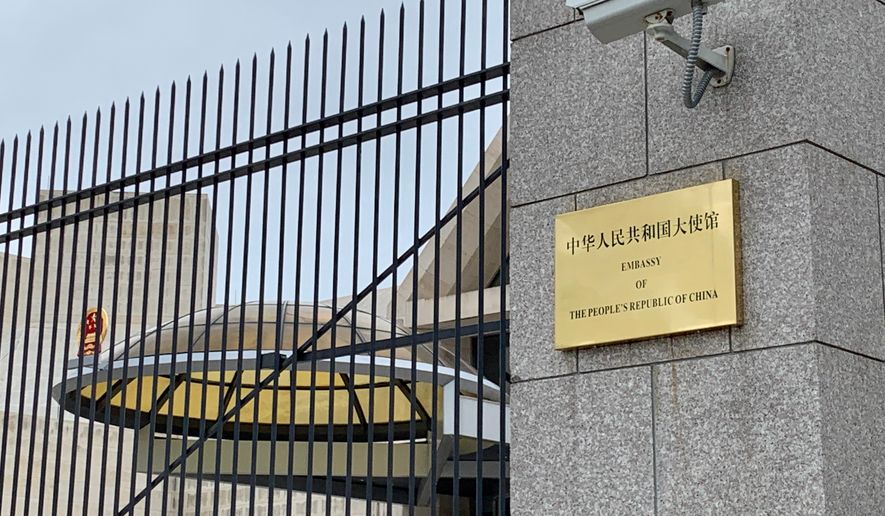
A senior Defense Department official marked the anniversary of the Chinese Communist Party’s military arm with a speech at the Chinese embassy in Washington Tuesday, declaring the U.S.-China military relationship to be “stronger than it has been in years.”
Deputy Assistant Defense Secretary Alvaro Smith spoke at an army day ceremony at the embassy to mark the 99th anniversary of the founding of the People’s Liberation Army.
“We seek a decent peace, fair trade and respectful relations with China,” said Mr. Smith, who is in charge of China, Taiwan and Mongolia policy. His remarks were posted online by the Pentagon.
The conciliatory comments were made despite mounting tensions with China and what many analysts say is Beijing’s low-level warfare against the U.S.
China’s threatening actions have included cyberattacks on critical U.S. infrastructure and large-scale espionage and influence operations. President Trump has also accused Beijing of interfering in U.S. elections.
The State Department contends China is violating international law in the South China Sea by ignoring an international tribunal ruling dismissing Beijing’s expansive maritime claims as illegal.
China’s military has also ramped up operations near Taiwan and has harshly criticized Japan for Tokyo’s talk of building nuclear weapons and showing support for regional nations such as Taiwan and the Philippines.
Beijing’s military also is engaged in a secretive and large-scale nuclear missile buildup while refusing to join arms control talks as required under a nuclear nonproliferation treaty.
Chinese exports of deadly fentanyl precursors to Mexican drug cartels also are continuing, despite Beijing’s promises to halt the trade.
Mr. Smith said the Pentagon, under Defense Secretary Pete Hegseth, is seeking to repair “a once-broken military-to-military channel” and is making progress.
The new approach to U.S.-China military ties is based on “candid, respectful and clear conversations with genuine interest in de-escalation,” he said.
The new policy is based on what Mr. Smith called a “realism” he did not fully explain, other than to state that the Trump administration’s national defense strategy calls for a favorable balance of power in the region.
“And as we pursue and defend our interests, I would reiterate that we do not seek conflict with China,” he said, noting that open lines of military-to-military talks are aimed at reducing the danger of miscalculation and building “mutual understanding.”
The Pentagon for decades has sought to build better relations with the Chinese military — an effort critics say has failed.
In incidents such as the downing of a U.S. surveillance aircraft near China in 2001 and the Chinese intelligence-gathering balloon that transited the U.S. in 2023, efforts to reach out to Chinese military leaders were unsuccessful.
The new conciliatory China policy is the work of Elbridge Colby, undersecretary of defense for policy, who criticized the first Trump administration’s hard-line stance toward China in a recent New York Times podcast.
Mr. Colby said he is a “realist” but not an isolationist or “uber-hawk” who personally engages with Chinese defense and military officials.
The undersecretary put in place what he calls a “denial strategy” that does not seek regime change in Beijing.
“I feel very confident that I’m not being conniving or dissembling at all when I say that our posture is designed for strategic stability and the status quo and a balance of power. It’s not the kind of capabilities that you can use reasonably to conduct aggression against military power,” he said.
“Speaking respectfully” with China is a shift from the first Trump administration that was “talking about regime change in China,” Mr. Colby said.
In the first administration, then-Secretary of State Mike Pompeo stopped short of calling for overthrowing the communist regime. Instead, Mr. Pompeo in a 2020 speech said the U.S. should work with Chinese people to change CCP behavior.
Critics have said the realist policy and limited denial defense toward China lean toward defeatism.
The new approach is a marked departure from the “peace through strength” policies toward the Soviet Union in the 1980s under President Reagan.
Reagan never called for respecting the Soviet communist system. He labeled it an “evil empire.” Reagan once remarked to an aide that his approach to the Cold War was simple: “We win; they lose.”
Those policies led to the Soviet Union’s collapse in 1991.
Retired Navy Capt. Jim Fanell and China expert Bradley A. Thayer criticized U.S. efforts to seek warm military ties with China in their recent book, “Embracing Communist China: America’s Greatest Strategic Failure.”
Senior Navy officers allowed Chinese visitors to gain valuable intelligence on the vulnerabilities of U.S. warships during exchanges over the years, leading Congress to limit the exchanges.
Capt. Fanell and Mr. Thayer wrote that too many admirals were weak and failed to advocate building naval strength under several administrations’ pro-China policies. The result was that many flag officers adopted “a profoundly dangerous attitude toward unconstrained and unaccountable engagement with their PLA navy counterparts,” they stated.
House seeks report on Pentagon arms shortages
Amid reports that the U.S. military is running out of missiles and anti-missile interceptors from the conflict with Iran, House defense legislators want the Pentagon to produce regular reports to Congress on the impact of weapons shortages needed to deter China.
A section added to the pending fiscal 2027 defense policy bill calls for the Pentagon to report on the effects of “unplanned global taskings” on the operations, deterrence and force readiness in the military’s Pacific theater.
The quarterly reports “would provide the sense of Congress that deterring China and maintaining a favorable balance of military power in the Indo-Pacific region is a strategic priority of the United States,” a House report on the $1.1 trillion authorization bill states.
The provision calls on the director of the Joint Staff to include in the reports the impact of contingency deployments and diverted assets on operations.
The section notes that the Trump administration national security strategy makes deterring China and keeping a favorable military balance in the Indo-Pacific a strategy priority.
The reports are to be sent to the defense committees of Congress every three months and must describe specific effects on current and planned operations, exercises and training and an assessment of how the Pacific Command will maintain required deterrence levels.
Also included will be an assessment of capability gaps or increased risks and the impact on munitions inventories, shortfalls and projected resupply timelines for the command from conflicts elsewhere.
Congress also wants to know what steps the Pacific Command plans to take to mitigate weapons and other military shortfalls from regional conflicts.
President Trump reportedly is holding off on stepping up military strikes on Iran amid concerns the escalation will lead to dangerous shortfalls in anti-missile interceptors.
During the Iran war, more than 1,200 Patriot interceptors, costing more than $4 million each, were fired, The New York Times reported.
A new report on the Project on Government Oversight states as a result of large-scale missile firings against Iran, “the U.S. has created a multiyear ’window of vulnerability’ in the Western Pacific that will persist until munitions inventories are restored.”
The report examined the use of both offensive and defensive missiles, including Tomahawk cruise missiles, Joint Direct Attack Munitions, Hellfire missiles, Patriot and THAAD missile interceptors and Navy SM-3 and SM-6 missiles.
Navy advances ship-based laser gun
The Navy this week announced a $17 million contract was awarded to a California contractor for a program to build a new laser gun called SONGBOW.
The high-powered laser is being sought as a ship-based weapon powerful enough to destroy fast-moving targets — both missiles and drones — with enough power to fire multiple times. Other aerial threats, such as hypersonic missiles, also will be targets.
Two functions of the systems will be remote sensing and target illumination for tracking, and a second module to fire and sustain a powerful target-destroying beam.
The weapon will be integrated into Aegis battle-management-equipped warships currently armed with SM-6 missiles.
Japan’s navy already has a 100-kilowatt laser gun on one of its warships that completed sea trials in March.
The Navy wants the new weapon to reduce reliance on expensive anti-missile interceptors that each can cost $1 million or more.
A single laser bolt is estimated to cost between $1 and $10, sharply reducing defense costs.
Pulsed fiber lasers produce short, high-intensity bursts of light through strands of glass fibers. The technology has been used in industrial cutting tools and military targeting systems.
The SONGBOW will use “wavefront control” — optical engineering that allows the laser beam to remain sharp and focused as it is fired from the gun to the target.
The Office of Naval Research is leading the programs and in June 2025 announced a $30 million contract to develop the 400-kilowatt laser weapon that will combine several 50-kilowatt beam systems into a unified high-precision directed energy stream.
The latest contract extended the time for development from an original target date of January 2027 to January 2028. The extra time is reportedly needed to help engineers solve one of the most difficult naval defense problems: neutralizing a swarm of attack drones without draining the warship’s stockpile of defensive missiles.
SONGBOW will be the Navy’s most advanced laser gun after the service ran into problems with a lower-power 30-kilowatt AN/SEQ-3 Laser Weapon System that was taken out of service in 2017.
Work on the weapon is being done by Coherent Aerospace & Defense, which won the $30 million contract, and Attalon, which was awarded the $17 million contract. Both are located in California.
“SONGBOW is focused on advancing the technologies that will enable the next generation of directed energy systems,” said Matt Straup, Attalon’s vice president of directed energy and advanced lasers.
The Navy’s urgency behind getting SONGBOW up and running is based on the use of dozens of interceptor missiles in 2023 in the Red Sea in countering missile attacks by Yemen’s Houthi rebels, and then the hundreds of interceptors used in the Persian Gulf during the Iran conflict.
Corrections: An earlier version of this column incorrectly reported the location of Deputy Assistant Defense Secretary Alvaro Smith’s speech marking the anniversary of the Chinese Communist Party’s military arm. The speech was at the Chinese Embassy in Washington. It also incorrectly reported that the contracting agency for the SONGBOW pulsed fiber lasers and direct energy program. It is the Office of Naval Research.
• Contact Bill Gertz on X @BillGertz.
Contact the author


Please read our comment policy before commenting.