



OPINION:
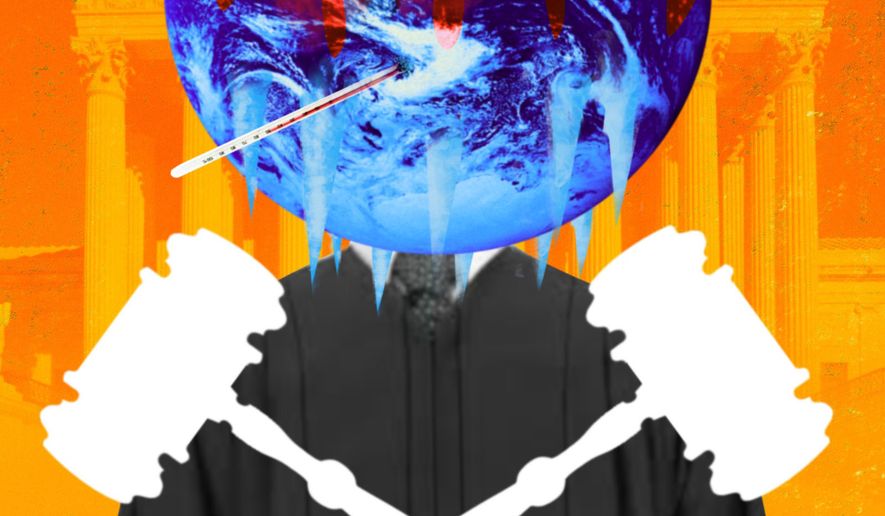
U.S. Supreme Court Justice Elena Kagan is facing appropriate calls to recuse herself from an important climate change lawfare case on the high court’s October docket.
Suncor Energy v. County Commissioners of Boulder County is one of multiple lawsuits that could decide whether energy companies can be held liable for supposed damages related to climate change or just bad weather in general.
In the case, Boulder County, Colorado, and the city of Boulder, Colorado, filed a lawsuit against Suncor Energy and Exxon Mobil because the firms dared to produce and sell oil and gas that state residents demand.
The city accuses the oil companies of causing wildfires, floods and associated damage to homes and infrastructure — not by some industrial accident, but through the long and convoluted pathway that is anthropogenic (human-caused) climate change. This happened because residents in Boulder use the companies’ products every day.
The government of Boulder, Colorado, is seeking monetary damages, claiming Suncor caused the bad weather.
From a local perspective, this is hypocrisy.
For one, Colorado receives billions of dollars in annual revenue from the oil and gas industry despite having throttled it in recent years. The granola people in Boulder might not realize they are biting the hand that feeds them while attempting to crush their neighbors in Weld County, where the oil and gas industry is central alongside cattle ranching, another target of the greens.
The other issue here, as pointed out with regard to Louisiana’s ban on this kind of lawfare, is that you cannot track a single molecule of carbon dioxide or methane emitted by a particular company’s oil and gas. Carbon dioxide and methane are distributed throughout the atmosphere and do not have a direct, linear relationship with regional weather patterns.
Regardless, a single company’s downstream emissions are a vanishingly small fraction of all global emissions. The kind of modeling that attempts to attribute emissions to weather events does not even pretend to work at that small a scale.
Back to Justice Kagan. She has implied support for this theory of climate liability. She wrote the foreword to the Federal Judicial Center’s Reference Manual on Scientific Evidence, Fourth Edition, which included a chapter that touted weather attribution studies as proof for courts that oil companies are causing catastrophic climate change. They are not.
The people who wrote that chapter are actively involved in the various county and city cases, working on behalf of the plaintiffs against oil companies, and would benefit in various lawsuits should the courts accept the theories they inserted into the manual. This presents an obvious conflict of interest that could call into question the judiciary’s objectivity.
In her foreword, Justice Kagan described the manual as “dispassionate.” It is anything but.
Under pressure from various states’ attorneys general, Judge Robin L. Rosenberg, director of the Federal Judicial Center, announced in a letter to West Virginia Attorney General John B. McCuskey that the Federal Judicial Center would remove the chapter on climate science from the manual.
Despite the obvious bias, the National Academies of Sciences, Engineering, and Medicine, which helped write and review the document, continues to endorse on its website the debunked version of the Federal Judicial Center report, complete with the removed chapter.
President Trump weighed in on the manual on Truth Social, calling it “fraudulent, biased and misleading.” He subsequently ordered federal suspension and debarment officials to review the National Academies’ conduct and taxpayers’ exposure to what he called “Climate Fraud.”
After feeling some heat regarding her endorsement of the compromised manual, Justice Kagan defended herself by making perhaps the worst claim she could: that she never read the chapter.
Justice Kagan — a sitting member of the nation’s highest court — says she endorsed a now-withdrawn document she did not read. This alone should raise concerns about the basis of her court rulings.
Does she bother to read arguments in a case before she writes or endorses decisions, especially in instances where she has previously weighed in on a matter before the court?
This level of carelessness should at least raise eyebrows. Justice Kagan’s excuse did nothing to quiet demands from the Heartland Institute, Judicial Crisis Network, the Heritage Foundation and others that the Senate Judiciary Committee examine whether it is appropriate for her to refuse to recuse herself from Suncor v. Boulder County.
If Justice Kagan knowingly approved of the biased, legally compromised judicial manual, it is an ethics issue deserving of investigation. If she did not read the document she endorsed, that is also a breach of ethics and good judgment.
Either way, it seems inappropriate that she should be allowed to weigh in on pending climate-related cases.
• Linnea Lueken (llueken@heartland.org; X: @LinneaLueken) is a senior fellow with the Arthur B. Robinson Center on Climate and Environmental Policy at the Heartland Institute, a nonpartisan, nonprofit research institute based in Illinois. H. Sterling Burnett, Ph.D. (hsburnett@heartland.org), is director of the Robinson Center.

Please read our comment policy before commenting.