



The dayslong pause in the Iran war was shattered Tuesday night and into Wednesday as the U.S. and Saudi Arabia launched joint airstrikes on Iranian-linked militias in Iraq, drawing yet more countries into Tehran’s crosshairs and casting further doubt on the prospects of an easy peace.
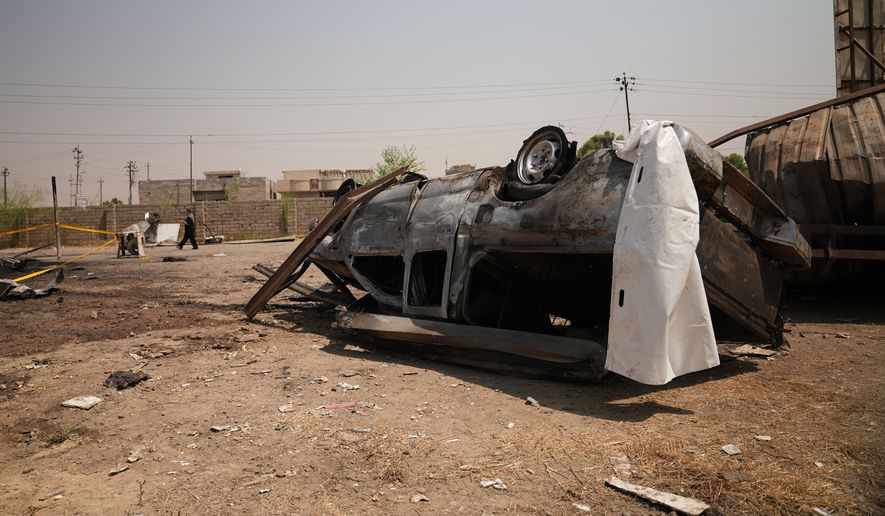
Those strikes, announced Tuesday evening, killed at least 20 fighters and wounded 32 others, according to the Popular Mobilization Forces, an Iraqi state-sponsored umbrella organization of paramilitary groups.
Notably, some reports from the region say the strikes killed numerous Iranian military advisers, mostly from Iran’s Islamic Revolutionary Guard Corps. Iran’s Consulate General in Karbala, Iraq, denied reports that IRGC officials had been killed in the strikes.
President Trump said he planned to strike again at Iran after its forces sent a volley of missiles toward U.S. troops stationed in Jordan on Tuesday.
“We’re going to be hitting them very hard because it’s our turn to hit them,” Mr. Trump said Wednesday in the Oval Office. “We’ll see if we get there with an agreement at some point, but we’re going to hit them very hard.”
Mr. Trump said U.S. troops intercepted all five missiles that Iran shot toward the Jordan base, though the Jordanian military said it shot them down itself.
SEE ALSO: Mission accomplished? Why simply declaring victory could be Trump’s best option in Iran
U.S. Central Command, which oversees American military operations in the Middle East, said there were no casualties.
Mr. Trump said the U.S.-Saudi counterstrikes had been carried out in coordination with the Iraqi government.
However, Iraqi officials seemed to condemn the strikes as a violation of the country’s territorial integrity. Iraq’s Security Council urged all parties to halt escalation and insisted that Baghdad would remain neutral in the regional conflict.
Iraqi Prime Minister Ali al-Zaidi called the attacks an “unacceptable aggression” by the U.S. and Saudi Arabia and insisted that Iraq be allowed to respond to security threats within its own borders.
Iraq’s Kataib Hezbollah, a prominent Shiite paramilitary group with ties to Iran, said a response to the joint strikes would be inevitable, including attacks on U.S. assets in Saudi Arabia.
However, the group added that it would give the Iraqi government until Aug. 6 to respond to the strikes before taking any action.
SEE ALSO: U.S. Treasury targets Iran’s levers of control in Strait of Hormuz as blockade continues
The Saudi military confirmed it participated in the joint strikes in retaliation for recent drone attacks on its oil infrastructure, which it blamed on Iran-backed militia groups in Iraq.
Satellite images released on Monday show large, black smoke plumes rising from a Saudi Aramco oil processing facility in Abqaiq.
The U.S. military said there had been more than 30 drone attacks originating from Iranian-backed groups in Iraq over the previous 72 hours.
Iran also roundly condemned the U.S.-Saudi strikes, calling them a flagrant violation of Iraq’s territorial integrity.
The Iranian Foreign Ministry said in a statement that the attacks were orchestrated by the U.S. and Israel in an attempt to widen the scope of the war and that the strikes targeted civilians on a pilgrimage.
Notably, Tehran refrained from naming Riyadh in its statement on the attacks, even after Saudi officials acknowledged a role in the operation — a sharp shift in the kingdom’s strategic approach.
Though Saudi Arabia has faced repeated strikes from Iran and its allied forces since hostilities began at the end of February, the kingdom had avoided involvement in U.S. retaliation, at least publicly.
The Iranian strikes, which CENTCOM called “surprise attacks,” followed several days of relative peace in the region after the two sides resumed active conflict on July 12 over control of the Strait of Hormuz, a vital shipping waterway.
Mr. Trump on Saturday declared a pause on the intense bombing operation after nearly two weeks of consecutive attacks on key Iranian military and civilian targets. In retaliation, Iran had launched dozens of strikes on commercial tankers, U.S. military installations and energy sites around the Middle East over 13 days.
Although some hope the pause will improve efforts by Pakistan and Qatar to rekindle diplomatic talks between the U.S. and Iran, the renewed attacks underscore the deep divisions separating Tehran and Washington.
The war, which began as a fight over regime change and limits on Iran’s nuclear program, has since become a conflict about control over the Strait of Hormuz.
Iran has maintained for months that the Strait of Hormuz will remain under its authority indefinitely and that ships seeking to pass through will have to pay fees and coordinate directly with its military.
The U.S., along with several other world powers, has rejected Iranian control over the strait and has floated escort missions for commercial vessels attempting to traverse the waterway.
Under international law, because the Strait of Hormuz is so narrow (just 21 miles at one point), all countries have the right of free passage through it, even though it is part of the territorial waters of Iran and Oman.
At least 20% of the world’s oil passes through the strait each year, and its closure has driven up energy prices. Brent crude, the international benchmark, rose from roughly $83 a barrel on July 12 to more than $90 a barrel by Tuesday.
The strait’s closure was made all the more dire after Houthi rebels in Yemen declared a blockade of Saudi trade through the Bab el-Mandeb strait in the Red Sea on Sunday, closing off an essential alternative route.
The Houthis have admitted to conducting strikes on at least two tankers in surrounding waters, causing a noticeable decline in regional transit.
Recent figures from shipping data firm Kpler reveal that just 11 commercial ships navigated the waterway on Monday, marking the largest traffic slump in several months.
Saudi Arabia’s military launched several strikes on Houthi enclaves in Yemen following the announcement of the blockade.
The ongoing blockade by Houthi forces and diplomatic and military assistance from Tehran appear to have driven Riyadh to assume a more assertive role in the conflict.
The kingdom became more directly involved in the war effort after Saudi Arabia finalized a nuclear deal with the U.S. that would eventually lead to the kingdom developing a domestic nuclear program.
Traditionally, Washington has imposed strict limits on the nuclear capabilities of Arab countries, including the United Arab Emirates.
The deal, according to early reports, would not require the kingdom to formally recognize Israel, which had been a condition of the agreement in prior phases of negotiations. However, Mr. Trump said just hours after the deal’s announcement on Sunday that recognition of Israel was a precondition.
Further Saudi involvement in the war could be another condition imposed on the kingdom by the Trump administration in exchange for closer cooperation on a domestic nuclear program.
Contact the author


Please read our comment policy before commenting.