



OPINION:
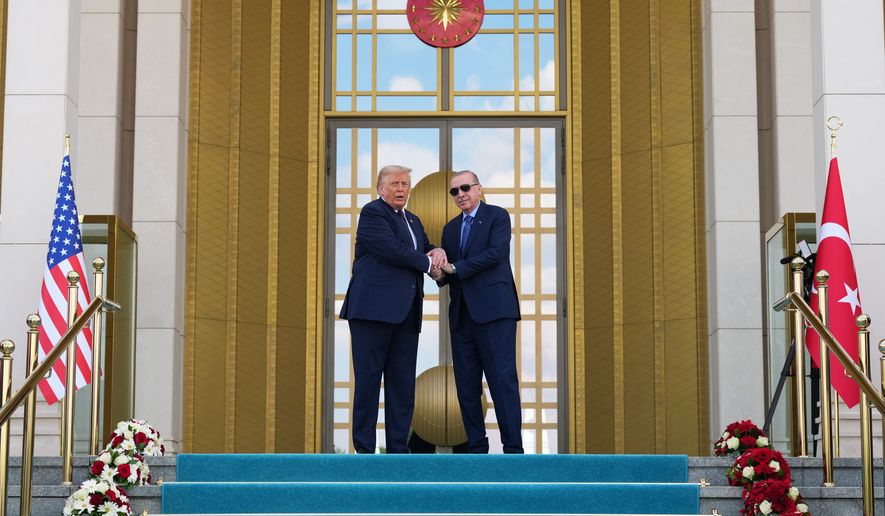
President Trump has already shown that American leadership can shape the future of the South Caucasus. After visiting Turkey this week for the NATO leaders’ summit, he should use the same practical approach to help open the Armenia-Turkey border and strengthen America’s position in a strategically important region.
In August 2025, Mr. Trump brought Armenian Prime Minister Nikol Pashinyan and Azerbaijani President Ilham Aliyev together at the White House, helping them reach a historic breakthrough after years of conflict. That agreement led to the creation of the Trump Route for International Peace and Prosperity, or TRIPP, a practical plan that turns diplomacy into significant economic opportunities for the region and the United States.
Mr. Trump should now use that model with Turkish President Recep Tayyip Erdogan. Opening the Armenia-Turkey border would help turn peace into tangible economic progress and give the United States a stronger role in a more stable South Caucasus.
People were interested in these podcasts
The Armenia-Turkey border has been closed since 1993, when Turkey shut it in support of Azerbaijan during the first Nagorno-Karabakh war. For more than 30 years, Armenia and Turkey have lacked formal diplomatic relations.
Yet the region has changed. Armenia and Azerbaijan have moved closer to peace with support from the United States. Armenia and Turkey are taking steps toward normal relations, including talks through special envoys and moves to ease trade. What they need now is high-level political support to achieve an open border.
Mr. Trump can help.
For Armenia, an open border with Turkey would create direct access to a neighboring market of more than 85 million people and lower the cost of reaching European and Mediterranean trade routes. It could support long-term energy cooperation, giving Armenia a more secure economic future.
Turkey would benefit from cross-border trade, new infrastructure projects and improved links between Europe and the South Caucasus. It would show that Ankara can use its influence as a NATO ally to support stability on the alliance’s southeastern flank.
For the United States, the strategic reasons are even stronger. An open Armenia-Turkey border would make the U.S.-backed TRIPP plan more valuable. For American investors, a better-connected Armenia is more attractive than a landlocked market with limited overland access.
American technology companies — including Synopsys, Nvidia, Adobe and Cisco — already have footholds in Armenia. Firebird’s U.S.-linked artificial intelligence infrastructure project shows the scale of new investment the country can attract.
An open border would give these companies and those that follow a stronger platform from which to serve regional markets. Lower transport costs and more reliable supply routes would make it easier to expand operations and earn returns on long-term investment.
It would also show that American leadership can create commercial opportunity in a strategically important region without sending in troops or writing blank checks.
Armenia and Turkey share a difficult history. The events of 1915 are still deeply felt by Armenians everywhere. Opening the border will not erase the past, and no Armenian leader could ask people to forget it. Yet keeping the border closed has not brought justice or security. It has only kept communities apart and allowed mistrust to grow.
Discussions about history will continue, but the past should not prevent progress toward a better future.
Mr. Trump does not need to start from scratch to help open the border. Discussions are already underway. The border could first open to third-country nationals and holders of diplomatic passports. Cargo and direct trade could move more easily. Transport links could be restored, followed by a schedule for the resumption of full diplomatic relations.
Armenia and Turkey should make the agreement themselves, but Mr. Trump can help.
With the NATO summit now over, President Trump should make clear that opening the Armenia-Turkey border would serve Turkey’s interests and give Ankara a constructive stake in a more stable South Caucasus.
In doing so, he would strengthen America’s position in the South Caucasus and demonstrate that American leadership can deliver tangible economic results.
• Darren G. Spinck is co-founder and managing director of the Janus Forum and a nonresident fellow with the Danube Institute.

Please read our comment policy before commenting.