


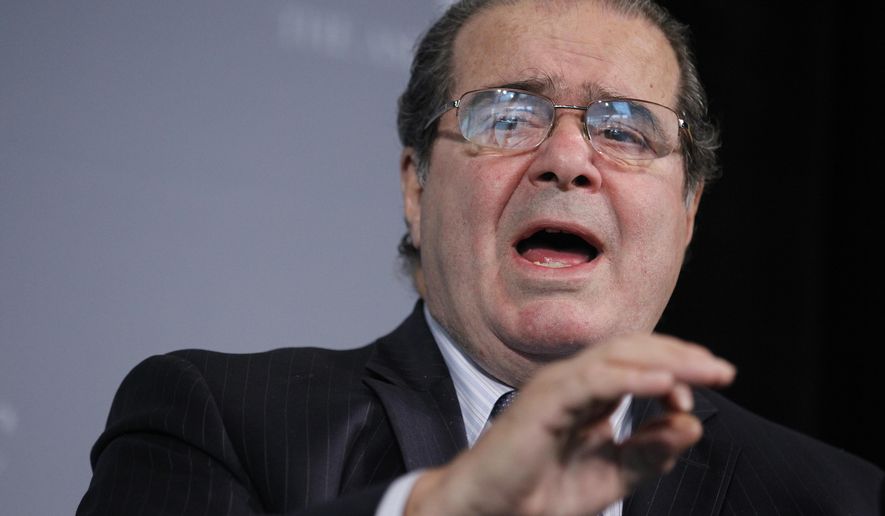


Justice Scalia defended attacks on his landmark religious-liberty opinion, a new document shows
Justice Antonin Scalia usually let his opinions speak for themselves, but he was so irked by criticism of one of his religious liberty rulings that he wrote a private defense of his reasoning, according to an unsealed court document obtained by “Seen, Heard & Whispered.”
People were interested in these podcasts
The case was Employment Division v. Smith, where Scalia led the court’s majority in rejecting a pair of drug counselors challenging the denial of unemployment benefits after they were fired for ingesting peyote, a powerful hallucinogen. They said they used it as part of their American Indian faith and argued the denial was punishment for religious beliefs.
Scalia, though, said that it doesn’t run afoul of the First Amendment for a state to pass and uphold neutral laws applicable to all — even if it might ding someone’s religious practice.
A decision the other way would have been “courting anarchy,” Scalia wrote in the landmark decision.
“We have never held that an individual’s religious beliefs excuse him from compliance with an otherwise valid law prohibiting conduct that the State is free to regulate,” he wrote.
The ruling drew sharp criticism from religious-liberty advocates and conservatives who had backed Scalia’s nomination to the high court.
“You should tell your students that there is a difference between demolishing a building and clearing up rubble that someone might trip on,” Scalia wrote to Judge Thomas J. Aquilino Jr. of the U.S. Court of International Trade on May 25, 1990, just weeks after the decision was issued.
The newly found communication was unearthed in the justice’s papers at Harvard Law School. It’s a signed letter on official chambers stationery.
The justice was defending the Smith decision in a reply to Judge Aquilino, who had previously voiced disagreements about it.
James Rosen, chief Washington correspondent at Newsmax, discovered the letter while researching his final installment in a three-volume Scalia biography he is currently compiling.
“Scalia: Rise to Greatness, 1936 to 1986” was released in 2023, and “Scalia: Supreme Court Years, 1986 to 2001” was published in February. Mr. Rosen has the third volume in the works.
“Rarely did Justice Scalia defend his judicial opinions in his correspondence,” Mr. Rosen said.
“This letter captures Scalia fully confident that his decision was the right one: a bright-line ruling of the sort he believed the justices should be providing to lower courts, offering them guidance to adjudicate similar cases on their own.”
In “Scalia: Supreme Court Years,” Mr. Rosen wrote evidence that the justice in his final days had some doubts about his decision in Smith. Scalia died while on a hunting trip to Texas in 2016.
Mr. Rosen quoted a former Harvard Law classmate as having told him in an interview that in 2015, Scalia said: “I have really got to seriously consider the effects of that decision … I’m really reconsidering it.”
Birthright citizenship is the new Roe v. Wade
It took nearly 50 years for conservatives to see Roe v. Wade overturned. They’re hoping it won’t take that long to nix Trump v. Barbara, last month’s decision on birthright citizenship.
One of the influential voices championing that comparison is Rachel Bovard, a conservative policy wonk and vice president of programming at the Conservative Partnership Institute.
She called for birthright citizenship to be a litmus test for every future conservative nominee to the Supreme Court.
“Only nominees prepared to reconsider expansive readings of the Citizenship Clause — and who understand that a nation is more than simply a collection of individuals in the same geographic location — deserve elevation,” she wrote in the First Things blog.
The court ruled that the Citizenship Clause in the 14th Amendment guarantees automatic citizenship to nearly all children born on U.S. soil, including children of unauthorized immigrants and temporary legal visitors.
The court struck down President Trump’s executive order to strip recognition of citizenship from those two categories.
Five justices, including two GOP appointees, ruled that the Constitution guaranteed citizenship. Four Republican appointees disagreed on that, though one of them, Justice Brett M. Kavanaugh, still argued that a 1940 law superseded the president’s order.
South Florida faces illegal dating problem
Dating is hard enough without throwing illegal immigration into the equation.
But that’s exactly what women in South Florida are now facing, a conservative communications professional told “Seen, Heard & Whispered.”
She said at least three of her friends have been bamboozled by migrants to date — and even marry — American citizens.
As she tells it, couples will meet and date, and then months into a relationship, the man is revealed to be in the country with less-than-firm legal status.
One friend met an immigrant at church, and they dated for several months, even going to Thanksgiving dinner together.
Someone at the dinner told the woman something seemed off: the man had little social media activity after 2021, had not traveled back home to Guyana in three years and had no close family in America.
Local court filings confirmed that the man had been married twice before, using different variations of his name — but each marriage lasted less than a year, falling short of the time needed to obtain a green card.
“They are there to attract a woman who is in the position to desire a serious relationship, and they are on the dating apps, they are all on the Facebook chats, and they are at every party,” the woman said.
She said dating apps don’t require proof of legal status, and states that allow unauthorized immigrants to get driver’s licenses make it easier for them to blend in.
“Illegals can cheat the system and do whatever it takes to stay in this country, even go to great lengths to prove their love and marry an American citizen,” she said.
Correction: An earlier version of this article incorrectly attributed Scalia’s quote in Employment Division v. Smith. He wrote it as part of the ruling.
• Seen, Heard & Whispered is a weekly column taking you inside the conversations happening in Washington’s power corridors, the moves being made and the whispers that explain what’s really going on in the nation’s capital. Email tips to whispered@washingtontimes.com. Click here to receive this in your inbox every Friday morning.
Contact the author


Please read our comment policy before commenting.