


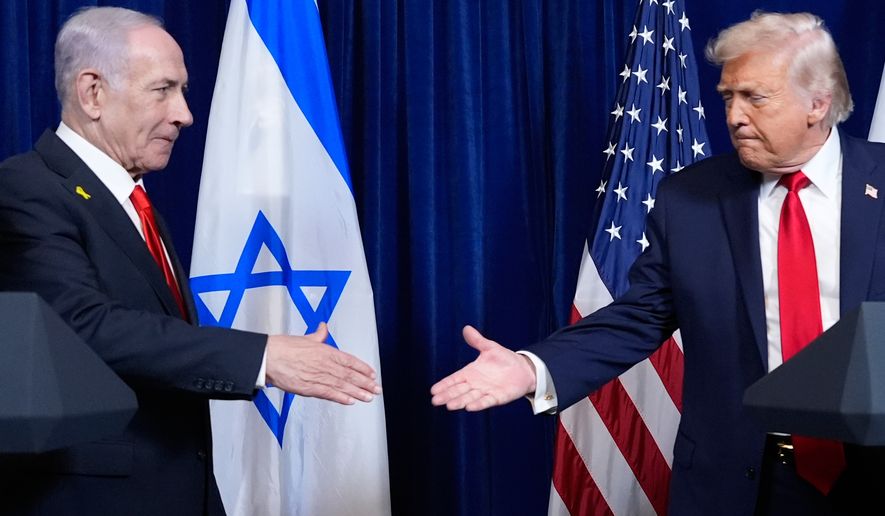

Buried inside the Senate Intelligence Authorization Act is a provision to expand sharing information with Israel, with a key stipulation: Such security exchanges can’t be suspended or reduced unless the president identifies a specific national security concern.
Citing the “evolving threat environment in the Middle East,” the amendment is intended to enhance intelligence collaboration through a robust analytic partnership to counter terrorism, cyber threats, sanctions evasion and other transnational security challenges.
The bill argues that U.S. security assistance and defense cooperation will “help Israel maintain its qualitative military edge” with a focus on “integrated air and missile defense, maritime security, early warning systems, and intelligence-sharing frameworks.”
People were interested in these podcasts
Under the bill, the president must also expand and enhance intelligence sharing and analytic cooperation with countries that have “normalized relations with Israel pursuant to the Abraham Accords” to “strengthen regional security integration.” This includes the United Arab Emirates, Bahrain, Sudan and Morocco.
If passed, all future presidents must document any determination to suspend, reduce or limit intelligence sharing with Israel, including the national security rationale for doing so, such as the protection of intelligence sources and methods or counterintelligence risk.
After making the determination, the president must notify the congressional intelligence committees of the decision.
The bill was introduced by Sen. Tom Cotton, Arkansas Republican, chairman of the Senate Select Committee on Intelligence.
It now awaits consideration on the Senate floor.
Each report would be unclassified, but may include a classified annex.
The president must also update the committees on progress toward “seamlessly integrating Israel into regional air and missile defense.”
If an information-sharing recipient nation also has an analytic cooperation with an adversarial country, there is one method to bypass the president to suspend sharing: the director of national intelligence.
Included in the bill, the DNI must adopt guidelines and safeguards to protect intelligence sources and methods and to ensure that recipients maintain U.S. security protection.
If the director determines that a recipient of intelligence sharing has any intelligence, defense or technological information-sharing relationship with an adversarial nation, the director would restrict all access to it.
Israel is not the only country under the bill to receive special attention regarding information sharing.
Other sections address intelligence cooperation in the Indo-Pacific — Australia, Japan, New Zealand, the Philippines, South Korea, Thailand, India and Vietnam.
The bill also encourages cooperation on maritime security and military warning with Taiwan.
Another country with an intelligence support clause is Ukraine during its war with Russia. Such information sharing would be terminated after reaching a peace agreement with Russia.
Contact the author


Please read our comment policy before commenting.